Stress-activated protein kinases (SAPKs) respond to a wide variety of stressors. In most cases, the pathways through which specific stress signals are transmitted to the SAPK are not known. We show that the yeast SAPK Hog1 is activated by acetic acid through an intracellular mechanism that does not involve stimulation of the high osmolarity glycerol (HOG) signaling pathway beyond its basal level. Rather, acetic acid treatment drives the formation of stress granules, which function as a scaffold to bring Hog1 together with Pbs2, its immediately upstream activating kinase, in a stable assembly that leverages the basal activity of Pbs2 to phosphorylate Hog1. Deletion analysis of stress granule components revealed that the assembly is critical for both the acetic acid–induced activation of Hog1 and its association with Pbs2. Activated Hog1 remains associated with stress granules, which may have implications for its targeting.
Introduction
Stress-activated protein kinases (SAPKs) and MAPKs (MAPKs) in eukaryotes are stimulated through protein kinase cascades connected to sensors or receptors on the cell surface (Mordente et al., 2024). Activated SAPKs/MAPKs then induce an appropriate response though phosphorylation of their target proteins. The budding yeast, Saccharomyces cerevisiae, has two SAPK pathways—the cell wall integrity pathway (reviewed in Klis et al. [2002]; Lesage and Bussey [2006]; Levin [2011]) and the high osmolarity glycerol (HOG) pathway (reviewed in Saito and Posas [2012]; de Nadal and Posas [2022]). The HOG pathway has been well characterized in its response to hyperosmotic stress (Hohmann, 2009; Saito and Posas, 2012; Brewster and Gustin, 2014). Under osmo-stress conditions, two osmosensors in the plasma membrane activate a protein kinase cascade that culminates in the activation of SAPK Hog1 and consequently results in the accumulation of glycerol to restore osmotic balance. This occurs through several means—closure of glycerol channel Fps1 (Tamás et al., 1999) in response to Hog1 phosphorylation of its regulators Rgc1 and Rgc2 (Lee et al., 2013), metabolic adjustments to enhance glycerol production (Dihazi et al., 2004; Hohmann, 2009), and transcriptional control of glycerol biosynthetic genes (Hohmann 2002; de Nadal and Posas, 2010).
However, Hog1 is also stimulated by a wide array of unrelated stress signals, including heat shock (Winkler et al., 2002), cold shock (Panadero et al., 2006), acetic acid (AA) (Mollapour and Piper, 2006), citric acid (Lawrence et al., 2004), oxidative stress (Bilsland et al., 2004), methylglyoxal (Aguilera et al., 2005), bacterial lipopolysaccharide (Marques et al., 2006), glucose starvation (Piao et al., 2012), chloroquine (Baranwal et al., 2014), curcumin (Azad et al., 2014), cadmium (Jiang et al., 2014), DNA damage (Huang et al., 2020), and arsenite (Sotelo and Rodríguez-Gabriel, 2006; Thorsen et al., 2006; Lee and Levin, 2018). Mammalian SAPK p38 is the functional ortholog of Hog1 (Han et al., 1994) and is similarly activated by most of these stress-inducing agents (Ono and Han, 2000; de Nadal et al., 2002).
The multitude of stresses capable of activating Hog1 raises two important and related questions. First, do these various stresses activate the target SAPK through a common pathway or through alternative inputs? This is especially significant for the HOG pathway because the osmosensors are its only known connection to the cell surface (de Nadal and Posas, 2022). Second, how does an activated SAPK mount a specific response appropriate to the particular stress experienced? We have begun to address these questions by analysis of HOG pathway signaling in response to selected stressors. For example, we have shown that Hog1 is activated by the reactive metalloid arsenite, through a lateral, intracellular input to the HOG pathway. Arsenite is metabolized to methylaresenite, which covalently modifies and inactivates the tyrosine-specific protein phosphatases (Ptp2 and Ptp3) that maintain Hog1 in a low-activity state (Lee and Levin, 2018). Inactivation of these phosphatases allows the passive accumulation of phosphorylated Hog1 without activation of its upstream pathway components above basal levels. This lateral pathway for Hog1 activation results in the closure of glycerol channel Fps1, which is also the major port of entry for arsenite (Thorsen et al., 2006; Lee and Levin, 2018). Additionally, closure of Fps1 in response to arsenite exposure does not result in osmotic imbalance due to the accumulation of glycerol because methylarsenite inhibits glycerol biosynthesis through reaction with the glycerol-3-phosphate dehydrogenases, Gpd1 and Gpd2 (Lee and Levin, 2019). Thus, activation of Hog1 in response to arsenite exposure allows the cell to protect itself from the toxin while preventing the accumulation of intracellular glycerol that would occur if Hog1 was activated by hyperosmotic stress.
In this study, we examined the mechanism by which AA activates Hog1. S. cerevisiae is not able to use AA as a carbon source when in the presence of fermentable sugars (Casal et al., 1996). In fact, cells of this species are sensitive to growth inhibition by AA, particularly at moderately acidic pH, when it is mainly in the protonated state (Mollapour and Piper, 2006). This is because undissociated AA enters the cell through Fps1 (Mollapour and Piper, 2007). Hog1 is critical to the protective response of yeast cells exposed to AA at pH 4.5 and is activated rapidly under these conditions, but not at neutral pH, suggesting the importance of AA entry to the cell for Hog1 activation. However, Hog1 activated by AA does not drive either the transcriptional induction of glycerol biosynthetic genes or the accumulation of glycerol observed under hyperosmotic stress conditions (Mollapour and Piper, 2006). Instead, Hog1 protects the cell from AA toxicity at low pH principally by blocking its entry through Fps1. Hog1 activated by AA phosphorylates Fps1 and drives its endocytosis and proteolytic degradation (Mollapour and Piper, 2007). Although these findings collectively suggest that AA activates Hog1 through an intracellular mechanism (Mollapour and Piper, 2006), rather than from the cell surface, the level at which the AA-induced stress signal enters the HOG pathway is not known. Here we demonstrate that AA activates Hog1 without stimulation of the canonical HOG pathway beyond basal levels by driving the formation of stress granules (SGs) that contain both Hog1 and its activating MAPK kinase (MEK) Pbs2.
Results
AA signals to Hog1 through an intracellular pathway
The HOG pathway is comprised of two branches from the cell surface that converge to activate Pbs2, which then phosphorylates Hog1 (Fig. 1 A). In the absence of stress, a low level of Pbs2 activity is maintained through the Sln1 branch of the HOG pathway (Macia et al., 2009). This basal pathway activity is critical for Hog1 activation in response to arsenite, which amplifies basal Hog1 phosphorylation through inhibition of the phosphatases that normally act to dephosphorylate the SAPK (Lee and Levin, 2018). We speculated that additional mechanisms exist by which the cell can leverage the basal activity of the HOG pathway to activate Hog1 without stimulation of upstream pathway components.
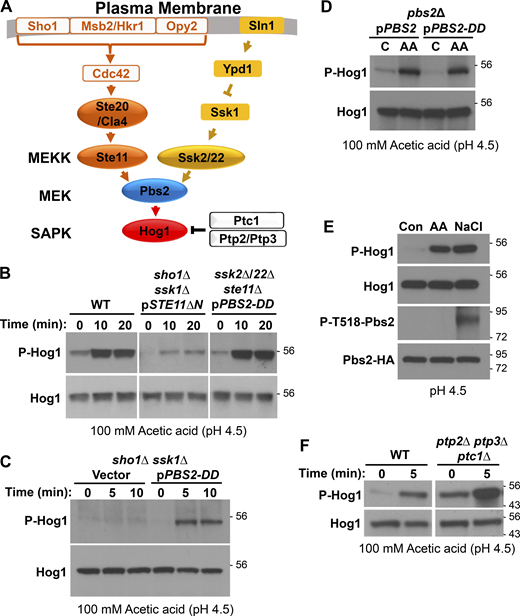
Hog1 is activated in response to AA through a lateral intracellular pathway. (A) HOG pathway from the plasma membrane to Hog1. (B) Bypass of the upper components of the HOG pathway for Hog1 activation by AA. WT cells (DL3187), a sho1Δ ssk1Δ mutant (DL4306) transformed with a plasmid-expressing Ste11ΔN (p1230), and an ssk2Δ ssk22Δ ste11Δ mutant (DL2344) transformed with a plasmid expressing Pbs2-DD (p3370) were treated with AA (100 mM; pH 4.5). Molecular mass markers (in kDa) are on the right. (C) Basal phosphorylation of Hog1 by Pbs2 is required for Hog1 activation by AA. A sho1Δ ssk1Δ mutant (DL4306) transformed with a plasmid-expressing Pbs2-DD (p3675) or empty vector (pRS316) was treated as above. (D) A constitutive form of Pbs2 (PBS2-DD) is as effective as WT for Hog1 activation by AA treatment. A pbs2Δ mutant (DL4278) transformed with a plasmid expressing Pbs2 (p3671) or Pbs2-DD (p3675) was treated as above. Extracts were subjected to SDS-PAGE and immunoblot analysis for detection of total Hog1 and phosphorylated Hog1 (P-Hog1). (E) AA treatment does not induce phosphorylation of Pbs2. WT cells transformed with a plasmid expressing Pbs2-HA (p3671) were preadapted to growth at pH 4.5 and treated with AA (100 mM, 10 min), NaCl (200 mM, 3 min), or untreated (Con). Extracts were subjected to SDS-PAGE and immunoblot analysis for detection of total Hog1, phosphorylated Hog1 (P-Hog1), total Pbs2 (Pbs2-HA), and phosphorylated Pbs2 (P-T518-Pbs2). Molecular mass markers (in kDa) are on the right. (F) Hog1 activation by AA is retained in the absence of protein phosphatases that negatively regulate Hog1. WT cells (DL3187) or a ptp2Δ ptp3Δ ptc1Δ mutant (DL4309) were treated with AA and processed as above. Source data are available for this figure: SourceData F1.
Hog1 is activated in response to AA through a lateral intracellular pathway. (A) HOG pathway from the plasma membrane to Hog1. (B) Bypass of the upper components of the HOG pathway for Hog1 activation by AA. WT cells (DL3187), a sho1Δ ssk1Δ mutant (DL4306) transformed with a plasmid-expressing Ste11ΔN (p1230), and an ssk2Δ ssk22Δ ste11Δ mutant (DL2344) transformed with a plasmid expressing Pbs2-DD (p3370) were treated with AA (100 mM; pH 4.5). Molecular mass markers (in kDa) are on the right. (C) Basal phosphorylation of Hog1 by Pbs2 is required for Hog1 activation by AA. A sho1Δ ssk1Δ mutant (DL4306) transformed with a plasmid-expressing Pbs2-DD (p3675) or empty vector (pRS316) was treated as above. (D) A constitutive form of Pbs2 (PBS2-DD) is as effective as WT for Hog1 activation by AA treatment. A pbs2Δ mutant (DL4278) transformed with a plasmid expressing Pbs2 (p3671) or Pbs2-DD (p3675) was treated as above. Extracts were subjected to SDS-PAGE and immunoblot analysis for detection of total Hog1 and phosphorylated Hog1 (P-Hog1). (E) AA treatment does not induce phosphorylation of Pbs2. WT cells transformed with a plasmid expressing Pbs2-HA (p3671) were preadapted to growth at pH 4.5 and treated with AA (100 mM, 10 min), NaCl (200 mM, 3 min), or untreated (Con). Extracts were subjected to SDS-PAGE and immunoblot analysis for detection of total Hog1, phosphorylated Hog1 (P-Hog1), total Pbs2 (Pbs2-HA), and phosphorylated Pbs2 (P-T518-Pbs2). Molecular mass markers (in kDa) are on the right. (F) Hog1 activation by AA is retained in the absence of protein phosphatases that negatively regulate Hog1. WT cells (DL3187) or a ptp2Δ ptp3Δ ptc1Δ mutant (DL4309) were treated with AA and processed as above. Source data are available for this figure: SourceData F1.
A previous study found that activation of Hog1 by AA requires the Sln1 branch of the HOG pathway (Mollapour and Piper, 2006). However, such findings are not sufficient to allow the conclusion that AA activates signaling through Sln1. This pathway branch may be required only to provide the basal flow of Pbs2 activity toward Hog1, which may then be amplified by other mechanisms. To assess whether AA activates Hog1 by signaling from the cell surface or through an intracellular pathway, we examined a pair of HOG pathway mutants in which Hog1 is genetically severed from its upstream activators, but basal Pbs2 activity is restored by a constitutive pathway mutation. In one mutant strain, both HOG pathway branches were blocked by deletion of genes encoding upper pathway components (sho1∆ ssk1∆). Basal Pbs2 activity was restored in this strain by low-level expression of a constitutive allele of STE11 (STE11-∆N; Cairns et al., 1992), which encodes one of three HOG pathway MEK kinases (MEKKs). The other mutant strain carries deletion mutations in all three MEKK-encoding genes of the HOG pathway (ssk2∆ ssk22∆ ste11∆). In this strain, basal Pbs2 activity was restored by low-level expression of a constitutive phospho-mimetic form of PBS2 (PBS2-DD) (Wurgler-Murphy et al., 1997).
To assess Hog1 activation status, we used antibodies that specifically recognize dually phosphorylated Hog1 (on Thr174 and Tyr176). In both mutational settings, Hog1 was activated by AA treatment (100 mM at pH 4.5; Fig. 1 B), revealing that the upper HOG pathway components could be bypassed for Hog1 activation by this stress. In the case of PBS2-DD, the activation signal was similar to that observed in the WT strain, so subsequent experiments were carried out using this allele. Activation of Hog1 by AA in the sho1∆ ssk1∆ strain required restoration of basal Pbs2 activity by expression of PBS2-DD (Fig. 1 C), as we have seen previously for arsenite treatment (Lee and Levin, 2018). These results indicate that the AA signal to Hog1 enters the pathway either at the level of Pbs2 or Hog1 itself. They suggest further that Hog1 activation by AA is not through cross talk from another SAPK cascade because the catalytic activity of phospho-mimetic Pbs2-DD cannot be regulated by MEKK phosphorylation.
Replacement of PBS2 with PBS2-DD in an otherwise WT strain resulted in Hog1 activation by AA that was comparable with that of WT (Fig. 1 D), suggesting that upstream pathway components may not contribute to Hog1 activation by AA, aside from providing basal phosphorylation. We tested this directly by assessing the activation of Pbs2 in response to either AA treatment or hyperosmotic stress. The HOG pathway is activated by hyperosmotic shock through the cell surface osmosensors, resulting in dual phosphorylation of Pbs2 at Ser514 and Thr518 (Wurgler-Murphy et al., 1997). We detected Pbs2 activation by assessing its phosphorylation status with an antibody that specifically detects phospho-Thr518 (Tatebayashi et al., 2020). For this experiment, we used WT cells adapted to growth at pH 4.5 and imposed a mild hyperosmotic stress treatment (200 mM NaCl for 3 min), which resulted in a level of Hog1 activation that was similar to that obtained by treatment with 100 mM AA for 10 min (Fig. 1 E). As expected, hyperosmotic stress resulted in phosphorylation of Pbs2 (Fig. 1 E). However, AA treatment induced Hog1 phosphorylation without detectable Pbs2 phosphorylation, supporting the conclusion that Hog1 activation by AA stress occurs without stimulation of the upper components of the HOG pathway.
The above results indicate that AA stress activates Hog1 without altering the activation state of Pbs2. One mechanism by which this may happen is through the inhibition of protein phosphatases that reverse Hog1 phosphorylation. Three protein phosphatases have been implicated in the downregulation of Hog1. These are the Tyr-specific phosphatases Ptp2 and Ptp3 and the Ser/Thr-specific phosphatase, Ptc1 (Saito and Posas, 2012). We demonstrated previously that arsenite treatment activates Hog1 by inhibition of Ptp2 and Ptp3, the phosphatases that normally maintain Hog1 in a low-activity state, thereby allowing phosphorylated Hog1 to accumulate without activation of Pbs2 beyond its basal level (Lee and Levin, 2018). Therefore, we tested the involvement of these phosphatases in AA-induced activation of Hog1 using a ptp2Δ ptp3Δ ptc1Δ mutant, which maintains a constitutively elevated Hog1 phosphorylation status. We found that, despite the observed increase in basal Hog1 phosphorylation in a ptp2Δ ptp3Δ ptc1Δ mutant relative to WT, Hog1 was further activated by AA treatment in this mutant (Fig. 1 F). This result indicates that Hog1 activation by AA, in contrast to arsenite, cannot be explained by inhibition of the Hog1 regulatory protein phosphatases.
AA treatment induces stable association between Hog1 and Pbs2
Another mechanism by which an intracellular stressor might amplify the basal activity of a MEK is through the formation of a scaffold that brings it into association with its SAPK. Hog1 was shown previously by co-immunoprecipitation (co-IP) to form a stable association with Pbs2 that requires its common docking (CD) domain (Murakami et al., 2008). The CD domain is a cluster of negatively charged residues that facilitates SAPK interaction with its regulators and effectors, which resides immediately C-terminal to the Hog1 kinase domain (residues 302–316). We were able to detect by co-IP a weak association of Hog1-Myc with Pbs2-HA that was not affected by growth at pH 4.5 (Fig. 2 A). Therefore, we tested for enhanced association of Hog1 with Pbs2 by AA treatment. We found that AA treatment induced a strong increase in the stable association between Hog1 and either WT Pbs2 or Pbs2-DD in WT cells (Fig. 2 B). This was also observed in the context of an sho1Δ ssk1Δ mutant (Fig. 2 C), revealing that the induced association is independent of both the activity of upstream HOG pathway components and the phosphorylation state of Pbs2 and Hog1.
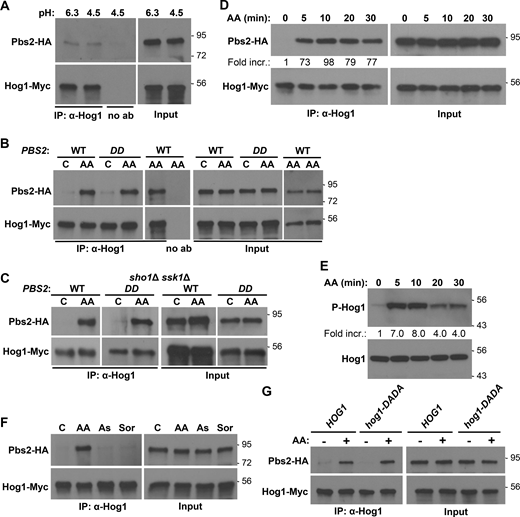
HOG pathway MEK Pbs2 forms a stable association with Hog1 in response to AA treatment. (A) Hog1 and Pbs2 associate weakly in the absence of stress. WT cells (DL3187) co-expressing Hog1-Myc (p3673) and Pbs2-HA (p3671) were grown in selective medium at the indicated pH. Anti-Hog1 IPs of extracts were separated by SDS-PAGE and subjected to immunoblot analysis. Molecular mass markers (in kDa) are shown on the right. (B) AA treatment induces association of Pbs2 with Hog1. WT cells (DL3187) co-expressing Hog1-Myc (p3673) and either Pbs2-HA (p3671) or Pbs2-DD (p3675) were treated with AA or not (C) and extracts were processed for co-IP, as above. (C) AA-induced association of Pbs2 with Hog1 is independent of the phosphorylation state of Pbs2. A sho1Δ ssk1Δ mutant (DL4306) transformed with a plasmid expressing either Pbs2-HA (p3671) or Pbs2-DD (p3675) was treated with AA and extracts processed for co-IP. (D) Time-course of AA-induced Pbs2 association with Hog1. WT cells (DL3187) co-expressing Hog1-Myc (p3673) and Pbs2-HA (p3671) were treated with AA for the indicated times. Extracts were processed for co-IP. The fold increase over signal from unstressed cells was calculated relative to the Hog1-Myc1 IP signal. (E) Time-course of AA-induced Hog1 activation. The samples in D were processed for immunoblot detection of Hog1 and P-Hog1. (F) Neither hyperosmotic stress nor arsenite treatment induces association of Pbs2 with Hog1. WT cells (DL3187) co-expressing Hog1-Myc (p3673) and Pbs2-HA (p3671) were treated with AA, arsenite (As; 1 mM for 10 min) or hyperosmotic stress with sorbitol (700 mM for 10 min). Extracts were processed for co-IP of Pbs2 with Hog1. (G) A hog1Δ strain (DL3158)-expressing Hog1-Myc (p3673) or Hog1-DADA-Myc (p3685). Source data are available for this figure: SourceData F2.
HOG pathway MEK Pbs2 forms a stable association with Hog1 in response to AA treatment. (A) Hog1 and Pbs2 associate weakly in the absence of stress. WT cells (DL3187) co-expressing Hog1-Myc (p3673) and Pbs2-HA (p3671) were grown in selective medium at the indicated pH. Anti-Hog1 IPs of extracts were separated by SDS-PAGE and subjected to immunoblot analysis. Molecular mass markers (in kDa) are shown on the right. (B) AA treatment induces association of Pbs2 with Hog1. WT cells (DL3187) co-expressing Hog1-Myc (p3673) and either Pbs2-HA (p3671) or Pbs2-DD (p3675) were treated with AA or not (C) and extracts were processed for co-IP, as above. (C) AA-induced association of Pbs2 with Hog1 is independent of the phosphorylation state of Pbs2. A sho1Δ ssk1Δ mutant (DL4306) transformed with a plasmid expressing either Pbs2-HA (p3671) or Pbs2-DD (p3675) was treated with AA and extracts processed for co-IP. (D) Time-course of AA-induced Pbs2 association with Hog1. WT cells (DL3187) co-expressing Hog1-Myc (p3673) and Pbs2-HA (p3671) were treated with AA for the indicated times. Extracts were processed for co-IP. The fold increase over signal from unstressed cells was calculated relative to the Hog1-Myc1 IP signal. (E) Time-course of AA-induced Hog1 activation. The samples in D were processed for immunoblot detection of Hog1 and P-Hog1. (F) Neither hyperosmotic stress nor arsenite treatment induces association of Pbs2 with Hog1. WT cells (DL3187) co-expressing Hog1-Myc (p3673) and Pbs2-HA (p3671) were treated with AA, arsenite (As; 1 mM for 10 min) or hyperosmotic stress with sorbitol (700 mM for 10 min). Extracts were processed for co-IP of Pbs2 with Hog1. (G) A hog1Δ strain (DL3158)-expressing Hog1-Myc (p3673) or Hog1-DADA-Myc (p3685). Source data are available for this figure: SourceData F2.
A time-course of AA-induced Pbs2 association with Hog1 was consistent with the kinetics of Hog1 activation, both of which appeared to peak at ∼5–10 min (Fig. 2, D and E, respectively). However, the association between Hog1 and Pbs2 remained stable for at least 30 min, whereas Hog1 activity began to decline at 20 min. Importantly, the stable association between Hog1 and Pbs2 induced by AA treatment was not observed in response to other stresses that activate Hog1, including hyperosmotic stress (induced by 700 mM sorbitol) and arsenite (Fig. 2 F).
We next examined a CD domain mutant of Hog1 (D307A/D310A; Hog1-DADA) that fails to bind to Pbs2 (Murakami et al., 2008). AA treatment induced association of the Hog1-DADA protein with Pbs2 as effectively as WT Hog1 (Fig. 2 G), suggesting that AA-induced association of Hog1 with Pbs2 involves a separate mechanism from the weak constitutive association described previously.
Hog1 and Pbs2 associate with SGs
Because Hog1 and Pbs2 form a stable association in response to AA treatment, we sought to identify potential scaffold proteins that might also associate with Hog1 under this stress condition. We carried out a mass spectrometry–based proteomic analysis of Hog1 immunoprecipitated from extracts of a yeast strain bearing the minimal HOG pathway signaling components required for Hog1 activation by AA (sho1Δ ssk1Δ PBS2-DD). In addition to Pbs2, we detected AA-induced association of 21 other proteins with Hog1, identified uniquely in the stressed sample with a minimum threshold of two peptides (Table 1; marked in bold in Table S1). The HOG pathway MEKK Ssk2 was among the proteins detected, suggesting that all three protein kinases from the cascade were assembled into a complex in response to AA treatment.
MS analysis of Hog1 and Pbs2 co-IPs from AA-treated cells
| Co-IP with Hog1 in sho1Δ ssk1Δ PBS2-DD | Co-IP with both Hog1 and Pbs2 in WT | SGs: 46°C (Cherkasov et al., 2015) | SGs: arsenite (Jacobson et al., 2012) | SGs: azide (Jain et al., 2016) | |
|---|---|---|---|---|---|
| HOG1 | PBS2 | ||||
| PBS2 | GUS1 | X | X | ||
| SAM1 | SAM1 | X | X | ||
| JLP1 | DED1 | X | X | ||
| SEC53 | MET5 | X | |||
| DED1 | MET10 | ||||
| SSK2 | KAP123 | X | X | X | |
| RPS7A | PFK1 | X | X | X | |
| GUS1 | LEU1 | X | X | X | |
| PDC6 | JLP1 | X | |||
| MET5 | VMA2 | X | |||
| PAB1 | HOG1 | ||||
| SAM2 | FAS2 | X | |||
| POR1 | PDC6 | ||||
| URA3 | EFT2 | X | |||
| TSA1 | PAB1 | X | X | X | |
| ARC1 | SEC53 | X | X | X | |
| VMA2 | SHM2 | X | |||
| PFK1 | URA3 | X | |||
| RPL2B | URA2 | X | |||
| KAP123 | GFA1 | X | X | ||
| RPL6A | DUR12 | ||||
| RPL11A | VMA1 | ||||
| ARC1 | X | X | |||
| FAS1 | X | ||||
| GPM1 | X | ||||
| SAM2 | X | ||||
| OLA1 | X | X | X | ||
| MET13 | X | ||||
| MET6 | |||||
| RPS14A | |||||
| TY1B-H | |||||
| CYS4 | X | ||||
| MCM5 | |||||
| RPS0A | X | ||||
| CYS3 | X | ||||
| VAS1 | X | ||||
| TRP2 | |||||
| RPB2 | X | X | |||
| RPS20 | |||||
| RPL10 | X | ||||
| DLD3 | X | X | X | ||
| YVH1 | X | ||||
| RPL23A | |||||
| HSP26 | X | X | |||
| APA1 | X | X | |||
| RPS7A | |||||
| NUM1 | |||||
| VMA6 | |||||
| NAB6 | X | ||||
| MRN1 | X | ||||
| PAA1 | X | X | X | ||
| MCM6 | X | ||||
| IKI3 | |||||
| KRS1 | X | ||||
| GDH1 | X | ||||
| SUP45 | X | X | |||
| DBF2 | |||||
| CKI1 | X | ||||
| MET3 | X | X | |||
| BMH1 | X | ||||
| PGI1 | |||||
| RVB1 | X | X | |||
| CHC1 | X | ||||
| YHB1 | |||||
| RPC40 | X | ||||
| RPN2 | X | ||||
| RIO2 | X | ||||
| TUB2 | X | ||||
| RPN1 | |||||
| MCM7 | |||||
| IML2 | |||||
| MCM4 | X | X | |||
| RPT2 | |||||
| THS1 | X | ||||
| ARO9 | X | X | |||
| MES1 | X | X | |||
| RPA135 | X | ||||
| PUP2 | |||||
| FKS1 | X | ||||
| ELP3 | |||||
| RPG1 | X | X | |||
| ARP2 |
These protein names were colored to indicate components of the HOG pathway in the same way as in Fig. 1 A.
We conducted further proteomic analyses in WT cells to address two additional questions. First, we were interested in the degree of overlap of the proteins identified from a Pbs2-HA co-IP as compared with a Hog1 co-IP. To identify proteins that were induced to associate with both Hog1 and Pbs2 in response to AA treatment, we filtered the two data sets using the following criteria: (1) a minimum of five unique peptides in at least one of the AA-treated samples; and (2) a minimum threshold of fourfold enrichment of peptides between AA-treated and untreated conditions in both the Hog1 and Pbs2 samples. These analyses revealed a striking level of concordance between proteins induced to associate with Hog1 (Table S2) and those induced to associate with Pbs2 (Table S3). Among the 20 most abundant proteins induced to associate with Pbs2 in response to AA treatment, all were identified as induced to associate with Hog1. Similarly, among the 20 most abundant proteins induced to associate with Hog1, induced associations with Pbs2 were also detected for 19 of them. In total, we identified 81 proteins that were induced to associate with both Pbs2 and Hog1 in response to AA treatment. These are listed in Table 1 in order of abundance for induced association with Pbs2. We ordered this list by abundance rather than by fold enrichment because the AA-induced protein associations detected in the Pbs2 co-IP sample were nearly all absent from the untreated sample—for 77 of the 81 proteins identified in the AA-treated sample, no peptides were detected in the untreated control and for the remaining four proteins, only one peptide was identified in the control. We noted that Ssk2 was not detected in association with either Hog1 or Pbs2 isolated from the WT strain, bringing into question the significance of its presence in the AA-treated sample from the sho1Δ ssk1Δ PBS2-DD mutant strain.
Second, we included hyperosmotic stress treatments (with 500 mM NaCl) within the same experiments for comparison with the AA-induced protein associations to Pbs2 and Hog1. Remarkably, we detected only three proteins whose association with Hog1 was strongly induced by hyperosmotic stress (Cct2, Cct4, and Cct5, subunits of the cytosolic chaperonin Cct ring complex), and none that were induced to associate with Pbs2 (Table S2 and Table S3, respectively), suggesting that the AA-induced associations detected are specific to this stress.
Among the most abundant proteins found in both the Hog1 and Pbs2 co-IPs from cells treated with AA were poly(A)-binding (Pab1), an mRNA-binding protein; Ded1, an ATP-dependent DEAD-box RNA helicase; and Gus1, a glutamyl-tRNA synthetase, all of which have been identified as components of SGs in yeast (Hilliker et al., 2011; Buchan et al., 2011; Cherkasov et al., 2015; Grousl et al., 2022). SGs are large, diverse assemblies of protein and mRNA that coalesce in response to various forms of environmental stress (Grousl et al., 2022; Van Treeck and Parker, 2019). The sequestration of mRNAs, specific translation initiation factors, and other mRNA-binding proteins into SGs appears to allow preferential translation of stress-specific mRNAs. Indeed, comparison of the proteins identified in our proteomic experiments with comprehensive analyses of SG composition induced by other stresses revealed a high degree of overlap. Among the 81 proteins induced by AA treatment to associate with both Hog1 and Pbs2, 35 were identified in SGs induced by azide treatment (Jain et al., 2016), 29 in SGs induced by extreme heat shock (at 46°C; Cherkasov et al., 2015), and 23 in SGs induced by arsenite exposure (Jacobson et al., 2012). Overall, 56 of the 81 proteins identified in both the Hog1 and Pbs2 assemblies induced by AA were detected previously in SGs induced by at least one of the three other stress conditions (Fig. 3 and Table 1). However, neither Hog1 nor Pbs2 were among the proteins identified in these previous studies.

Proteins identified by mass spectrometry as recruited to both Hog1 and Pbs2 in response to AA treatment. Gene ontology cellular components (Saccharomyces Genome Database; https://yeastgenome.org) assigned to proteins identified from mass spectrometric analyses of Hog1 and Pbs2 co-IPs from AA-treated cells. Listed proteins were identified as induced or enriched in both samples.
Proteins identified by mass spectrometry as recruited to both Hog1 and Pbs2 in response to AA treatment. Gene ontology cellular components (Saccharomyces Genome Database; https://yeastgenome.org) assigned to proteins identified from mass spectrometric analyses of Hog1 and Pbs2 co-IPs from AA-treated cells. Listed proteins were identified as induced or enriched in both samples.
We validated some of the AA-induced protein associations detected by mass spectrometry using pairwise co-IPs with epitope-tagged versions of either Hog1 or Pbs2. These included Sam1, an S-adenosylmethionine (SAM) synthetase; Jlp1, an Fe(II)-dependent sulfonate/α-ketoglutarate dioxygenase; Kap123, a karyopherin β; Sec53, a phosphomannomutase; and Dur12, a urea amidolyase. Tagged forms of each of these proteins were detected in association with Hog1-Myc, and the association was increased in WT cells in response to brief AA treatment (Fig. S1). We also detected induced association of these proteins with Hog1-Myc in a pbs2Δ mutant (Fig. S2) and with Pbs2-Myc in a hog1Δ mutant (Fig. S3), indicating that their interactions with Hog1 or Pbs2 are independent of the presence of the other kinase, consistent with the hypothesis that they are part of a large assembly.
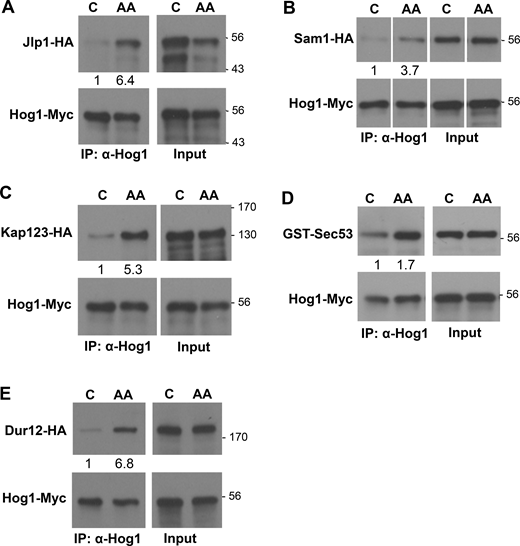
Co-IP of selected proteins with Hog1-Myc. (A–E) WT cells (DL3187) co-expressing Hog1-Myc (p3673) and one of the following: (A) Jlp1-HA (p3676), (B) Sam1-HA (p3677), (C) Kap123-HA (p3678), (D) GST-Sec53 (p3649), or (E) Dur12-HA (p3679) were treated with AA (100 mM, pH 4.5 for 10 min). Anti-Hog1 IPs of extracts were separated by SDS-PAGE and subjected to immunoblot analysis. Molecular mass markers (in kDa) are shown on the right. The fold increase over signal from unstressed cells (C) was calculated relative to Hog1-Myc IP signal. Source data are available for this figure: SourceData FS1.
Co-IP of selected proteins with Hog1-Myc. (A–E) WT cells (DL3187) co-expressing Hog1-Myc (p3673) and one of the following: (A) Jlp1-HA (p3676), (B) Sam1-HA (p3677), (C) Kap123-HA (p3678), (D) GST-Sec53 (p3649), or (E) Dur12-HA (p3679) were treated with AA (100 mM, pH 4.5 for 10 min). Anti-Hog1 IPs of extracts were separated by SDS-PAGE and subjected to immunoblot analysis. Molecular mass markers (in kDa) are shown on the right. The fold increase over signal from unstressed cells (C) was calculated relative to Hog1-Myc IP signal. Source data are available for this figure: SourceData FS1.
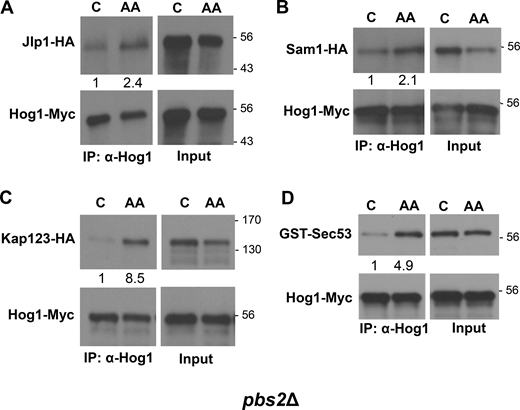
Co-IP of selected proteins with Hog1-Myc in a pbs2Δ strain. (A–D) A pbs2Δ strain (DL4278) co-expressing Hog1-Myc (p3673) and one of the following: (A) Jlp1-HA (p3676), (B) Sam1-HA (p3677), (C) Kap123-HA (p3678), or (D) GST-Sec53 (p3649 were treated with AA (100 mM, pH 4.5 for 10 min). Anti-Hog1 IPs of extracts were separated by SDS-PAGE and subjected to immunoblot analysis. Molecular mass markers (in kDa) are shown on the right. The fold increase over signal from unstressed cells (C) was calculated relative to Hog1-Myc IP signal. Source data are available for this figure: SourceData FS2.
Co-IP of selected proteins with Hog1-Myc in a pbs2Δ strain. (A–D) A pbs2Δ strain (DL4278) co-expressing Hog1-Myc (p3673) and one of the following: (A) Jlp1-HA (p3676), (B) Sam1-HA (p3677), (C) Kap123-HA (p3678), or (D) GST-Sec53 (p3649 were treated with AA (100 mM, pH 4.5 for 10 min). Anti-Hog1 IPs of extracts were separated by SDS-PAGE and subjected to immunoblot analysis. Molecular mass markers (in kDa) are shown on the right. The fold increase over signal from unstressed cells (C) was calculated relative to Hog1-Myc IP signal. Source data are available for this figure: SourceData FS2.
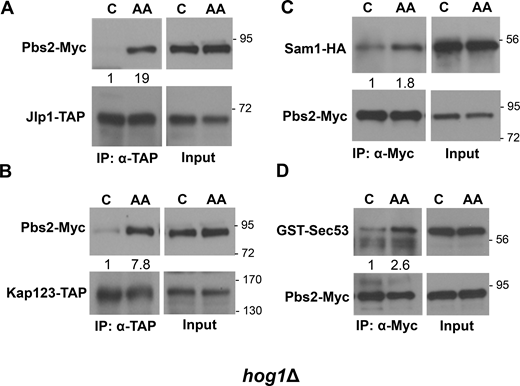
Co-IP of selected proteins with Pbs2-Myc in a hog1Δ strain. (A–D) A hog1Δ strain (DL3158) co-expressing Pbs2-Myc (p3674) and one of the following: (A) Jlp1-TAP (p3651), (B) Kap123-TAP (p3652), (C) Sam1-HA (p3677), or (D) GST-Sec53 (p3649) were treated with AA (100 mM, pH 4.5 for 10 min). Anti-TAP (A and B) or anti-Myc (C and D) IPs of extracts were separated by SDS-PAGE and subjected to immunoblot analysis. Molecular mass markers (in kDa) are shown on the right. The fold increase over signal from unstressed cells (C) was calculated relative to the TAP or Myc IP signals. Source data are available for this figure: SourceData FS3.
Co-IP of selected proteins with Pbs2-Myc in a hog1Δ strain. (A–D) A hog1Δ strain (DL3158) co-expressing Pbs2-Myc (p3674) and one of the following: (A) Jlp1-TAP (p3651), (B) Kap123-TAP (p3652), (C) Sam1-HA (p3677), or (D) GST-Sec53 (p3649) were treated with AA (100 mM, pH 4.5 for 10 min). Anti-TAP (A and B) or anti-Myc (C and D) IPs of extracts were separated by SDS-PAGE and subjected to immunoblot analysis. Molecular mass markers (in kDa) are shown on the right. The fold increase over signal from unstressed cells (C) was calculated relative to the TAP or Myc IP signals. Source data are available for this figure: SourceData FS3.
We used three criteria to establish that AA exposure induces the formation of SGs. First, we found that a fluorophore-tagged version of SG component Pab1 (Pab1-mCherry) formed punctate foci in response to AA treatment that are microscopically similar to SGs (Fig. 4 A). Second, because a defining characteristic of SGs is the requirement for ribosome-free mRNAs, treatment with cycloheximide (CHX), an inhibitor of ribosome translocation, blocks their formation (Kedersha et al., 2000; Buchan et al., 2011). We found that pre-treatment with CHX (50 µg/ml for 30 min) prevented the formation of AA-induced Pab1-mCherry foci (Fig. 4 A). Third, SGs are stable in cell lysates and can be isolated by centrifugation at 18,000 g (Jain et al., 2016). We detected Pab1-mCherry in granules prepared from lysates of AA-treated cells, but not in the absence of stress (Fig. 4 A). Moreover, addition of CHX to cultures prior to AA treatment greatly diminished the number of Pab1-mCherry fluorescent granules observed in the lysates. Therefore, we conclude that AA treatment induces formation of SGs in yeast.

AA treatment induces the assembly of Pab1-containing SGs, to which Hog1 associates. (A) WT cells (DL3187) expressing Pab1-mCherry (p3681) were treated with AA (10 min) ± pre-treatment with CHX (30 min). SGs were isolated from lysates of cells treated as above (lower panels). Scale bars for images of cells are 1 μm and for lysates are 5 μm. (B) WT cells expressing Hog1-GFP (p3680) were treated with AA. (C) Hog1-GFP and Pab1-mCherry granules. WT cells co-expressing Hog1-GFP (p3680) and Pab1-mCherry (p3681) were treated with AA or unstressed, and SGs were isolated from cell lysates. (D) Hog1-GFP and Pbs2-mCherry granules. WT cells (upper panels) co-expressing Hog1-GFP (p3680) and Pbs2-mCherry (p3686) were treated with AA or unstressed, and SGs were isolated from cell lysates. Scale bars in C and D are 5 μm, and the Merge panel corresponds to the inset boxes.
AA treatment induces the assembly of Pab1-containing SGs, to which Hog1 associates. (A) WT cells (DL3187) expressing Pab1-mCherry (p3681) were treated with AA (10 min) ± pre-treatment with CHX (30 min). SGs were isolated from lysates of cells treated as above (lower panels). Scale bars for images of cells are 1 μm and for lysates are 5 μm. (B) WT cells expressing Hog1-GFP (p3680) were treated with AA. (C) Hog1-GFP and Pab1-mCherry granules. WT cells co-expressing Hog1-GFP (p3680) and Pab1-mCherry (p3681) were treated with AA or unstressed, and SGs were isolated from cell lysates. (D) Hog1-GFP and Pbs2-mCherry granules. WT cells (upper panels) co-expressing Hog1-GFP (p3680) and Pbs2-mCherry (p3686) were treated with AA or unstressed, and SGs were isolated from cell lysates. Scale bars in C and D are 5 μm, and the Merge panel corresponds to the inset boxes.
To detect Hog1 in association with AA-induced SGs, we next examined the intracellular location of Hog1-GFP. However, we did not observe punctate foci of Hog1-GFP induced by AA stress. In fact, we did not detect any shift in its nucleo-cytoplasmic localization under this condition (Fig. 4 B). It is possible that a pool of Hog1 localizes to SGs, but its presence is not enriched sufficiently over the cytoplasmic fluorescence to detect punctate foci, as has been found for some SG components (Jain et al., 2016). Therefore, we took two approaches to test this possibility. First, we asked if Hog1-GFP could be detected in Pab1-mCherry granules prepared from lysates in the absence of cytoplasm. Hog1-GFP–containing granules were abundant and co-localized with Pab1-mCherry in the ex vivo setting (Fig. 4 C; ∼50% co-localization, Fig. S4 A). No granules were detected in extracts from unstressed cells.

Fluorescence micrographs of SG protein co-localizations. (A) Hog1-GFP and Pab1-mCherry granules isolated from WT cells treated with AA. Values are mean granules detected per visual field ± standard deviation. (B) Hog1/Jlp1 Cyan BiFC and Pab1-mCherry granules isolated from WT cells treated with AA. Co-localization was carried out using Zen 64 software to identify signal overlap. (C) BiFC negative control images of cells expressing Jlp1-CFP-N (p3683) with CFP-C vector (p3199) in the absence of stress visualized by fluorescence (left) or visible light (DIC; right). (D) Hog1-GFP and Pbs2-mCherry granules isolated from cells treated with AA.
Fluorescence micrographs of SG protein co-localizations. (A) Hog1-GFP and Pab1-mCherry granules isolated from WT cells treated with AA. Values are mean granules detected per visual field ± standard deviation. (B) Hog1/Jlp1 Cyan BiFC and Pab1-mCherry granules isolated from WT cells treated with AA. Co-localization was carried out using Zen 64 software to identify signal overlap. (C) BiFC negative control images of cells expressing Jlp1-CFP-N (p3683) with CFP-C vector (p3199) in the absence of stress visualized by fluorescence (left) or visible light (DIC; right). (D) Hog1-GFP and Pbs2-mCherry granules isolated from cells treated with AA.
Second, we used bimolecular fluorescence complementation (BiFC) as an alternative approach to detect Hog1 recruitment to punctate foci by AA treatment. BiFC unites two halves of a split CFP fluorophore (CFP-N and CFP-C) upon interaction of the proteins to which they are fused (Lipatova et al., 2012). We tested the interaction of CFP-C-Hog1 (Lee et al., 2013) with CFP-N fusions of several prominent proteins identified in the Hog1 and Pbs2 co-IPs, expecting that most may not associate with sufficient proximity to Hog1 to allow unification of the CFP halves. Among the fusions tested, CFP-C-Hog1 combined with Jlp1-CFP-N to produce a diffuse cytoplasmic signal in unstressed cells (Fig. 5 A), which, in response to brief treatment with AA, condensed into cytoplasmic puncta (Fig. 5 B). As expected, many of these BiFC granules co-localized with Pab1-mCherry granules (Fig. 5 B; ∼50% co-localization, Fig. S4 B), supporting the conclusion that Hog1 associates with AA-induced SGs. The CFP-C-Hog1 and Jlp1-CFP-N fusion proteins expressed individually did not display any detectable fluorescence (Lee and Levin, 2022 and Fig. S4 C, respectively).

AA induces Hog1/Jlp1 punctate foci that associate with Pab1-containing SGs. (A and B) WT cells (DL3187) co-expressing CFP-C-Hog1 (p3217), Jlp1-CFP-N (p3683), and Pab1-mCherry (p3681) were not stressed (A) or treated with AA (B). SGs were isolated from cell lysates (lower panels). The Merge panel for the image of granules corresponds to the inset boxes. Scale bars for images of cells are 1 μm and for images of lysates are 5 μm.
AA induces Hog1/Jlp1 punctate foci that associate with Pab1-containing SGs. (A and B) WT cells (DL3187) co-expressing CFP-C-Hog1 (p3217), Jlp1-CFP-N (p3683), and Pab1-mCherry (p3681) were not stressed (A) or treated with AA (B). SGs were isolated from cell lysates (lower panels). The Merge panel for the image of granules corresponds to the inset boxes. Scale bars for images of cells are 1 μm and for images of lysates are 5 μm.
Because AA treatment induces association of Hog1 with Pbs2, we asked if we could detect co-localization of Hog1 and Pbs2 within AA-induced SGs. AA-induced SGs were isolated from cells co-expressing Hog1-GFP and Pbs2-mCherry. We detected granules containing both fluorophores and many of these signals co-localized (Fig. 4 D; ∼40% co-localization, Fig. S4 D). An sho1Δ ssk1Δ mutant, which is blocked for activation of Hog1 by AA treatment (Fig. 1 C), nevertheless displayed recruitment of both Hog1-GFP and Pbs2-mCherry to SGs, as well as their co-localization in a manner that was indistinguishable from that of WT cells (Fig. 6 A). This result is consistent with the finding that AA treatment induces stable association between Hog1 and Pbs2 in an sho1Δ ssk1Δ mutant (Fig. 2 C) and supports the conclusions that recruitment of these kinases to SGs is independent of their phosphorylation state and that their stable association detected by co-IP is a reflection of their recruitment to SGs.
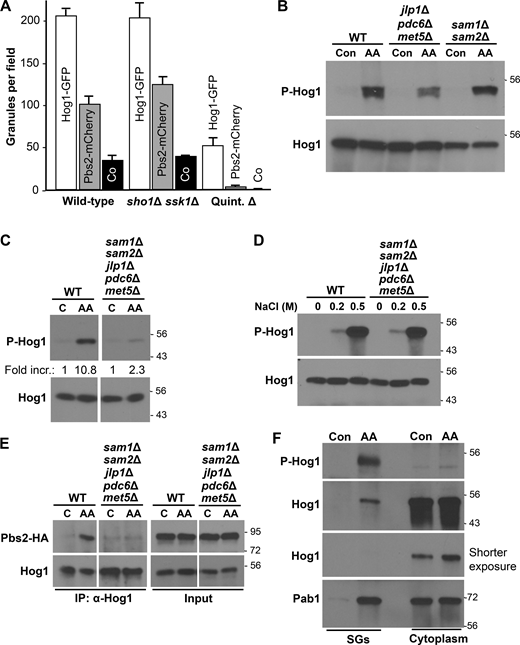
Ablation of SG components blocks AA-induced activation of Hog1 and its association with Pbs2. (A) WT cells (DL3187), a sho1Δ ssk1Δ mutant (DL4306), and the quintuple deletion mutant (sam1Δ sam2Δ jlp1Δ pdc6Δ met5Δ; Quint Δ; DL4622) co-expressing Hog1-GFP (p3680; open bars) and Pbs2-mCherry (p3686; gray bars) were treated with AA and SGs that were isolated from cell lysates. SG preparations were assessed by fluorescence microscopy for quantitative analysis of Hog1-GFP and Pbs2-mCherry granules and co-localization (Co; black bars) of these signals. Values represent the mean number of granules detected per visual field (n = 3) ± standard deviation. (B and C) WT cells (DL3187) or the indicated deletion mutants were treated with AA for 10 min or untreated (Con). Extracts were processed for immunoblot detection of Hog1 and P-Hog1. (D) WT cells (DL3187) and the quintuple mutant (DL4622) were subjected to hyperosmotic stress with the indicated concentration of NaCl for 5 min and extracts were treated as above. (E) The strains in D, co-expressing Hog1-Myc (p3673) and Pbs2-HA (p3671), were treated with AA or untreated (C) and anti-Hog1 IPs of extracts were separated by SDS-PAGE and subjected to immunoblot analysis for co-IP of Pbs2-HA. (F) AA-induced Phospho-Hog1 is largely restricted to SGs. SGs were prepared from lysates of WT cells (DL3187) treated with AA or untreated (Con). The SG fraction (25% of total) and the depleted cytoplasm (0.5% of total) were processed for immunoblot detection of Hog1, P-Hog1, and Pab1. A shorter exposure of the Hog1 signals is included. Molecular mass markers (in kDa) for Pab1 are on the right. Source data are available for this figure: SourceData F6.
Ablation of SG components blocks AA-induced activation of Hog1 and its association with Pbs2. (A) WT cells (DL3187), a sho1Δ ssk1Δ mutant (DL4306), and the quintuple deletion mutant (sam1Δ sam2Δ jlp1Δ pdc6Δ met5Δ; Quint Δ; DL4622) co-expressing Hog1-GFP (p3680; open bars) and Pbs2-mCherry (p3686; gray bars) were treated with AA and SGs that were isolated from cell lysates. SG preparations were assessed by fluorescence microscopy for quantitative analysis of Hog1-GFP and Pbs2-mCherry granules and co-localization (Co; black bars) of these signals. Values represent the mean number of granules detected per visual field (n = 3) ± standard deviation. (B and C) WT cells (DL3187) or the indicated deletion mutants were treated with AA for 10 min or untreated (Con). Extracts were processed for immunoblot detection of Hog1 and P-Hog1. (D) WT cells (DL3187) and the quintuple mutant (DL4622) were subjected to hyperosmotic stress with the indicated concentration of NaCl for 5 min and extracts were treated as above. (E) The strains in D, co-expressing Hog1-Myc (p3673) and Pbs2-HA (p3671), were treated with AA or untreated (C) and anti-Hog1 IPs of extracts were separated by SDS-PAGE and subjected to immunoblot analysis for co-IP of Pbs2-HA. (F) AA-induced Phospho-Hog1 is largely restricted to SGs. SGs were prepared from lysates of WT cells (DL3187) treated with AA or untreated (Con). The SG fraction (25% of total) and the depleted cytoplasm (0.5% of total) were processed for immunoblot detection of Hog1, P-Hog1, and Pab1. A shorter exposure of the Hog1 signals is included. Molecular mass markers (in kDa) for Pab1 are on the right. Source data are available for this figure: SourceData F6.
SG formation is required for AA-induced activation of Hog1 and its association with Pbs2
Because both Hog1 and Pbs2 are recruited to AA-induced SGs, we tested the impact of deletions in nonessential genes whose proteins were found within the SG assembly on Hog1 activation and association with Pbs2. Among the most abundant proteins detected in the complex with Hog1 and Pbs2, we chose five whose genes are not essential for viability. These were Sam1, Sam2, Jlp1, Pdc6, and Met5. Sam1 and Sam2 are paralogous SAM synthetases (Table 1 and Table S1). We tested deletion mutants in these five genes, individually and in combination, for activation of Hog1 by AA. The single mutants did not display deficiencies in Hog1 activation (Fig. S5). However, a jlp1Δ pdc6Δ met5Δ mutant displayed a moderate decrease in Hog1 activation (Fig. 6 B). Hog1 activation in an sam1Δ sam2Δ mutant, which is auxotrophic for SAM, was not detectably impaired. Therefore, we constructed a quintuple deletion mutant, whose growth rate is somewhat reduced from WT (doubling time at 30°C of 120 versus 99 min for WT in YEPD + SAM). Hog1 activation by AA in the quintuple deletion mutant was nearly completely ablated (Fig. 6 C). In contrast to this, Hog1 activation in response to hyperosmotic shock was not diminished in the quintuple deletion mutant (Fig. 6 D), suggesting that the observed effect is specific to AA-induced stress. Consistent with our hypothesis that Hog1 activation in response to AA treatment requires the recruitment of both Pbs2 and Hog1 to SGs, the AA-induced association of Hog1 with Pbs2 was eliminated in the quintuple deletion mutant (Fig. 6 E). As a direct test of this hypothesis, we examined the recruitment of Hog1-GFP and Pbs2-mCherry to SGs in the quintuple deletion mutant. AA-induced recruitment of Hog1-GFP to SGs in the quintuple deletion mutant was reduced to 25% of that detected in WT cells (Fig. 6 A). Recruitment of Pbs2-mCherry to SGs was reduced to 4% of WT (Fig. 6 A). Perhaps most importantly, we detected <1% co-localization of Hog1-GFP signals with Pbs2-mCherry signals, supporting the conclusion that the AA-induced association of these kinases within SGs was disrupted in the quintuple deletion mutant.
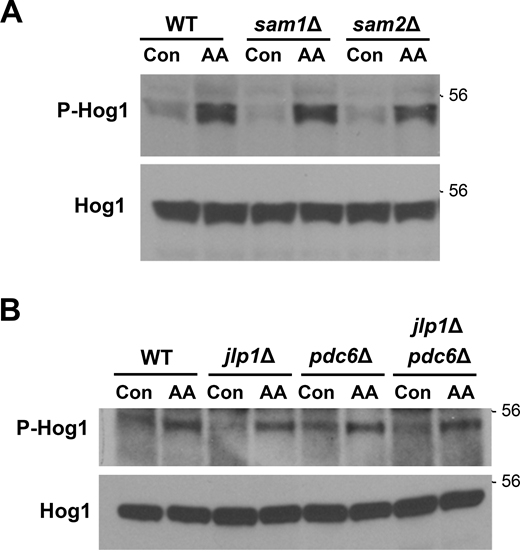
Hog1 activation by AA treatment in single and double mutants of SG components. (A and B) WT cells (DL3187) or the indicated deletion mutants were treated with AA for 10 min or untreated (Con). Extracts were processed for immunoblot detection of Hog1 and P-Hog1. Source data are available for this figure: SourceData FS5.
Hog1 activation by AA treatment in single and double mutants of SG components. (A and B) WT cells (DL3187) or the indicated deletion mutants were treated with AA for 10 min or untreated (Con). Extracts were processed for immunoblot detection of Hog1 and P-Hog1. Source data are available for this figure: SourceData FS5.
It is possible that Hog1 association with SGs is dynamic, with phosphorylated Hog1 being exchanged on SGs with inactive Hog1, allowing the accumulation of active Hog1 in the cytoplasm. Alternatively, the granules may be stable, with activated Hog1 remaining associated with the assembly. To assess these possibilities, we separated SGs from the cytoplasm by centrifugation and tested these fractions for total Hog1 and active (phosphorylated) Hog1. We found that phospho-Hog1 was highly concentrated in the AA-induced SGs (Fig. 6 F). In contrast, the bulk of the Hog1 remained in the cytoplasm after AA treatment (>99%) and displayed only a basal level of phosphorylation, supporting the conclusion that Hog1 activated within SGs remains associated with the granules.
Hog1 closes Fps1 in response to AA
Undissociated AA enters the yeast cell through the glycerol channel Fps1 (Mollapour and Piper, 2007), as is also the case for arsenite (Thorsen et al., 2006; Lee and Levin, 2018). Hog1 activated by either hyperosmotic stress or arsenite phosphorylates the positive regulators of Fps1, Rgc1, and Rgc2, driving their rapid eviction from the glycerol channel and consequent channel closure (Lee et al., 2013; Lee and Levin, 2018). In response to AA treatment, we detected a similarly rapid dissociation of Rgc2 from Fps1, which was accompanied by an Rgc2 band shift that is characteristic of its phosphorylation by Hog1 (Fig. 7 A). The induced dissociation was dependent upon Hog1, suggesting that the same mechanism of Fps1 regulation described previously in response to either hyperosmotic stress or arsenite exposure is active in response to AA treatment (100 mM, pH 4.5). Mollapour and Piper (2007) presented evidence that Hog1 activated by AA phosphorylates Fps1 on Thr231, which drives its ubiquitin-mediated endocytosis and degradation. We detected a moderate decrease in the level of Fps1 over a 60-min time-course treatment with AA (Fig. 7 B). Thus, it appears that the initial response of Hog1 activated by AA is to close Fps1, with degradation of this channel occurring as a slower, secondary response.
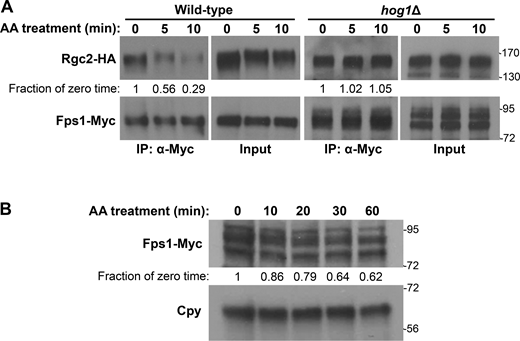
AA treatment induces Hog1-dependent closure of glycerol channel Fps1. (A) AA treatment induces Hog1-dependent eviction of Rgc2 from Fps1. WT cells (DL3187) and hog1Δ strain (DL3158) co-expressing Fps1-Myc (p3121) and Rgc2-HA (p3151) were treated with AA for the indicated times. Anti-Myc IPs of extracts were separated by SDS-PAGE and subjected to immunoblot analysis for co-IP of Rgc2-HA. (B) AA treatment induces a small decrease in steady-state level of Fps1. WT cells (DL3187) expressing Fps1-Myc (p3121) were treated with AA for the indicated times. Extracts were subjected to SDS-PAGE and immunoblot analysis for detection of Fps1-Myc and Cpy. Molecular mass markers (in kDa) are on the right. Source data are available for this figure: SourceData F7.
AA treatment induces Hog1-dependent closure of glycerol channel Fps1. (A) AA treatment induces Hog1-dependent eviction of Rgc2 from Fps1. WT cells (DL3187) and hog1Δ strain (DL3158) co-expressing Fps1-Myc (p3121) and Rgc2-HA (p3151) were treated with AA for the indicated times. Anti-Myc IPs of extracts were separated by SDS-PAGE and subjected to immunoblot analysis for co-IP of Rgc2-HA. (B) AA treatment induces a small decrease in steady-state level of Fps1. WT cells (DL3187) expressing Fps1-Myc (p3121) were treated with AA for the indicated times. Extracts were subjected to SDS-PAGE and immunoblot analysis for detection of Fps1-Myc and Cpy. Molecular mass markers (in kDa) are on the right. Source data are available for this figure: SourceData F7.
Discussion
In this study, we have described a novel mechanism for the activation of SAPK Hog1 by AA, an intracellular stressor. This mechanism does not involve stimulation of the canonical HOG pathway initiated at the cell surface, but instead leverages the basal activity of MEK Pbs2 to increase phosphorylation of Hog1. Proteomic data revealed the formation of a protein assembly induced by AA treatment that brings Hog1 together with Pbs2 within SGs. In the absence of basal Pbs2 activity, both Hog1 and Pbs2 are recruited to SGs, but Hog1 is not phosphorylated. Our findings indicate that SGs act as a scaffold to bring Hog1 and Pbs2 into proximity in a manner that increases the turnover number for Pbs2 without altering its catalytic activity. Although the structural details of their induced association is not yet clear, the CD domain of Hog1, which is responsible for its weak constitutive association with Pbs2 (Murakami et al., 2008), was not required for the AA-induced association between these kinases. Previous work demonstrated the requirement for the Sln1 branch, but not the Sho1 branch, of the HOG pathway for Hog1 activation by AA (Mollapour and Piper, 2006). This makes sense for an activation mechanism that relies on basal Pbs2 activity because the Sln1 pathway branch provides this basal activity (Macia et al., 2009).
Hyperosmotic stress, which activates the HOG pathway protein kinase cascade from the cell surface, did not induce the formation of a stable association between Hog1 and Pbs2. This suggests that the AA-induced association of these kinases is atypical behavior. However, Hog1 is activated by many other stressors whose mechanisms remain unknown, and at least some of these signal to Hog1 through pathways that do not engage the cell surface osmosensors (e.g., arsenite; Lee and Levin, 2018). It will be interesting to examine other such stresses for the formation of Hog1-containing SGs. In this regard, it is important to point out that the yeast cells in these experiments were preadapted to growth at pH 4.5, so the observed formation of SGs and activation of Hog1 was not a consequence of a change in environmental pH but was specific to AA treatment. When undissociated AA enters the cell and encounters the near neutral pH of the cytoplasm, it releases a proton. It is likely that acidification of the cytoplasm is the proximate cause of the perceived stress (Arneborg et al., 2000). How this drives the assembly of SGs remains an open question.
SGs have been implicated previously in the modulation of cell signaling (Kedersha et al., 2013; Takahara and Maeda, 2012). However, consistent with their role in the sequestration of proteins, the impact of SGs on signaling generally results from the depletion of key signaling proteins from the cytosol. For example, phosphorylated Hog1 orthologs in several fungal species, including Candida boidinni, Pichia pastoris, and Saccharomyces pombe, are sequestered in SGs induced by heat shock as a mechanism to diminish the level of active Hog1 in the cytoplasm (Shiraishi et al., 2018). However, examination of S. cerevisiae Hog1 in the same study showed that it is not recruited to SGs by heat shock. Recruitment of C. boidinni Hog1 to SGs was dependent on a hydrophobic β-sheet near its N terminus, which may be shielded in S. cerevisiae Hog1 by a region at its C terminus (Shiraishi et al., 2018). Additionally, mammalian p38 was recruited to SGs in HeLa cells in response to arsenite treatment, but the consequence of this localization was not examined (Hsiao et al., 2020). In any case, these examples are quite different from the function of AA-induced SGs revealed here as an activating scaffold for Hog1. Thus, SGs can be added to the list of intracellular mechanisms used by yeast to activate SAPKs in response to specific stresses (Lee and Levin, 2018; Liu and Levin, 2018). However, it appears that SG formation is not a sufficient condition for recruitment of Hog1 because a previous proteomic analysis of arsenite-induced SGs did not detect either Hog1 or Pbs2 (Jacobson et al., 2012), and we did not detect the induction of a stable association between these proteins in response to arsenite treatment.
SG composition
It is clear that SG composition varies with the stress experienced (Jain et al., 2016; Cherkasov et al., 2015; Jacobson et al., 2012). This may explain the observed specificity for recruitment of Hog1 and Pbs2 to AA-induced SGs. A diverse set of proteins with a variety of enzymatic functions were represented within the SGs formed in response to AA stress. We identified many methionine biosynthetic and sulfur metabolism enzymes, including Met5 and Met10 (sulfite reductases), Met6 (cobalamin-independent methionine synthase), Met13 (methylenetetrahydrofolate reductase), Met3 (ATP sulfurylase), Sam1 and Sam2 (SAM synthetases), Cys4 (cystathionine β-synthase), Cys3 (cysthionine γ-lyase), the Gus1 (glutamyl-tRNA synthetase)/Mes1 (methionyl-tRNA synthetase)/Arc1 complex, and Jlp1 (Fe[II]-dependent sulfonate/α-ketoglutarate dioxygenase). Several additional proteins identified within the SGs are required for the biosynthesis of other amino acids, including Ura2 (bifunctional carbamoylphosphate synthetase/aspartate transcarbamylase), Ura3 (orotidine-5′-phosphate decarboxylase), Leu1 (isopropylmalate isomerase), Trp2 (anthranilate synthase), and Shm2 (serine hydroxymethyltransferase). The significance of this set of enzymes within AA-induced SGs is not clear. We found that genetic ablation of a set of abundant SG components (Sam1, Sam2, Jlp1, Pdc6, and Met5) blocked the AA-induced recruitment of Hog1 and Pbs2 to SGs, the association of these kinases with each other, and consequent Hog1 activation, confirming the importance of the induced assembly for the activation of Hog1 by this stressor.
We were able to visualize formation of SGs through the appearance of cytoplasmic puncta observable by BiFC when Hog1 associated with Jlp1, another SG component. However, we were not able to detect localization of Hog1-GFP to SGs in vivo because most of the Hog1 remained diffusely cytoplasmic in response to AA treatment. Nevertheless, we detected Hog1-GFP in isolated SGs. These results suggested that a small subpopulation of Hog1 becomes associated with SGs. Indeed, measurement of Hog1 in AA-induced granules isolated from lysates revealed that >99% of the Hog1 remained soluble. However, active Hog1 was concentrated in the granules and was not detected above basal levels in cytoplasm depleted of granules. The restriction of active Hog1 to SGs suggests a mechanism by which Hog1 action may be limited to cytoplasmic targets. For example, in contrast to hyperosmotic stress, Hog1 activated by AA treatment neither translocates to the nucleus (Fig. 4 B) nor drives transcription of osmo-stress–induced genes (Mollapour and Piper, 2006). Additionally, active Hog1 within SGs may phosphorylate other components of the granules as part of the response to AA stress.
The HOG pathway MEKK Ssk2 was present in SGs isolated from a mutant strain missing the upper HOG pathway components (sho1Δ ssk1Δ PBS2-DD). However, we did not detect Ssk2 in granules isolated from WT cells, suggesting that its presence in the mutant context may be artifactual. Moreover, our finding that AA treatment does not induce phosphorylation of Pbs2 suggests that Ssk2 does not play an active role in the response to AA stress.
Finally, we found that AA treatment induced closure of plasma membrane glycerol channel Fps1, the entry port for the undissociated form of the acid. As in the cases of hyperosmotic shock and arsenite stress, Fps1 closure was catalyzed by Hog1-driven eviction of its regulator, Rgc2, from the cytoplasmic surface of Fps1. Mollapour and Piper (2007) reported that AA-activated Hog1 drives ubiquitin-mediated endocytosis and degradation of Hog1 over 20–60 min. Although we detected a moderate decrease in Fps1 levels over a 1-h time-course, the Hog1-dependent closure of Fps1 occurred very rapidly. These results suggest that the primary response to AA is Hog1-induced Fps1 closure, followed by its degradation. An interesting unresolved question is how AA treatment prevents passive accumulation of glycerol after Fps1 inactivation (Mollapour and Piper, 2006, 2007). In the case of arsenite treatment, the toxic metalloid is metabolized to methylarsenite, which reacts with the active site Cys residues of the glycerol-3-phosphate dehydrogenases (Gpd1 and Gpd2), thereby blocking the production of glycerol (Lee and Levin, 2019). We expect that these enzymes are inactivated in some manner by AA treatment. However, we did not detect either Gpd1 or Gpd2 sequestered within AA-induced SGs in our proteomic studies.
The mechanism described here for the activation of Hog1 in response to AA stress supports the notion that other Hog1-activating stressors may act at different points along the HOG pathway. Detailed examination of the mechanisms by which other stressors activate Hog1 may reveal a multitude of intracellular inputs to this SAPK. Moreover, how the variety of stress-induced signal input mechanisms contribute to the specificity of SAPK output is an important question and is likely one key to understanding the full range of SAPK signaling in yeast and humans.
Materials and methods
Strains, growth conditions, transformations, and gene deletions
The S. cerevisiae strains used in this study were all derived from Research Genetics background S288c (Research Genetics, Inc.) and are listed in Table 2. Yeast cell cultures were grown in YPD (1% Bacto yeast extract, 2% Bacto Peptone, and 2% glucose) or minimal selective medium, SD (0.67% yeast nitrogen base and 2% glucose) supplemented with the appropriate nutrients to select for plasmids. For AA experiments, media were prepared at pH 4.5. Yeast cells were transformed according to Gietz et al. (1995). Briefly, 5 ml yeast cultures were grown to a density (A600) of ∼0.6 and centrifuged at 3,000 g for 3 min. Pellets were resuspended in 1 ml dH2O and centrifuged at 8,000 g for 1 min. Pellets were resuspended in 250 μl TE/LiAc (10 mM Tris, 1 mM EDTA, and 100 mM lithium acetate, pH 7.0). DNA was added to 50 μl aliquots and incubated at 30°C for 10 min, and 300 μl PEG/TE/LiAc (40% polyethylene glycol 4,000, TE/LiAc) was added, followed by an additional 30-min incubation at 30°C. Cells were then exposed to heat shock at 42°C for 20 min prior to centrifugation at 8,000 g for 1 min. The pellets were resuspended in SD medium for plating.
Yeast strains
| Strain | Relevant genotype | Source or reference |
|---|---|---|
| DL2344 | MATa S288c ssk2∆::leu2 ssk22∆::leu2 ste11∆::his3 | Posas and Saito (1997) |
| DL2772 | MATα S288c (BY4742) his3∆ leu2∆ ura3∆ lys2∆ | Research Genetics |
| DL3158 | MATa S288c hog1∆::KanMX | Research Genetics |
| DL3187 | MATa S288c (BY4741) his3∆ leu2∆ ura3∆ met15∆ | Research Genetics |
| DL4278 | MATα S288c pbs2∆::KanMX | Research Genetics |
| DL4306 | MATa S288c sho1∆::HPHMX4 ssk1∆::KanMX | Lee and Levin (2018) |
| DL4309 | MATα S288c ptp2∆::KanMX ptp3∆::HPHMX4 ptc1∆::HIS3 | Lee and Levin (2018) |
| DL4600 | MATα S288c sam1∆::KanMX | Research Genetics |
| DL4605 | MATa S288c pdc6∆::HPHMX4 | This study |
| DL4606 | MATa S288c sam2∆::HPHMX4 | This study |
| DL4610 | MATa S288c jlp1∆::HIS3 | This study |
| DL4611 | MATa S288c pdc6∆::HPHMX4 jlp1∆::HIS3 | This study |
| DL4614 | MATa S288c pdc6∆::HPHMX4 jlp1∆::HIS3 met5∆::KanMX | This study |
| DL4617 | MATα S288c sam1∆::KanMX sam2∆::HPHMX4 | This study |
| DL4622 | MATa S288c sam1∆::KanMX sam2∆::HPHMX4 pdc6∆::HPHMX4 jlp1∆::HIS3 met5∆::KanMX | This study |
Chromosomal deletion of genes was carried out by homologous recombination and genetic crosses. Several selectable markers were used. The hygromycin-resistance gene HPHMX4 from pAG32 (Goldstein and McCusker, 1999) was amplified by high-fidelity PCR (Phusion; F530S; Thermo Fisher Scientific) using primers containing the upstream region (40 bp immediately before the starting ATG) and downstream region (40 bp immediately after the stop codon) of the target gene. The PCR products were integrated individually and sequentially into the genome of the WT strain (DL3187) or an sam1∆::KanMX strain (DL4600) by homologous recombination. To generate pdc6∆::HPHMX4 (DL4605), integrants were selected on YPD plates containing hygromycin B. To generate sam1∆::KanMX sam2∆::HPHMX4 (DL4617), integrants were selected with hygromycin B on YPD plates supplemented with SAM (60 μM) because sam1∆ sam2∆ strains are auxotrophic for SAM. Deletion of JLP1 in DL4605 was generated using the HIS3 marker. The HIS3 gene from pFA6a-HIS3MX6 (p3263) was amplified by PCR, as above. Integration into the genome of DL4605 was selected for on the plates without histidine, yielding pdc6∆::HPHMX4 jlp1∆::HIS3 (DL4611). Additional deletion of MET5 in DL4611 was generated using kanamycin resistance gene KanMX from pFA6a-KanMX (p3261). Integration was selected for on the plates with G418, yielding pdc6∆::HPHMX4 jlp1∆::HIS3 met5∆::KanMX (DL4614). A quintuple deletion mutant was generated by mating DL4617 with DL4614, followed by tetrad analysis and phenotypic and genomic screening to identify a sam1∆::KanMX sam2∆::HPHMX4 pdc6∆::HPHMX4 jlp1∆::HIS3 met5∆::KanMX strain (DL4622). All gene replacements were validated by PCR analysis across both integration junctions.
Chemicals
AA was purchased from Fisher Chemical, and S-(5′Adenosyl)-L-methionine chloride dihydrochloride (A7007; SAM) was purchased from Sigma-Aldrich.
Plasmid construction and mutagenesis
The plasmids and oligonucleotides used in this study are presented in Table 3 and Table 4, respectively. For co-IP, Pbs2, Hog1, Jlp1, Sam1, and Kap123 were tagged at their C-termini with the 3HA epitope and expressed under the control of the MET25 promoter. The coding regions were amplified by high-fidelity PCR from genomic yeast DNA using a forward primer that contained an XbaI site (upstream) before the start codon and a reverse primer without a stop codon and a NotI site (downstream). Amplified fragments were cloned into pRS316-MET25P-RGC2-3HA-ADH1T (p3151), from which Rgc2 was removed by digestion with the same enzymes, to yield pRS316-MET25P-PBS2-3HA (p3671), pRS316-MET25P-HOG1-3HA (p3672), pRS316-MET25P-JLP1-3HA (p3676), pRS316-MET25P-SAM1-3HA (p3677), and pRS316-MET25P-KAP123-3HA (p3678). pRS316-MET25P-DUR12-3HA (p3679) was generated by double overlap PCR. The MET25P-DUR12 was prepared in two steps. First, the DUR12-coding sequence was amplified from the genome with a primer that included an overlapping region with MET25P (upstream; pMET25.DUR12.start.For) and a primer that contained a Not1 site (downstream; DUR12.Not1.Rev). The MET25P sequence was amplified from YEp181-MET25P-FPS1-Myc (p3121) with a primer that included an EcoR1 site (upstream; pMET25.start.EcoR1) and a primer that included an overlapping region with DUR12 (pMET25.DUR12.start.Rev). Next, these fragments were amplified together using primers pMET25.start.EcoR1 and DUR12.Not1.Rev and cloned into pRS316-3HA-ADH1T (p3148) at the EcoR1 and Not1 to yield pRS316-MET25P-DUR12-3HA (p3679). Pbs2 and Hog1 were also tagged at their C-termini with the Myc epitope and expressed under the control of the MET25 promoter. The PBS2-coding region was amplified by high-fidelity PCR from genomic yeast DNA using a forward primer that contained an XbaI site (upstream; PBS2.Xba1.For) before the start codon and a reverse primer without a stop codon and a SmaI site (downstream; PBS2.Sma1.Rev) and cloned into YEp181-MET25P-FPS1-Myc (p3121) from which FPS1 was removed by digestion with the same enzymes, to yield YEp181-MET25P-PBS2-Myc (p3674). The MET25P-HOG1 was amplified from pUT36- MET25P-HOG1-HIS6 (p3454) with a primer that included a HindIII site (upstream; pMET25.start.HindIII) and a primer that included a BamH1 site without a stop codon (downstream of HOG1; HOG1.BamH1.Xba1/Rev) and cloned into YEp181-MET25P-FPS1-Myc (p3121) from which MET25P-FPS1 was removed by digestion with the same enzymes, to yield YEp181-MET25P-HOG1-Myc (p3673).
Plasmids
| Plasmid | Description | Source or reference |
|---|---|---|
| p115 | pRS316 | Sikorski and Hieter (1989) |
| p1105 | pRS425 | Sikorski and Hieter (1989) |
| p1230 | pYES2-GAL1P-STE11-N∆ | pNC544, Posas and Saito (1997) |
| p2823 | pAG32 | Goldstein and McCusker (1999) |
| p3121 | YEp181-MET25P-FPS1-Myc | Lee et al. (2013) |
| p3148 | pRS316-3HA-ADH1T | Lee et al. (2013) |
| p3151 | pRS316-MET25P-RGC2-3HA | Lee et al. (2013) |
| p3177 | pRS416-HOG1-GFP | Ferrigno et al. (1998) |
| p3199 | pRS413-CFP-C | Lipatova et al. (2012) |
| p3200 | pRS415-CFP-N | Lipatova et al. (2012) |
| p3217 | pRS413-CFP-C-HOG1 (BiFC) | Lee et al. (2013) |
| p3261 | pFA6a-KanMX6 | Longtine et al. (1998) |
| p3263 | pFA6a-HIS3MX6 | Longtine et al. (1998) |
| p3370 | pYES2-GAL1P-PBS2-DD | pGPBD21, Wurgler-Murphy et al. (1997) |
| p3454 | pUT36- MET25P-HOG1-HIS6 | Lee and Levin (2018) |
| p3649 | GAL1P-GST-SEC53 | Open Biosystems |
| p3651 | GAL1P-JLP1-TAP | Open Biosystems |
| p3652 | GAL1P-KAP123-TAP | Open Biosystems |
| p3668 | TDH3-mCherry vector, URA3 | pRP1669, Roy Parker, University of Colorado, Boulder, CO, USA |
| p3670 | PAB1-GFP, HIS3 | pRP2477, Roy Parker, University of Colorado, Boulder, CO, USA |
| p3671 | pRS316-MET25P-PBS2-3HA | This study |
| p3672 | pRS316-MET25P-HOG1-3HA | This study |
| p3673 | YEp181-MET25P-HOG1-Myc | This study |
| p3674 | YEp181-MET25P-PBS2-Myc | This study |
| p3675 | pRS316-MET25P-PBS2-S514DT518D-(DD)-3HA | This study |
| p3676 | pRS316-MET25P-JLP1-3HA | This study |
| p3677 | pRS316-MET25P-SAM1-3HA | This study |
| p3678 | pRS316-MET25P-KAP123-3HA | This study |
| p3679 | pRS316-MET25P-DUR12-3HA | This study |
| p3680 | pRS425-HOG1-GFP | This study |
| p3681 | pRP1669-PAB1-mCherry (URA3) | This study |
| p3683 | pRS415-JLP1-CFP-N (BiFC) | This study |
| p3685 | YEp181-MET25P-HOG1-D307A/D310A-Myc (HOG1-DADA) | This study |
| p3686 | pRP1669-MET25P-PBS2-mCherry (URA3) | This study |
Oligonucleotides
| Primer name | Primer sequence | Purpose |
|---|---|---|
| PBS2.XbaI.For | 5′-GATCtctagaACTAGAATGGAAGACAAGTTTGCTAA-3′ | PBS2 cloning |
| PBS2.Not1.Rev | 5′-GATCgcggccgcTAAACCACCCATATGTAATG-3′ | PBS2 cloning |
| HOG1.XbaI.For | 5′-GATCtctagaACTAGAATGACCACTAACGAGGAATT-3′ | HOG1 cloning |
| HOG1.Not1.Rev | 5′-GATCgcggccgcCTGTTGGAACTCATTAGCGTACT-3′ | HOG1 cloning |
| JLP1.XbaI.For | 5′-GATCtctagaATGTCTCCTGCAGCAGCTCAAACAGCA-3′ | JLP1 cloning |
| JLP1.Not1.Rev | 5′-GATCgcggccgcAATATCCAAAGTTAATGAAGAAGGA-3′ | JLP1 cloning |
| SAM1.XbaI.For | 5′-GATCtctagaATGGCCGGTACATTTTTATTC-3′ | SAM1 cloning |
| SAM1.Not1.Rev | 5′-GATCgcggccgcGAACTTCAAAGTCTTAGGCT-3′ | SAM1 cloning |
| KAP123.XbaI.For | 5′-GATCtctagaATGGATCAACAATTTCTAAG-3′ | KAP123 cloning |
| KAP123.Not1.Rev | 5′-GATCgcggccgcAGCAATGACGGCAGCTAAAAC-3′ | KAP123 cloning |
| pMET25.DUR12.start.For | 5′-ATACAATTCTATTACCCCCATCCATACTCTAGAACTAGAATGACAGTTAGTTCCGATAC-3′ | DUR12 cloning |
| pMET25.DUR12.start.Rev | 5′-CTAACGATATTTCAGCAGTTGTATCGGAACTAACTGTCATTCTAGTTCTAGAGTATGGAT-3′ | DUR12 cloning |
| pMET25.start.EcoR1 | 5′-GATCgaattcAGCTCCGGATGCAAGGGTTC-3′ | DUR12 cloning |
| DUR12.Not1.Rev | 5′-GATCgcggccgcTGCCAATGTCTCTATGACGGCCACT-3′ | DUR12 cloning |
| PBS2.Sma1.Rev | 5′-GATCcccgggATAAACCACCCATATGTAATG-3′ | PBS2 cloning |
| pMET25.start.HindIII | 5′-GATCaagcttAGCTCCGGATGCAAGGGTTC-3′ | HOG1 cloning |
| HOG1.BamH1.Xba1.Rev | 5′-GATCggatcctctagaGCCTGTTGGAACTCATTAGCGTACT-3′ | HOG1 cloning |
| pPAB1.SacI.For | 5′-GATCgagctcTAGATCAATCATGTTTAACG-3′ | PAB1 cloning |
| PAB1.Pac1.Rev | 5′-GATCttaattaaAGCTTGCTCAGTTTGTTGTTC-3′ | PAB1 cloning |
| pHOG1.Sac1.For | 5′-GATCgagctcATCGATTGAAGGAAATAAGAGGAAT-3′ | HOG1 cloning |
| GFP.Not1.Rev | 5′-GATCgcggccgcCTTCACATGTTCCGCAGAT-3′ | HOG1 cloning |
| pMET25.Sac1.For | 5′-GATCgagctcAGCTCCGGATGCAAGGGTTC-3′ | PBS2 cloning |
| PBS2.BamH1.Rev | 5′-GATCggatccATAAACCACCCATATGTAATG-3′ | PBS2 cloning |
| JLP1.BspE1.Rev | 5′-GATCtccggaAATATCCAAAGTTAATGAAGAAGGA-3′ | JLP1 cloning |
| PBS2-S514DT518D | 5′-CGGTGTTTCTGGTAATTTGGTGGCAGATTTAGCGAAGGATAATATTGGTTGTCAGTCATACATG-3′ | PBS2-DD cloning |
| PBS2-S514DT518D.anti | 5′-CATGTATGACTGACAACCAATATTATCCTTCGCTAAATCTGCCACCAAATTACCAGAAACACCG-3′ | PBS2-DD cloning |
| HOG1-DADA | 5′-GCTCCTTACCACGCTCCAACGGCTGAACCAGTAGCC-3′ | HOG1-DADA cloning |
| HOG1-DADA.anti | 5′-GGCTACTGGTTCAGCCGTTGGAGCGTGGTAAGGAGC-3′ | HOG1-DADA cloning |
Restrictions sites are in lower case.
For fluorescence microscopy studies, Pab1 was tagged at its C terminus with mCherry and expressed under the control of its native promoter. The PAB1-coding sequence was amplified together with its promoter (397 nucleotides upstream of the ATG) from pRP2477 (Pab1-GFP, p3670) using primers designed with a SacI site (upstream; pPAB1.Sac1.For) and with a PacI site (downstream; PAB1.Pac1.Rev) and cloned into pRP1669 (TDH3P-mCherry, p3668), from which the TDH3 promoter was removed with the same enzymes, to yield pPAB1-mCherry (URA3, p3681). HOG1-GFP was generated in a 2-µm vector. The promoter (489 nucleotides upstream of the ATG) and the coding sequence of the HOG1 and the GFP gene were amplified from pRS416-HOG1-GFP (p3177) using the primers with a Sac1 (upstream; pHOG1.Sac1.For) and a Not1 (downstream; GFP.Not1.Rev). The digested fragments were cloned into pRS425 (p1105) digested with same enzymes, yielding YEp425-HOG1-GFP (p3680). The PBS2-coding sequence was tagged at its C terminus with the mCherry and expressed under the control of the MET25 promoter. The MET25P-PBS2 sequence was amplified from pRS316-MET25P-PBS2-3HA (p3671) with a primer that included a SacI site (upstream; pMET25.Sac1.For) and a primer that included a BamH1 site without a stop codon (downstream of PBS2; PBS2.BamH1.Rev) and cloned into pRP1669 (TDH3P-mCherry, p3668) from which the TDH3 promoter was removed with same digestion enzymes, to yield pRP1669-MET25P-PBS2-mCherry (URA3, p3686).
For BiFC experiments, the JLP1-coding sequence was amplified by PCR using primers with XbaI (upstream; JLP1.Xba1.For) and BspE1 (downstream; JLP1.BspE1.Rev) sites for pRS415-CFP-N vector. The digested fragments were cloned into this vector, yielding pRS415-JLP1-CFP-N (p3683).
Point mutations in PBS2 and HOG1 were generated by Quick Change mutagenesis (Agilent Technologies), yielding pRS316-MET25P-PBS2DD-3HA (p3675) and YEp181-MET25P-HOG1-DADA-Myc (p3685). Mutant alleles were confirmed by DNA sequence analysis of the entire open reading frame.
Protein extraction
Protein extraction for co-IP was carried out as follows. Cells were harvested from 5 ml of medium by centrifugation at 3,000 g for 5 min. The cell pellet was suspended in 0.7 ml of ice-cold lysis buffer (1% Triton X-100, 50 mM Tris-HCl [pH 7.5], 150 mM NaCl, 5 mM EDTA, 5 mM EGTA, 20 µg/ml leupeptin, 20 µg/ml benzamidine, 10 µg/ml pepstatin A, 40 µg/ml aprotinin, 1 mM PMSF, and phosphatase inhibitors [PhosSTOP; NC0922733; Roche]). Glass beads (0.3-mm diameter) were added to this suspension, and cells were broken by bead beating for 1 min at 4°C. The beads and cell debris were removed by centrifugation at 13,500 rpm for 10 min at 4 oC, and the supernatant was subjected to co-IP. The rapid boiling method (Kushnirov, 2000) was used for direct immunoblot experiments because signal from phosphorylated Hog1 was improved over the protein extraction method. Here, cells were suspended in 200 μl 0.1 M NaOH was added and incubated for 2 min at room temperature. Cells were pelleted and resuspended in 50 μl SDS sample buffer, boiled for 5 min, and centrifuged to clear.
Co-IP
Cultures for co-IP experiments using genes under the repressible control of the MET25 promoter were grown to mid-log phase in selective medium. They were starved for methionine for 2 h to induce expression of the epitope-tagged genes. Cultures were then treated with 100 mM AA (pH 4.5) for 10 min. For CHX experiments, the cultures were pre-treated with CHX (50 μg/ml) for 30 min, followed by AA treatment for 10 min. For co-IP experiments using Hog1 or Pbs2 under the MET25 promoter and SEC53, JLP1, or KAP123 under the inducible control of the GAL1 promoter, seed cultures were grown in selective medium containing 2% glucose and transferred to selective medium containing 2% raffinose for growth to mid-log phase. Cultures were then transferred to selective medium without methionine (to induce Hog1 or Pbs2 expression) and with 2% galactose (to induce Sec53, Jlp1, or Kap123 expression) for 2 h.
Co-IPs were carried out as follows: extracts (100 µg of protein) were incubated with mouse monoclonal α-Hog1 (D-3; sc-165978; Santa Cruz) or α-Myc antibody for Rgc2 and Fps1 (9E10; sc-40; Santa Cruz) for 1 h at 4°C, which were precipitated with protein A Sepharose 4B beads (101042; Thermo Fisher Scientific) for 1 h at 4°C. Samples were washed with IP washing buffer (50 mM Tris-HCl, pH 7.5, 150 mM NaCl, 5 mM EDTA, and 5 mM EGTA) three times and boiled in SDS-PAGE buffer (Lee et al., 2013).
SDS-PAGE electrophoresis and immunoblot analysis
Proteins were separated by SDS-PAGE (7.5% or 10% gels), followed by immunoblot analysis on Immobilon-P membranes (IPVH00010; MilliporeSigma) using mouse monoclonal α-Hog1 antibody (D-3; sc-165978; Santa Cruz), α-Myc antibody (9E10; sc-40; Santa Cruz), α-HA (16B12; mms101R; Covance), α-GST (B-14; sc-138; Santa Cruz), or α-carboxypeptidase Y (10A5B5; CPY; A-6428; Thermo Fisher Scientific) at a dilution of 1:10,000. Mouse monoclonal α-Pab1 antibody (1G1; MA5–47390; Thermo Fisher Scientific) was used at a dilution of 1:2,000. Rabbit polyclonal α-phospho-p38 (T180/Y182, #9211; Cell Signaling) was used at a dilution of 1:2,000 to detect phosphorylated Hog1. Rabbit polyvalent antibody directed against Pbs2 P-T518 at a dilution of 1:1,000 (Tatebayashi et al., 2020). Secondary goat anti-mouse (AB_2338447; Jackson ImmunoResearch) antibody was used at a dilution of 1:10,000 and secondary donkey anti-rabbit (NA9340; Amersham) antibody was used at a dilution of 1:2,000. Detection of TAP-tagged proteins was carried out by polyclonal rabbit peroxidase α-peroxidase (P1291; Sigma-Aldrich) at a dilution of 1:10,000. All immunoblot analyses were replicated at least once and representative blots are shown.
Fluorescence microscopy (mCherry, GFP, and BIFC)
Cells were transformed with plasmids expressing Hog1-GFP (pRS425-HOG1-GFP, p3680), Pab1-mCherry (p3681), Pbs2-mCherry (p3686), CFP-C-Hog1 (pRS413-CFP-C-HOG1; p3217), Jlp1-CFP-N (pRS415-JLP1-CFP-N, p3683), and empty vectors (pRS413-CFP-C or pRS415-CFP-N; p3199 or p3200) in combinations, as indicated. Transformants were grown in selective medium and treated without stress or with AA (10 min), CHX (30 min), or CHX, followed by AA. Cells were fixed with 1% paraformaldehyde (10 min; Thermo Fisher Scientific), mounted in PBS, and visualized at room temperature with a Zeiss Axio Observer Z1 with a Plan-Apochromat 100× lens (numerical aperture of 0.55), fitted with CFP, GFP, or mCherry filters, and photographed with a Hamamatsu Orca Flash 4.0 V3 Camera.
SG isolation
SGs were isolated from lysates made from 50 ml cultures in 1.2 ml of lysis buffer (1% Triton X-100, 50 mM Tris-HCl [pH 7.5], 150 mM NaCl, 5 mM EDTA, 5 mM EGTA, 20 µg/ml leupeptin, 20 µg/ml benzamidine, 10 µg/ml pepstatin A, 40 µg/ml aprotinin, 1 mM PMSF, and phosphatase inhibitors [PhosSTOP; NC0922733; Roche]; Lee and Levin, 2022) by modification of the serial centrifugation method described by Jain et al. (2016). Briefly, lysates were centrifuged at 800 g for 2 min, and the supernatant fractions were centrifuged at 18,000 g for 10 min to pellet SGs. Pellets were washed with 100 μl lysis buffer and centrifuged at 18,000 g for 20 s. Granules were resuspended in 15 μl lysis buffer and transferred to a new tube for a final clarifying centrifugation at 850 g for 2 min. The suspension (5 μl) was mounted on a microscope slide and visualized with a Zeiss Axio Observer Z1.
Image processing
Images were processed using Zen 3.10 and ImageJ software. For quantitation of granules isolated from lysates using ImageJ, images were converted to greyscale and processed for contrast, threshold, binary conversion, and mask creation. The co-localized particles were identified using co-localization plugins. The granules were counted using the “Analyze Particles” function.
Sample preparation and mass spectrometry
Cultures (400 ml) of strains co-expressing Hog1-Myc (p3673) and Pbs2-HA (p3671) were grown to mid-log phase in selective medium and starved for methionine for two h to induce expression of Hog1 and Pbs2, which were expressed under the control of the conditional MET25 promoter. The cultures were subdivided (100 ml each) and treated as indicated. Lysates were subjected to co-IP with α-Hog1 (4 µg) antibody, or α-HA (5 µg) antibody, to pull down Hog1 or Pbs2, respectively. The samples were separated by SDS-PAGE and stained with Coomassie staining blue (Imperial staining solution, Thermo Fisher Scientific). The proteins were analyzed by microcapillary LC/MS/MS techniques at the Taplin Mass Spectrometry Facility, Harvard Medical School (https://taplin.hms.harvard.edu/home). One sample from each condition was analyzed.
Online supplemental material
Fig. S1 shows the co-IP of selected proteins with Hog1-Myc in a WT strain. Fig. S2 shows the co-IP of selected proteins with Hog1-Myc in a pbs2Δ strain. Fig. S3 shows the co-IP of selected proteins with Pbs2-Myc in a hog1Δ strain. Fig. S4 shows the fluorescence micrographs of SG protein co-localizations. Fig. S5 shows the Hog1 activation by AA stress in single and double mutants of SG components. Table S1 shows the mass spectrometric analysis of proteins in Hog1 co-IP from sho1Δ ssk1Δ PBS2-DD cells treated with 100 mM AA, pH 4.5. Table S2 shows the mass spectrometric analysis of proteins in Hog1 co-IP from WT cells treated with 100 mM AA, pH 4.5, or 500 mM NaCl (5 min). Table S3 shows the mass spectrometric analysis of proteins in Pbs2 co-IP from WT cells treated with 100 mM AA (10 min), pH 4.5, or 500 mM NaCl (5 min).
Data availability
The data underlying all figures and tables are available in the published article and its online supplemental material.
Acknowledgments
We thank Roy Parker (University of Colorado, Boulder, CO, USA) for providing yeast plasmids for stress granule studies and Francesc Posas (Universitat Pompeu Fabra, Barcelona, Spain) for providing HOG pathway plasmids.
This work was supported by grants from the National Institutes of Health (R01GM48533 and R01GM138413) to D.E. Levin, a grant from the Japan Society for the Promotion of Science (Grants-in-Aid for Scientific Research [KAKENHI] Grant Number 21H02422), and a grant from the Future Medical Development Fund (Institute of Medical Science, University of Tokyo, Bunkyo City, Japan) to K. Tatebayashi.
Author contributions: J. Lee: conceptualization, data curation, formal analysis, funding acquisition, investigation, methodology, project administration, resources, supervision, validation, visualization, and writing—original draft, review, and editing. K. Tatebayashi: resources and writing—original draft, review, and editing. D.E. Levin: conceptualization, data curation, funding acquisition, investigation, methodology, project administration, resources, supervision, validation, visualization, and writing—original draft, review, and editing.