Precise output from the conserved Notch signaling pathway governs a plethora of cellular processes and developmental transitions. Unlike other pathways that use a cytoplasmic relay, the Notch cell surface receptor transduces signaling directly to the nucleus, with endocytic trafficking providing critical regulatory nodes. Here we report that the cytoplasmic tyrosine kinase Abelson (Abl) facilitates Notch internalization into late endosomes/multivesicular bodies (LEs), thereby limiting signaling output in both ligand-dependent and -independent contexts. Abl phosphorylates the PPxY motif within Notch, a molecular target for its degradation via Nedd4 family ubiquitin ligases. We show that Su(dx), a family member, mediates the Abl-directed LE regulation of Notch via the PPxY, while another family member, Nedd4Lo, contributes to Notch internalization into LEs through both PPxY-dependent and -independent mechanisms. Our findings demonstrate how a network of posttranslational modifiers converging at LEs cooperatively modulates Notch signaling to ensure the precision and robustness of its cellular and developmental functions.
Introduction
Metazoan development relies on spatiotemporal coordination of cellular behaviors. Cells communicate with each other through precisely regulated biochemical signals, with either too little or too much signaling linked to developmental disorders and pathologies (Berridge, 2014). Manipulations of the highly conserved Notch signaling pathway exemplify the sensitivity of developmental events to signal transmission levels (Siebel and Lendahl, 2017; Gozlan and Sprinzak, 2023). Notch orchestrates a diverse array of cellular and developmental processes, including cell fate determination and establishment of tissue boundaries. In some contexts, the on versus off Notch signaling state induces distinct outcomes, whereas in other cases more modest differences in signaling levels drive specific transitions (Ohlstein and Spradling, 2007; Van de Walle et al., 2009; Ninov et al., 2012; Gama-Norton et al., 2015; Basch et al., 2016; Contreras et al., 2018). Because both Notch and its ligands are broadly expressed, this versatility in function requires meticulous spatiotemporal control of the initiation, duration, and strength of signaling (Hori et al., 2013).
Notch is an integral membrane protein with a ligand-binding extracellular domain (NECD) and a signal-transducing intracellular domain (NICD) (Wharton et al., 1985; Lieber et al., 1993; Rebay et al., 1993). Canonical activation of Notch signaling (Kovall et al., 2017) involves cell surface interactions with Delta/Serrate/Lag2 family ligands that trigger endocytosis and proteolytic cleavage of the Notch receptor to release the NICD (De Strooper et al., 1999; Brou et al., 2000). Notch activation can also occur independent of ligand binding. Unbound Notch receptor is continuously endocytosed (Maitra et al., 2006) and either recycled back to the cell surface or delivered to the lysosome for degradation (Yamamoto et al., 2010). Ligand-independent release of the NICD from specific endosomal compartments is possible during this transport (Fortini and Bilder, 2009; Palmer and Deng, 2015; Hounjet and Vooijs, 2021). Once cleaved, activated Notch (free NICD) enters the nucleus and forms a protein complex that drives target gene transcription (Bailey and Posakony, 1995; Wu et al., 2000; Wilson and Kovall, 2006). The amount of free NICD quantitatively correlates with the overall transcriptional outcome of signaling (Shen et al., 2021), and different dynamics of NICD production can elicit distinct downstream responses (Nandagopal et al., 2018).
Multiple factors can influence the production of activated Notch and thereby fine-tune pathway activity. In ligand-induced signaling, the ligand/receptor abundance at cell surfaces (regulated by endocytosis) (Sala et al., 2012; Seib and Klein, 2021; Hounjet and Vooijs, 2021), the specific ligand–receptor complex formed (Benedito et al., 2009; Groot et al., 2014; Gama-Norton et al., 2015; Nandagopal et al., 2018), glycosylation of the receptor’s EGF repeats (Stanley and Okajima, 2010; Takeuchi and Haltiwanger, 2010; Kakuda and Haltiwanger, 2017), and lipid–ligand interactions (Suckling et al., 2017) can all affect Notch activation and NICD release dynamics (Shen et al., 2021). In ligand-independent signaling, residence of Notch at distinct endocytic/endosomal compartments can affect receptor activation and modify signaling levels (Vaccari et al., 2008; Windler and Bilder, 2010; Palmer and Deng, 2015; Alfred and Vaccari, 2018). Therefore, in both ligand-dependent and ligand-independent contexts, precise regulation of Notch endosomal transit must be ensured to modulate NICD release and pathway signaling output.
Endosomal trafficking of integral membrane receptors is controlled by posttranslational regulatory mechanisms, most frequently involving ubiquitination and phosphorylation (Offringa and Huang, 2013; Foot et al., 2017). Most insights into the roles of ubiquitination in modulating Notch endocytic flux and signaling stem from studying three specific E3 ubiquitin ligases: Deltex (Dx) and the Nedd4 family members Suppressor of dx (Su[dx]) and Nedd4 (Sakata et al., 2004; Wilkin et al., 2004; Wilkin and Baron, 2005; Yamada et al., 2011; Baron, 2012; Hori et al., 2012; Moretti and Brou, 2013; Schnute et al., 2018; Dutta et al., 2022; Revici et al., 2022). Genetic, molecular, and cell biological approaches have characterized Dx as a positive regulator and Su(dx) and Nedd4 as negative regulators of Notch (Xu and Artavanis-Tsakonas, 1990; Matsuno et al., 1995, 2002; Fostier et al., 1998; Cornell et al., 1999; Hori et al., 2004, 2011; Sakata et al., 2004; Wilkin et al., 2004, 2008; Shimizu et al., 2014; Schnute et al., 2022). Monoubiquitination of the NICD by Dx stabilizes Notch at the limiting membrane of late endosomes/multivesicular bodies (LEs/MVBs) (Hori et al., 2004, 2011; Wilkin et al., 2008; Yamada et al., 2011; Shimizu et al., 2014, 2024; Schnute et al., 2022), a topology permissive to NICD cleavage and pathway activation (Vaccari et al., 2008; Wilkin et al., 2008; Shimizu et al., 2014, 2024; Schnute et al., 2022). In contrast, recognition of the proline-rich PPxY motif in the NICD by the WW domains of Su(dx) or Nedd4 leads to polyubiquitination and downstream degradation of Notch (Sakata et al., 2004; Jennings et al., 2007; Shimizu et al., 2014, 2024; Schnute et al., 2022). Although unclear for Nedd4 (Sakata et al., 2004; Wilkin et al., 2004), the Su(dx)-mediated downregulation of Notch involves internalization of the receptor into the intraluminal vesicles of the LEs/MVBs (Sakata et al., 2004; Wilkin et al., 2004, 2008; Jennings et al., 2007; Shimizu et al., 2014, 2024; Schnute et al., 2022). This topologically prevents the release of cleaved NICD to the cytoplasm and targets Notch for lysosomal degradation (Vaccari et al., 2008; Wilkin et al., 2008; Shimizu et al., 2014, 2024; Schnute et al., 2022).
Although receptor trafficking is commonly regulated by both ubiquitination and phosphorylation, phosphorylation-based regulation of Notch endocytic trafficking remains largely unexplored (Sjöqvist et al., 2014). The Abelson (Abl) cytoplasmic tyrosine kinase offered an opportunity to address this gap. Abl is best studied as a regulator of the actin cytoskeleton and adherens junction dynamics, and Abl–Notch genetic interactions have been demonstrated during axon guidance and planar cell polarity establishment (Giniger, 1998; Crowner et al., 2003; Le Gall et al., 2008; Song and Giniger, 2011; Kuzina et al., 2011; Kannan et al., 2017; Koca et al., 2022). However, in these contexts, the underlying mechanism involves Notch-mediated organization of cytoplasmic protein complexes that modulate Abl function, rather than Abl-mediated regulation of Notch signaling. An additional and different role for Abl–Notch interactions was uncovered in the pupal eye disc, where we found that Abl loss impairs clearance of endocytosed Notch (Xiong et al., 2013). Because reducing the genetic dose of Notch or its transcriptional effector Su(H) suppressed abl mutant phenotypes in the eye, we proposed that Abl-mediated regulation of Notch trafficking might limit signaling. However, the complexity of the abl mutant phenotypes in the pupal eye disc (Xiong et al., 2013; Sun et al., 2024) made this hypothesis difficult to test.
In this study, we used the Drosophila wing vein pattern and S2 cultured cells to investigate the mechanisms by which Abl regulates Notch endocytic trafficking and signaling. We show that loss of Abl results in truncated veins, suggesting excessive Notch activity, and that increasing Abl leads to ectopic vein formation, consistent with insufficient Notch signaling. Subcellularly, loss of Abl results in aberrant accumulation of Notch at the LE membrane, a topology that increases Notch signaling output. Conversely, increased Abl activity drives Notch internalization into the LE lumen and reduces signaling. The LE regulation of Notch by Abl is kinase activity dependent and may involve phosphorylation of the NICD’s PPxY, a motif used by Nedd4 family ubiquitin ligases to recognize Notch. Mutation of this motif renders Notch insensitive to regulation by Abl and Su(dx) and partially resistant to a different Nedd4 family member, Nedd4Lo, that can also promote Notch internalization into the LE/MBV lumen. Genetic interaction experiments suggest that the Abl-mediated LE regulation of Notch requires Su(dx), with Nedd4Lo providing parallel PPxY-dependent and -independent inputs. We propose that LEs and the PPxY motif, respectively, provide subcellular and molecular integration points for multiple Notch regulatory inputs. Together or separately, they offer fine-tuning routes applicable to both ligand-dependent and ligand-independent signaling contexts.
Results
Loss of abl increases Notch signaling and disrupts wing vein pattern
Tightly regulated Notch signaling establishes vein-intervein boundaries in the developing Drosophila wing. As early as 16 h after puparium formation (APF), Delta-expressing provein cells activate Notch signaling in flanking intervein cells, repressing vein fate and ultimately producing the stereotypical vein-intervein pattern by around 32 h APF (Lyman and Yedvobnick, 1995; Huppert et al., 1997; de Celis et al., 1997; Herszterg et al., 2023, Preprint). While insufficient Notch activation results in excessive vein formation, too much Notch activity leads to vein loss (de Celis et al., 1993; de Celis and Garcia-Bellido, 1994; Johannes and Preiss, 2002). Thus, if Abl modulates Notch signaling, loss of this tyrosine kinase, which we confirmed is expressed during the critical wing vein patterning window (Fig. S1 K) (Bennett and Hoffmann, 1992; Herszterg et al., 2023, Preprint), should produce vein phenotypes characteristic of Notch misregulation.

Abl is required to limit Notch signaling during wing vein patterning. (A, B, and D–J) Maximal projections of WT and ablnull pupal wings. (A and B) 18 h APF, with zoomed insets in A′, and B′. (D and E) 24 h APF. (F and G) 26 h APF. (H–K) 38 h APF. Blue and red arrowheads mark ectopic signaling events at intervein and vein cells, respectively. Yellow arrowheads mark a loss of signaling event. Scale bars = 100 µm. (C) Plot showing the maximum number of cell rows expressing NRE-GFP reporter in L3/L4 veins at 18 and 20 h APF. Each dot represents the measurement from an individual wing. Sample size (# of wings evaluated): WT 18 h (N = 23), abl 18 h (N = 19), WT 20 h (N = 20), and abl 20 h (N = 14). A t-student means comparison test was performed, and P values <0.05 (*), <0.01 (**), <0.001(***), and <0.0001 (****) are indicated. (K) Maximal projection of a 24 h APF WT pupal wing, imaged live in situ, displaying expression of Abl-GFP. Scale bar = 100 µm.
Abl is required to limit Notch signaling during wing vein patterning. (A, B, and D–J) Maximal projections of WT and ablnull pupal wings. (A and B) 18 h APF, with zoomed insets in A′, and B′. (D and E) 24 h APF. (F and G) 26 h APF. (H–K) 38 h APF. Blue and red arrowheads mark ectopic signaling events at intervein and vein cells, respectively. Yellow arrowheads mark a loss of signaling event. Scale bars = 100 µm. (C) Plot showing the maximum number of cell rows expressing NRE-GFP reporter in L3/L4 veins at 18 and 20 h APF. Each dot represents the measurement from an individual wing. Sample size (# of wings evaluated): WT 18 h (N = 23), abl 18 h (N = 19), WT 20 h (N = 20), and abl 20 h (N = 14). A t-student means comparison test was performed, and P values <0.05 (*), <0.01 (**), <0.001(***), and <0.0001 (****) are indicated. (K) Maximal projection of a 24 h APF WT pupal wing, imaged live in situ, displaying expression of Abl-GFP. Scale bar = 100 µm.
To test this, we first examined adult wings. Inconveniently, although abl null mutants complete pupal development, they die as pharate adults (Henkemeyer et al., 1987) and, in accordance with our earlier observations (Xiong et al., 2009), RNAi-mediated Abl knockdown did not produce wing phenotypes, presumably because of Abl protein perdurance. Therefore, we used the deGradFP system (Caussinus and Affolter, 2016) to knock down Abl protein levels in animals carrying an endogenously GFP-tagged allele (Nagarkar-Jaiswal et al., 2015) over a null allele (ablGFP/abl2). Adding spatiotemporal control (McGuire et al., 2004) allowed us to target the knockdown specifically to the posterior compartment of developing pupal wings, thereby bypassing any earlier requirements for Abl function in the proliferation or patterning of the larval wing disc (Singh et al., 2010). The vein truncations found in 29% of otherwise WT-looking Abl knockdown adult wings (Fig. 1, A and B; and Table1) suggested a disruption in the vein patterning process and resembled Notch gain-of-function phenotypes. Genetic interactions further implicated Abl as a potential negative regulator within the Notch pathway: reducing abl dose, which on its own did not perturb pattern, suppressed the induction of excessive vein material associated with Notch heterozygosity or Su(dx) overexpression and enhanced Dx overexpression–induced vein loss (Table 1).

Abl is required to limit Notch signaling during wing vein patterning. (A and B) Adult wings. (A) WT, with L2, L3, L4, L5, ACV, and PCV veins indicated. (B)en-Gal4>UAS-deGradFP; ablGFP/abl2 (ablknockdown) adult wings. Orange arrowhead points to a gap in the PCV. In control crosses with the deGradFP components, no perturbations of adult vein pattern were seen (N = # of wings evaluated): En > Gal4/+ (N = 90), abl2/+ (N = 86), En > gal4/+;abl2/+ (N = 78), and abl-GFP,UAS-deGradFP/+ (N = 114). (C–H) Maximal projections comparing NRE-GFP reporter expression in WT and abl null (abl1/abl2) pupal wings at 16 h (C and D), 20 h (E and F), and 32 h (G and H) APF. (E′ and F′) Zoomed insets in E′ and F′ highlight the noisy signaling events in L3 and L4 vein (blue arrowheads) and intervein (red arrowheads) cells associated with abl knockdown. (G′ and H′) Zoomed insets in G′ and H′ highlight the loss of NRE-GFP expression in a presumptive PCV gap (yellow arrowhead) that occurs upon loss of abl. Scale bars = 100 µm (A–H) or 50 µm (E′, F′, G′, and H′). ACV/PCV, anterior/posterior cross vein.
Abl is required to limit Notch signaling during wing vein patterning. (A and B) Adult wings. (A) WT, with L2, L3, L4, L5, ACV, and PCV veins indicated. (B)en-Gal4>UAS-deGradFP; ablGFP/abl2 (ablknockdown) adult wings. Orange arrowhead points to a gap in the PCV. In control crosses with the deGradFP components, no perturbations of adult vein pattern were seen (N = # of wings evaluated): En > Gal4/+ (N = 90), abl2/+ (N = 86), En > gal4/+;abl2/+ (N = 78), and abl-GFP,UAS-deGradFP/+ (N = 114). (C–H) Maximal projections comparing NRE-GFP reporter expression in WT and abl null (abl1/abl2) pupal wings at 16 h (C and D), 20 h (E and F), and 32 h (G and H) APF. (E′ and F′) Zoomed insets in E′ and F′ highlight the noisy signaling events in L3 and L4 vein (blue arrowheads) and intervein (red arrowheads) cells associated with abl knockdown. (G′ and H′) Zoomed insets in G′ and H′ highlight the loss of NRE-GFP expression in a presumptive PCV gap (yellow arrowhead) that occurs upon loss of abl. Scale bars = 100 µm (A–H) or 50 µm (E′, F′, G′, and H′). ACV/PCV, anterior/posterior cross vein.
Penetrance of vein pattern phenotypes upon manipulation of Abl and other Notch endosomal trafficking regulators
| Genetic perturbation | Gain/loss of veins? | Penetrance (% of wings) | Regions affected |
|---|---|---|---|
| WT | - | 0% (N = 50) | - |
| AbldeGradFP (knockdown) | Loss | 29% (N = 70) | PCV |
| Notch54l9/+ | Gain | 94% (N = 54) | L3, L4, L5 |
| Notch54l9/+; abl2/+ | Gain | 80% (N = 76) | L3, L4, L5 |
| Su(dx) | Gain | 62% (N = 40) | PCV, occasionally ACV, L4, L5, and interveins. |
| Su(dx) + abl2/+ | Gain | 43% (N = 63) | PCV |
| Dx | Loss | 60% (N = 80) | L4, occasionally L5, PCV |
| Dx + abl2/+ | Loss | 71% (N = 44) | L4, occasionally L5, and PCV |
| Abl | Gain | 52% (N = 65) | PCV |
| AblK417N (kinase dead) | Gain | 4% (N = 48) | PCV |
| Abl + Su(dx) | Gain | 85% (N = 83) | PCV, ACV, L4, L5, and interveins |
| Su(dx)RNAi | - | 0% (N = 30) | - |
| Abl + Su(dx)RNAi | Gain | 18% (N = 60) | PCV |
| Nedd4RNAi | - | 0% (N = 40) | - |
| Abl + Nedd4RNAi | Gain | 24% (N = 54) | PCV |
| Nedd4S | Gain | 9% (N = 34) | PCV |
| Nedd4Lo | Gain | 90% (N = 42) | L4, L5, ACV, and PCV |
All genetic perturbations, except the Notch54l9/+; abl2/+ interaction, used engrailed-Gal4 to drive expression of UAS transgenes in the posterior compartment of developing pupal wings (see Materials and methods). Abl knockdown (AbldeGradFP) was performed in an ablGFP/abl2 background. ACV/PCV, anterior/posterior cross vein.
Multiple signaling pathways regulate wing vein patterning (Sotillos and De Celis, 2005; Blair, 2007). Therefore, to confirm that the Abl loss-of-function phenotypes resulted from misregulation of Notch, we evaluated the expression of a GFP reporter driven by a Notch-responsive element (NRE) (Furriols and Bray, 2001; Housden et al., 2012; Zacharioudaki and Bray, 2014). As previously shown (Lyman and Yedvobnick, 1995; Huppert et al., 1997; Herszterg et al., 2023, Preprint), in WT wings, Notch signaling was detected as early as 16 h APF in cells flanking the presumptive L3/L4 veins (Fig. 1 C) and increased in intensity over time as the pattern refined into two stripes flanking each vein (Fig. 1, E and G; and Fig. S1). At 18 h APF, zooming into the L3/L4 region (Fig. S1, A and A′), small patches of faint reporter expression were detected in the presumptive vein cells (blue arrowheads) and in intervein territory (red arrowheads). “Noisy” signaling activity was no longer evident at 20 h APF (Fig. 1, E and E′). The reporter was also detected at the wing margin at all stages examined, with no obvious change upon abl loss (Figs. 1 and S1).
In comparison with WT, wings from abl1/abl2 null mutants (ablnull) exhibited stronger NRE-GFP signal in the presumptive L3/L4 regions at 16 and 18 h APF (Fig. 1, C and D; and Fig. S1, A–B′). At 18 and 20 h APF, the pattern of NRE-GFP appeared “noisier” than in WT, with broader-ranged signaling activity in flanking intervein cells and more frequent ectopic signaling events in vein and intervein regions (Fig. 1, E–F′ and Fig. S1, A–C). This signaling “noise” was no longer evident at 24 h APF, after which the pattern and intensity of NRE-GFP reporter expression matched that of comparably staged WT wings (Fig. S1, D–G). Together these results argue that Abl limits Notch signaling activity during early stages of pupal wing vein patterning.
Starting at 32 h APF, gaps in the NRE-GFP pattern indicative of truncated vein structures were occasionally found in ablnull wings (5%, N = 40; Fig. 1, G–H′). The frequency of these gaps increased over time (21% at 38 h APF, N = 78; Fig. S1, H–J), consistent with the 29% observed in Abl knockdown adult wings (Table 1). Therefore, endpoint-looking vein pattern defects associated with loss of Abl can be observed as early as the developmental stage when the mature pattern first appears in WT (∼32 h APF).
While the increased and ectopic NRE-GFP signals detected in early stage ablnull wings and the adult stage gaps in Abl knockdown wings both supported a Notch gain-of-function interpretation, the loss of reporter expression in flanking intervein cells between 32 and 38 h APF (Fig. 1 H′; and Fig. S1, I and J) at first seemed contradictory. However, consideration of the Delta-Notch negative feedback loop that patterns the vein-intervein boundary (Huppert et al., 1997; de Celis et al., 1997) offers a logical explanation. According to the model, excessive Notch signaling in presumptive vein cells should abrogate Delta ligand expression and vein fate in those cells, which in turn should reduce ligand-induced Notch signaling in the adjacent cells. If sustained, this should manifest as gaps in NRE-GFP expression and ultimately vein loss. Although in-depth study of Notch-Delta feedback temporal dynamics will be required to confirm this explanation, as predicted by the model, ablnull vein gaps at times had ectopic NRE-GFP reporter expression within the provein region (arrowhead in Fig. 1 H′). Altogether, our analysis of Abl loss-of-function phenotypes argues that Abl represses Notch signaling during wing vein patterning.
Loss of Abl results in endocytic accumulation of Notch
To elucidate the cellular-level consequences of Abl loss that might increase Notch signaling, we compared the subcellular distribution of Notch protein in WT versus ablnull pupal wings. As previously described (Huppert et al., 1997), in WT 32 h APF wings, Notch is expressed ubiquitously, with the highest levels of expression (Fig. 2 A) and activation (Fig. 1 G) in cells immediately flanking the presumptive veins. Subcellularly, Notch appeared enriched at the plasma membrane and in the cytoplasm (Fig. 2, A′and A″), with a punctate distribution that was particularly obvious in the vein regions (arrowheads in Fig. 2 A′).

Loss of abl increases Notch levels and endocytic accumulation. (A–B″) Maximal projections showing Notch protein expression detected by indirect immunofluorescence with anti-Notch in 32 h APF WT and ablnull pupal wings, with zoomed views of the PCV region in A′, A″, B′, and B″. Scale bars = 100 µm (A and B), 20 µm (A′ and B′), or 5 µm (A″ and B″). Additional, and partially overlapping with (A″ and B″), zoomed views of the wings in A and B are shown in Fig. S2, A and B. (C and D) Plots of Notch fluorescent intensity values across the anterior-posterior axis of the wing blade (yellow lines in A and B). (E) Quantification of Notch fluorescent intensity at the cell cortex and cytoplasm of vein and intervein cells in 32 h APF wings. Each dot represents the individual measurement of a cell border (N = 158 in WT vein areas, N = 156 in abl vein areas, N = 130 in WT intervein areas, and N = 129 in abl intervein areas) or a cell cytoplasm (N = 70 in WT vein areas, N = 80 in abl vein areas, N = 52 in WT intervein areas, and N = 53 in abl intervein areas). A t-student means comparison test was performed, and P values <0.05 (*), <0.01 (**), <0.001(***), and <0.0001 (****) are indicated. (F and G) Quantification of the area and fluorescent intensity of Notch+ subcellular foci, respectively. Each dot represents the individual measurement of a cytoplasmic Notch+ structure (N = 455 in WT vein areas, N = 535 in abl vein areas, N = 296 in WT intervein areas, and N = 355 in abl intervein areas). A t-student means comparison test was performed, and P values <0.05 (*), <0.01 (**), <0.001(***), and <0.0001 (****) are indicated. (H) Quantification of the frequency of Notch+ subcellular foci. Each dot represents the average number of Notch+ structures per cell from measurements of 28 × 28-µm regions, as shown in 2A″ and B″, S2 A and S2 B. N = 20 regions were measured for each condition. The average cell number per region was 66.75 (WT vein), 64.8 (abl vein), 53.55 (WT intervein), and 56.2 (abl intervein), respectively. A t-student means comparison test was performed, and P values <0.05 (*), <0.01 (**), <0.001(***), and <0.0001 (****) are indicated.
Loss of abl increases Notch levels and endocytic accumulation. (A–B″) Maximal projections showing Notch protein expression detected by indirect immunofluorescence with anti-Notch in 32 h APF WT and ablnull pupal wings, with zoomed views of the PCV region in A′, A″, B′, and B″. Scale bars = 100 µm (A and B), 20 µm (A′ and B′), or 5 µm (A″ and B″). Additional, and partially overlapping with (A″ and B″), zoomed views of the wings in A and B are shown in Fig. S2, A and B. (C and D) Plots of Notch fluorescent intensity values across the anterior-posterior axis of the wing blade (yellow lines in A and B). (E) Quantification of Notch fluorescent intensity at the cell cortex and cytoplasm of vein and intervein cells in 32 h APF wings. Each dot represents the individual measurement of a cell border (N = 158 in WT vein areas, N = 156 in abl vein areas, N = 130 in WT intervein areas, and N = 129 in abl intervein areas) or a cell cytoplasm (N = 70 in WT vein areas, N = 80 in abl vein areas, N = 52 in WT intervein areas, and N = 53 in abl intervein areas). A t-student means comparison test was performed, and P values <0.05 (*), <0.01 (**), <0.001(***), and <0.0001 (****) are indicated. (F and G) Quantification of the area and fluorescent intensity of Notch+ subcellular foci, respectively. Each dot represents the individual measurement of a cytoplasmic Notch+ structure (N = 455 in WT vein areas, N = 535 in abl vein areas, N = 296 in WT intervein areas, and N = 355 in abl intervein areas). A t-student means comparison test was performed, and P values <0.05 (*), <0.01 (**), <0.001(***), and <0.0001 (****) are indicated. (H) Quantification of the frequency of Notch+ subcellular foci. Each dot represents the average number of Notch+ structures per cell from measurements of 28 × 28-µm regions, as shown in 2A″ and B″, S2 A and S2 B. N = 20 regions were measured for each condition. The average cell number per region was 66.75 (WT vein), 64.8 (abl vein), 53.55 (WT intervein), and 56.2 (abl intervein), respectively. A t-student means comparison test was performed, and P values <0.05 (*), <0.01 (**), <0.001(***), and <0.0001 (****) are indicated.
In agreement with our prior work (Xiong et al., 2013), Notch levels appeared elevated in ablnull wings, with the most pronounced increase in the vein regions (Fig. 2, B–D). Higher magnification revealed a reduction in membrane-localized Notch and an increase in cytoplasmic Notch (Fig. 2, B″ and E; and Fig. S2, A and B). The enrichment of Notch in cytoplasmic puncta was particularly striking in the vein regions (Fig. 2, B′ and B″), and a side-by-side comparison of ablnull and WT tissue in somatic mosaics confirmed these differences (Fig. S2, C and C′). Specifically, the size, fluorescent intensity, and frequency of Notch+ cytoplasmic structures were all significantly increased in ablnull tissue relative to WT, in both vein and intervein regions (Fig. 2, F–H).

Loss of abl selectively perturbs Notch endocytic trafficking. (A and B) Maximal projections of WT and ablnull pupal wing tissue at 32 h APF, from the same wings shown in Fig. 2, A and B. Panels show anti-Notch immunostaining in intervein cells between L3 and L4, proximal to the PCV. The region shown overlaps slightly with that in Fig. 2, A″ and B″. Scale bars = 5 µm. (C–G) 32 h APF pupal wing tissue with abl2 null clones marked by lack of GFP (green) and stained with the indicated marker (magenta or white). (C′–G′) Yellow lines in C′–G′ mark the clonal boundaries, and the L4 vein is indicated in C′. Stainings: (C) Notch, (D), Eps15, (E) Hrs, (F) Rab7, and (G) E-cad. A maximal projection is shown in C, and representative single confocal sections are shown in D–G. Scale bars = 20 µm (C) or 5 µm (D–G).
Loss of abl selectively perturbs Notch endocytic trafficking. (A and B) Maximal projections of WT and ablnull pupal wing tissue at 32 h APF, from the same wings shown in Fig. 2, A and B. Panels show anti-Notch immunostaining in intervein cells between L3 and L4, proximal to the PCV. The region shown overlaps slightly with that in Fig. 2, A″ and B″. Scale bars = 5 µm. (C–G) 32 h APF pupal wing tissue with abl2 null clones marked by lack of GFP (green) and stained with the indicated marker (magenta or white). (C′–G′) Yellow lines in C′–G′ mark the clonal boundaries, and the L4 vein is indicated in C′. Stainings: (C) Notch, (D), Eps15, (E) Hrs, (F) Rab7, and (G) E-cad. A maximal projection is shown in C, and representative single confocal sections are shown in D–G. Scale bars = 20 µm (C) or 5 µm (D–G).
The localization and turnover of membrane proteins is largely regulated by endocytosis (MacGurn et al., 2012; Cullen and Steinberg, 2018), and previous studies have shown that perturbing Notch flux through the endocytic pathway can impact signaling (Vaccari et al., 2008; Palmer and Deng, 2015; Alfred and Vaccari, 2018). Therefore, to assess whether altered patterns of residence in specific endocytic compartments could account for the increased Notch activity observed in ablnull wings, we examined the localization of Notch relative to three endomembrane compartments: upstream endocytic vesicles (Eps15), early endosomes (Hrs), and LEs (Rab7) (Tebar et al., 1996; Raiborg et al., 2002; Dunst et al., 2015; Shearer and Petersen, 2019). In comparison with WT, in ablnull wing cells, Notch enrichment was significantly increased at Eps15+ and Rab7+ structures and significantly decreased at Hrs+ structures (Fig. 3, A–G). We did not detect obvious differences in overall intensity or pattern of these three markers in WT versus abl null clones (Fig. S2, D–F′), nor in the subcellular distribution of E-cadherin (Fig. S2, G and G′), a junctional adhesion receptor subject to endocytic regulation in many epithelial tissues (De Beco et al., 2009, 2012; Kowalczyk and Nanes, 2012; Brüser and Bogdan, 2017). This suggests that Abl is not a general endocytic pathway modulator and that Abl-mediated regulation specifically impacts Notch trafficking.

Loss of Abl alters Notch co-localization with endosomal markers. (A–F″) Single confocal sections showing Notch and endosomal markers in 32 h APF WT and ablnull wings. (A and B) anti-Notch and anti-Eps15. (C and D) anti-Notch and anti-Hrs. (E and F) anti-Notch and endogenous Rab7-EYFP. Yellow arrowheads point to examples of Notch-endosomal marker co-localization. Scale bars = 5 µm. (G) Pearson’s coefficient–based co-localization analysis. Each dot represents the Pearson’s coefficient from a group of ∼100 cells in an individual wing. N = 24 different wings were evaluated per condition. A t-student means comparison test was performed, and P values <0.05 (*), <0.01 (**), <0.001(***), and <0.0001 (****) are indicated.
Loss of Abl alters Notch co-localization with endosomal markers. (A–F″) Single confocal sections showing Notch and endosomal markers in 32 h APF WT and ablnull wings. (A and B) anti-Notch and anti-Eps15. (C and D) anti-Notch and anti-Hrs. (E and F) anti-Notch and endogenous Rab7-EYFP. Yellow arrowheads point to examples of Notch-endosomal marker co-localization. Scale bars = 5 µm. (G) Pearson’s coefficient–based co-localization analysis. Each dot represents the Pearson’s coefficient from a group of ∼100 cells in an individual wing. N = 24 different wings were evaluated per condition. A t-student means comparison test was performed, and P values <0.05 (*), <0.01 (**), <0.001(***), and <0.0001 (****) are indicated.
Prior studies of Notch endocytic regulation offer insight into which of the altered patterns of Notch endocytic residence might underlie the gain-of-function wing vein phenotypes associated with Abl loss. While accumulation of Notch in upstream endocytic vesicles has been linked to decreased signaling (Vaccari et al., 2008), accumulation in Hrs+ compartments has been linked to increased signaling (Vaccari and Bilder, 2005; Vaccari et al., 2008; Mukherjee et al., 2011). Therefore, although the respectively increased and decreased localization to Eps15+ and Hrs+ compartments reflects aspects of the Notch trafficking/turnover defects caused by Abl loss, neither would be predicted to promote Notch activity. In contrast, Rab7-marked LEs and MVBs are competent compartments for Notch activation (Vaccari et al., 2008; Wilkin et al., 2008; Shimizu et al., 2014, 2024; Palmer and Deng, 2015; Alfred and Vaccari, 2018; Schnute et al., 2022). Therefore, the increased association with Rab7+ structures suggested a potential mechanism for Abl-mediated regulation of Notch activity.
Abl promotes Notch internalization into the LE lumen to limit signaling
The specific topology of Notch within LEs determines signaling competence (Vaccari et al., 2008; Wilkin et al., 2008; Shimizu et al., 2014, 2024; Schnute et al., 2022). When Notch localizes to the limiting membrane of the organelle, ICD cleavage and cytoplasmic release can activate nuclear signaling. In contrast, internalization of Notch into the LE lumen sequesters the NICD from the cytoplasm and prevents signaling. Therefore, if the increase in Notch localization to Rab7+ compartments in ablnull cells activates signaling, Notch should be preferentially enriched at the LE limiting membrane.
Because the small size of wing cells did not offer the resolution needed to distinguish clearly between membrane and luminal domains of Rab7+ compartments, we turned to Drosophila S2 cells, a cultured cell system the field has used to connect Notch cell biology with pathway activity (Fehon et al., 1990; Shimizu et al., 2014; Zacharioudaki and Bray, 2014). To validate the system, we first confirmed that Abl limits Notch signaling output. Since S2 cells express Abl endogenously (Zhang et al., 2010) but do not express Notch (Fehon et al., 1990), we transiently transfected Notch cDNA with or without Abl dsRNA and then assessed signaling output using the well-validated NRE > luciferase transcriptional reporter (Li et al., 2014; Zacharioudaki and Bray, 2014). Abl dsRNA led to significantly higher levels of Notch signaling in comparison with transfection with a control dsRNA (Fig. 4 G and Fig. S3 F), indicating that Abl negatively regulates Notch activity in S2 cells.

Abl knockdown alters Notch endocytic distribution in S2 cells similarly to abl loss in wings. (A–D″) Co-imaging of Notch and endosomal markers in WT and Abl dsRNA-treated S2 cells. Representative single confocal sections are shown. Transfections: Notch in A and C and Notch + Abl dsRNA in B and D. Stainings: Notch and Eps15 in A and B and Notch and Hrs in C and D. Scale bars = 5 µm. (E) Pearson’s coefficient–based co-localization analysis of Notch and endosomal markers shown in A–D. Each dot represents the Pearson’s coefficient from an individual S2 cell, with an average of 20 evaluated per condition. A t-student means comparison test was performed, and P values <0.05 (*), <0.01 (**), <0.001(***), and <0.0001 (****) are indicated. (F) Relative Notch activity (NRE > luciferase reporter) produced by co-transfection of dsRNAs targeting Notch trafficking regulators, in comparison to co-transfection of LacZ dsRNA or transfection of Notch alone. A t-student means comparison test was performed, and P values <0.05 (*), <0.01 (**), and <0.001(***) are indicated.
Abl knockdown alters Notch endocytic distribution in S2 cells similarly to abl loss in wings. (A–D″) Co-imaging of Notch and endosomal markers in WT and Abl dsRNA-treated S2 cells. Representative single confocal sections are shown. Transfections: Notch in A and C and Notch + Abl dsRNA in B and D. Stainings: Notch and Eps15 in A and B and Notch and Hrs in C and D. Scale bars = 5 µm. (E) Pearson’s coefficient–based co-localization analysis of Notch and endosomal markers shown in A–D. Each dot represents the Pearson’s coefficient from an individual S2 cell, with an average of 20 evaluated per condition. A t-student means comparison test was performed, and P values <0.05 (*), <0.01 (**), <0.001(***), and <0.0001 (****) are indicated. (F) Relative Notch activity (NRE > luciferase reporter) produced by co-transfection of dsRNAs targeting Notch trafficking regulators, in comparison to co-transfection of LacZ dsRNA or transfection of Notch alone. A t-student means comparison test was performed, and P values <0.05 (*), <0.01 (**), and <0.001(***) are indicated.
We next asked if the cellular response to Abl knockdown was comparable with that observed in the wing by examining Notch subcellular distribution in cells expressing Rab7-EYFP (Dunst et al., 2015). Consistent with previous descriptions (Fehon et al., 1990; Mukherjee et al., 2005; Lake et al., 2009; Shimizu et al., 2014, 2017; Schnute et al., 2022), in cells transfected with Notch alone, and therefore in the presence of endogenous Abl, Notch protein accumulated at the cell cortex and in the cytoplasm, often in small punctate structures (Fig. 4 A), some of which were Rab7+ (Fig. 4, A′ and A″). Within Rab7+ compartments, Notch could be found both at the membrane and in the lumen, with a slight preferential enrichment at the membrane of these vesicles (Fig. 4 F and Table 2). Abl knockdown produced a visually striking shift, with reduced cortical Notch and pronounced enrichment in ring-shaped Rab7+ cytoplasmic foci (Fig. 4 B and Fig. S3 E). Notch residence at other endosomal compartments was also impacted, with trends similar to those in the wing (Fig. S3, A–E, compare with Fig. 3 G). Treatment with imatinib mesylate, a specific inhibitor of Abl kinase activity (Hunter, 2007), similarly shifted Notch subcellular localization from the cell cortex into cytoplasmic foci (Fig. 4, C–C″). The predominant enrichment of Notch at the outer membrane of Rab7+ LEs was significant for both Abl loss-of-function manipulations (Fig. 4, B″, C″, and F; and Table 2).

Abl promotes Notch internalization into the LE lumen to limit signaling. (A–E″) Single confocal sections of representative S2 cells showing Notch (anti-Notch indirect immunofluorescence, magenta) and Rab7-EYFP (green). “n” marks the cell nucleus. Transfections and treatments are shown: (A) Notch, (B) Notch + Abl dsRNA, (C) Notch + imatinib mesylate (Gleevec), (D) Notch + Abl, and (E) Notch + AblK417N (kinase dead). Scale bars = 5 µm. (F) Plot showing profiles of Notch levels across LE diameters in conditions in A–E, as depicted by the black arrowhead in cartoon schematic. A 0° cross-sectional line was used to measure Notch fluorescent intensity across LEs. Both Notch levels and LE diameters were normalized. Sample size (# of LEs evaluated): Notch (WT, N = 38), Notch + Abl dsRNA (N = 32), Notch + imatinib (N = 50), Notch + Abl (N = 27), and Notch + AblK417N (N = 52). (G) Relative Notch activity in manipulations shown in A–E. A t-student means comparison test was performed, and P values <0.05 (*), <0.01 (**), and <0.001(***) are indicated. (H and I) en > Abl and en > AblK417N adult wings, respectively. Orange arrowhead in H points to an ectopic vein at the PCV. Scale bars = 100 µm.
Abl promotes Notch internalization into the LE lumen to limit signaling. (A–E″) Single confocal sections of representative S2 cells showing Notch (anti-Notch indirect immunofluorescence, magenta) and Rab7-EYFP (green). “n” marks the cell nucleus. Transfections and treatments are shown: (A) Notch, (B) Notch + Abl dsRNA, (C) Notch + imatinib mesylate (Gleevec), (D) Notch + Abl, and (E) Notch + AblK417N (kinase dead). Scale bars = 5 µm. (F) Plot showing profiles of Notch levels across LE diameters in conditions in A–E, as depicted by the black arrowhead in cartoon schematic. A 0° cross-sectional line was used to measure Notch fluorescent intensity across LEs. Both Notch levels and LE diameters were normalized. Sample size (# of LEs evaluated): Notch (WT, N = 38), Notch + Abl dsRNA (N = 32), Notch + imatinib (N = 50), Notch + Abl (N = 27), and Notch + AblK417N (N = 52). (G) Relative Notch activity in manipulations shown in A–E. A t-student means comparison test was performed, and P values <0.05 (*), <0.01 (**), and <0.001(***) are indicated. (H and I) en > Abl and en > AblK417N adult wings, respectively. Orange arrowhead in H points to an ectopic vein at the PCV. Scale bars = 100 µm.
Pairwise comparisons of Notch distribution at late endosomal vesicles upon manipulations of Notch endocytic trafficking
| Condition (M/L ratio) | WT (1.21) | LacZ dsRNA (1.22) | Abl dsRNA (1.69) | Imatinib (1.51) | Abl OE (0.55) | AblK417N OE (1.37) | Su(dx) dsRNA (2.18) | Su(dx) OE (0.88) | Abl dsRNA + Su(dx) dsRNA (2.42) | Abl OE + Su(dx) OE (0.76) | Abl OE + Su(dx) dsRNA (1.84) | Su(dx) OE + Abl dsRNA (0.96) |
|---|---|---|---|---|---|---|---|---|---|---|---|---|
| WT (1.21) | - | 0.0425 | 0.0202 | 0.0019 | 0.0002 | 0.7132 | 7.86 e-07 | 0.0057 | 2.04 e-07 | 0.0440 | 0.0047 | 0.3806 |
| LacZ dsRNA (1.22) | 0.0425 | - | 0.2693 | 0.4104 | 5.07 e-06 | 0.6403 | 0.0001 | 0.0013 | 2.09 e-06 | 0.0132 | 0.1377 | 0.2739 |
| Abl dsRNA (1.69) | 0.0202 | 0.2693 | - | 0.0642 | 7.05 e-10 | 0.0168 | 0.0060 | 3.85 e-07 | 0.0027 | 4.33 e-05 | 0.7467 | 0.0066 |
| Imatinib (1.51) | 0.0019 | 0.4104 | 0.0642 | - | 1.20 e-11 | 0.0235 | 2.65 e-07 | 3.40 e-10 | 8.9 e-10 | 1.39 e-06 | 0.1219 | 0.0004 |
| Abl OE (0.55) | 0.0002 | 5.07 e-06 | 7.05 e-10 | 1.20 e-11 | - | 6.11 e-05 | 1.18 e-18 | 0.3060 | 3.70 e-15 | 0.1560 | 3.25 e-10 | 0.0006 |
| AblK417N OE (1.37) | 0.7132 | 0.6403 | 0.0168 | 0.0235 | 6.11 e-05 | - | 3.51 e-08 | 8.40 e-05 | 1.83 e-06 | 0.0019 | 0.0035 | 0.0482 |
| Su(dx) dsRNA (2.18) | 7.86 e-07 | 0.0001 | 0.0060 | 2.65 e-07 | 1.18 e-18 | 3.51 e-08 | - | 3.05 e-17 | 0.0193 | 1.04 e-08 | 0.0507 | 3.55 e-06 |
| Su(dx) OE (0.88) | 0.0057 | 0.0013 | 3.85 e-07 | 3.40 e-10 | 0.3060 | 8.40 e-05 | 3.05 e-17 | - | 4.99 e-13 | 0.7768 | 1 e-07 | 0.0144 |
| Abl dsRNA + Su(dx) dsRNA (2.42) | 2.04 e-07 | 2.09 e-06 | 0.0027 | 8.9 e-10 | 3.70 e-15 | 1.83 e-06 | 0.0193 | 4.99 e-13 | - | 4.22 e-08 | 0.0058 | 8.74 e-05 |
| Abl OE + Su(dx) OE (0.76) | 0.0440 | 0.0132 | 4.33 e-05 | 1.39 e-06 | 0.1560 | 0.0019 | 1.04 e-08 | 0.7768 | 4.22 e-08 | - | 4.77 e-05 | 0.0995 |
| Abl OE + Su(dx) dsRNA (1.84) | 0.0047 | 0.1377 | 0.7467 | 0.1219 | 3.25 e-10 | 0.0035 | 0.0507 | 1 e-07 | 0.0058 | 4.77 e-05 | - | 0.0036 |
| Su(dx) OE + Abl dsRNA (0.96) | 0.3806 | 0.2739 | 0.0066 | 0.0004 | 0.0006 | 0.0482 | 3.55 e-06 | 0.0144 | 8.74 e-05 | 0.0995 | 0.0036 | - |
The average ratio of Notch signal at the membrane and at the lumen (M/L ratio) of late endosomal compartments is shown in parenthesis for each individual genetic manipulation in S2 cells. A pairwise two-sided Kolmogorov–Smirnov test was performed, and P values are indicated. Sample size (# of LEs evaluated): Notch (WT, N = 38), LacZ dsRA (N = 25) Notch + Abl dsRNA (N = 32), Notch + imatinib (N = 50), Notch + Abl (N = 27), Notch + AblK417N (N = 52), Notch + Su(dx) dsRNA (N = 68), Notch + Su(dx) (N = 51), Notch + Abl dsRNA + Su(dx) dsRNA (N = 53), Notch + Abl + Su(dx) (N = 25), Notch + Abl + Su(dx) dsRNA (N = 27), and Notch + Su(dx) + Abl dsRNA (N = 47).
Since internalization of Notch into the luminal space of LEs/MVBs targets the receptor for lysosomal degradation (Cornell et al., 1999; Vaccari et al., 2008; Wilkin et al., 2008; Shimizu et al., 2014, 2024; Schnute et al., 2022), Abl might limit Notch signaling by promoting Notch transit into the lumen of these compartments. To test this, we overexpressed Abl in S2 cells and then assessed Notch topology within Rab7+ LEs and NRE signaling output. Abl overexpression significantly shifted Notch localization to a predominantly luminal distribution in these compartments (Fig. 4, D–D″ and F; and Table 2) and reduced signaling output (Fig. 4 G). In contrast, overexpression of a well-validated kinase-dead Abl mutant (AblK417N) (Wills et al., 1999; Xiong et al., 2009; O’Donnell and Bashaw, 2013) did not promote Notch internalization into the LE lumen or attenuate signaling activity (Fig. 4, E–G and Table 2), further confirming the necessity of Abl’s kinase activity with respect to Notch regulation (Fig. 4, C–C″). We corroborated these findings in the wing, using the same spatiotemporal control strategy described for the Abl knockdown analysis (Fig. 1) to show that overexpression of Abl, but not of kinase-dead AblK417N, induced ectopic veins (Fig. 4, H and I; and Table 1). Altogether, our results suggest that, in a kinase activity-dependent fashion, Abl promotes Notch relocation from the membrane into the lumen of LEs, thereby negatively regulating Notch signaling by limiting its activation at the LE membrane.
Abl requires Su(dx) to regulate Notch trafficking and signaling
Targeting of Notch to different LE domains is orchestrated by E3 ubiquitin ligases (Cornell et al., 1999; Hori et al., 2004, 2011; Sakata et al., 2004; Wilkin et al., 2004, 2008; Yamada et al., 2011; Shimizu et al., 2014, 2024; Schnute et al., 2022). For example, while Notch is stabilized at the LE membrane by the activity of Dx (Fig. S4, A and D; and Table 3), Su(dx) counters this by promoting Notch luminal internalization (Fig. S4, B and D; and Table 2). These opposing inputs, respectively, promote and restrict Notch signaling during wing development (Xu and Artavanis-Tsakonas, 1990; Matsuno et al., 1995, 2002; Fostier et al., 1998; Cornell et al., 1999; Shimizu et al., 2014; Schnute et al., 2022) (Fig. S4, H and I; and Table 1).

Abl and Su(dx) cooperate to promote Notch internalization into the late endosomal lumen. (A–C″) Single confocal sections of representative S2 cells showing Notch (indirect immunofluorescence) and Rab7-EYFP. “n” marks the cell nucleus. Transfections shown: (A) Notch + Dx, (B) Notch + Su(dx), and (C) Notch + Abl + Su(dx). Scale bars = 5 µm. (D and F) Plot showing profiles of Notch levels across LE diameters in the indicated manipulations. Sample size (# of LEs evaluated): Notch (WT, N = 38), Notch + Dx (N = 68), Notch + Su(dx) (N = 51), Notch + Abl (N = 27), Notch + Abl + Su(dx) (N = 25), and Notch + Su(dx) + Abl dsRNA (N = 47). (E and G) Relative Notch activity in the indicated manipulations. A t-student means comparison test was performed, and P values <0.05 (*), <0.01 (**), and <0.001(***) are indicated. (H and I) en > Dx and en > Su(dx) adult wings, respectively. Scale bars = 100 µm.
Abl and Su(dx) cooperate to promote Notch internalization into the late endosomal lumen. (A–C″) Single confocal sections of representative S2 cells showing Notch (indirect immunofluorescence) and Rab7-EYFP. “n” marks the cell nucleus. Transfections shown: (A) Notch + Dx, (B) Notch + Su(dx), and (C) Notch + Abl + Su(dx). Scale bars = 5 µm. (D and F) Plot showing profiles of Notch levels across LE diameters in the indicated manipulations. Sample size (# of LEs evaluated): Notch (WT, N = 38), Notch + Dx (N = 68), Notch + Su(dx) (N = 51), Notch + Abl (N = 27), Notch + Abl + Su(dx) (N = 25), and Notch + Su(dx) + Abl dsRNA (N = 47). (E and G) Relative Notch activity in the indicated manipulations. A t-student means comparison test was performed, and P values <0.05 (*), <0.01 (**), and <0.001(***) are indicated. (H and I) en > Dx and en > Su(dx) adult wings, respectively. Scale bars = 100 µm.
Pairwise comparisons of NotchY2328F distribution at late endosomal vesicles upon manipulations of Notch endocytic trafficking regulators
| Condition (M/L ratio) | WT (1.21) | Abl OE (0.55) | Su(dx) OE (0.88) | Nedd4S OE (1.33) | Nedd4Lo OE (0.79) | Dx OE (2.94) | Nedd4 dsRNA 1 (1.49) | NYF (2.37) | NYF + Abl OE (2.47) | NYF + Su(dx) OE (2.58) | NYF + Nedd4Lo OE (1.75) |
|---|---|---|---|---|---|---|---|---|---|---|---|
| WT (1.21) | - | 0.0002 | 0.0057 | 0.1244 | 0.0391 | 2.68 e-06 | 0.3606 | 8.81 e-06 | 3.52 e-08 | 1 e-07 | 0.0054 |
| Abl OE (0.55) | 0.0002 | - | 1.18 e-18 | 1.82 e-07 | 0.0641 | 6.26 e-14 | 1.6 e-05 | 2.83 e-06 | 1.48 e-18 | 6.10 e-16 | 1.92 e-09 |
| Su(dx) OE (0.88) | 0.0057 | 1.18 e-18 | - | 6.59 e-05 | 0.5859 | 8.53 e-11 | 0.0008 | 4.73 e-13 | 5.58 e-16 | 2.33 e-13 | 1.26 e-07 |
| Nedd4S OE (1.33) | 0.1244 | 1.82 e-07 | 6.59 e-05 | - | 0.0009 | 4.44 e-05 | 0.9430 | 0.0024 | 5.63 e-06 | 7 e-07 | 0.3218 |
| Nedd4Lo OE (0.79) | 0.0391 | 0.0641 | 0.5859 | 0.0009 | - | 1.11 e-07 | 0.0129 | 8.14 e-10 | 9.94 e-11 | 7.66 e-10 | 0.0004 |
| Dx OE (2.94) | 2.68 e-06 | 6.26 e-14 | 8.53 e-11 | 4.44 e-05 | 1.11 e-07 | - | 0.0002 | 0.1544 | 0.1916 | 0.5083 | 0.0018 |
| Nedd4 dsRNA 1 (1.49) | 0.3606 | 1.6 e-05 | 0.0008 | 0.9430 | 0.0129 | 0.0002 | - | 0.0099 | 5.26 e-05 | 1.90 e-06 | 0.2685 |
| NYF (2.37) | 8.81 e-06 | 2.83 e-06 | 4.73 e-13 | 0.0024 | 8.14 e-10 | 0.1544 | 0.0099 | - | 0.4710 | 0.0648 | 0.0020 |
| NYF + Abl OE (2.47) | 3.52 e-08 | 1.48 e-18 | 5.58 e-16 | 5.63 e-06 | 9.94 e-11 | 0.1916 | 5.26 e-05 | 0.4710 | - | 0.7203 | 0.0009 |
| NYF + Su(dx) OE (2.58) | 1 e-07 | 6.10 e-16 | 2.33 e-13 | 7 e-07 | 7.66 e-10 | 0.5083 | 1.90 e-06 | 0.0648 | 0.7203 | - | 0.0001 |
| NYF + Nedd4Lo OE (1.75) | 0.0054 | 1.92 e-09 | 1.26 e-07 | 0.3218 | 0.0004 | 0.0018 | 0.2685 | 0.0020 | 0.0009 | 0.0001 | - |
The average ratio of Notch signal at the membrane and at the lumen (M/L) of late endosomal compartments is shown in parenthesis for each individual genetic manipulation in S2 cells. A pairwise two-sided Kolmogorov–Smirnov test was performed, and P values are indicated. Sample size (# of LEs evaluated): Notch (WT, N = 38), Notch + Abl (N = 27), Notch + Su(dx) (N = 51), Notch + Nedd4S (N = 27), Notch + Nedd4Lo (N = 36), Notch + Dx (N = 68), Notch + Nedd4 dsRNA1 (N = 25), NotchY2328F (NYF, N = 43), NotchY2328F + Abl (N = 73), NotchY2328F + Su(dx) (N = 38), and NotchY2328F + Nedd4Lo (N = 52).
Given the similarities between Abl and Su(dx) with respect to Notch, we examined genetic interactions between them to probe potential pathway relationships, using signaling output in S2 cells as a quantitative metric. As expected, dsRNA-mediated depletion of Su(dx) increased Notch localization to the membrane of LEs (Fig. 5, A and E; and Table 2) and upregulated signaling activity (Fig. 5 F). Co-transfection of Abl dsRNA further increased signaling (Fig. 5, B, E, and F), suggesting a cooperative relationship between Abl and Su(dx) in the LE regulation of Notch (Table 2). Supporting this, co-overexpression of Abl and Su(dx) led to a greater reduction in signaling than with either Abl or Su(dx) alone and to the expected Notch LE luminal enrichment (Fig. S4, C–E and Table 2). Such functional synergy could result from Abl and Su(dx) either working together in the same pathway or providing parallel inputs that converge on Notch.

Abl requires Su(dx) to internalize Notch into late endosomes and attenuate signaling. (A–D″) Single confocal sections of representative S2 cells showing Notch (indirect immunofluorescence) and Rab7-EYFP. “n” marks the cell nucleus. Transfections shown: (A) Notch + Su(dx) dsRNA, (B) Notch + Abl dsRNA + Su(dx) dsRNA, (C) Notch + Abl + Su(dx) dsRNA, and (D) Notch + Su(dx) + Abl dsRNA. Scale bars = 5 µm. (E and G) Plot showing profiles of Notch levels across LE diameters in the indicated manipulations. Sample size (# of LEs evaluated): Notch (WT, N = 38), Notch + Abl dsRNA (N = 32), Notch + Su(dx) dsRNA (N = 68), Notch + Abl dsRNA + Su(dx) dsRNA (N = 53), Notch + Abl (N = 27), and Notch + Abl + Su(dx) dsRNA (N = 27). (F and H) Relative Notch activity in the indicated manipulations. A t-student means comparison test was performed, and P values <0.05 (*), <0.01 (**), and <0.001(***) are indicated.
Abl requires Su(dx) to internalize Notch into late endosomes and attenuate signaling. (A–D″) Single confocal sections of representative S2 cells showing Notch (indirect immunofluorescence) and Rab7-EYFP. “n” marks the cell nucleus. Transfections shown: (A) Notch + Su(dx) dsRNA, (B) Notch + Abl dsRNA + Su(dx) dsRNA, (C) Notch + Abl + Su(dx) dsRNA, and (D) Notch + Su(dx) + Abl dsRNA. Scale bars = 5 µm. (E and G) Plot showing profiles of Notch levels across LE diameters in the indicated manipulations. Sample size (# of LEs evaluated): Notch (WT, N = 38), Notch + Abl dsRNA (N = 32), Notch + Su(dx) dsRNA (N = 68), Notch + Abl dsRNA + Su(dx) dsRNA (N = 53), Notch + Abl (N = 27), and Notch + Abl + Su(dx) dsRNA (N = 27). (F and H) Relative Notch activity in the indicated manipulations. A t-student means comparison test was performed, and P values <0.05 (*), <0.01 (**), and <0.001(***) are indicated.
To assess the epistatic relationship, we tested whether Su(dx) is required for Abl-mediated regulation of Notch, or vice versa. Depletion of Su(dx) completely masked the effects of Abl overexpression, producing an enrichment of Notch at LE membranes and an increased signaling output comparable with that produced by Su(dx) dsRNA alone (Fig. 5, C, G, and H; and Table 2). The epistatic relationship suggested that Abl-mediated regulation of Notch is dependent on Su(dx). Performing the experiment in the other direction, depletion of Abl in Su(dx)-overexpressing cells restored the balance of Notch LE luminal versus membrane localization and signaling output to that typical of cells transfected with Notch alone (Fig. 5 D, Fig. S4, F and G, and Table 2). The simplest interpretation of this mutual suppression is that the activity of Su(dx) on Notch is not mediated by Abl, consistent with Abl working upstream of Su(dx).
Suggesting a comparable Abl-Su(dx) synergy and epistatic relationship in vivo, the penetrance of ectopic veins resulting from co-overexpression of Abl and Su(dx) exceeded that of each individual manipulation (Table 1). Moreover, while Su(dx) RNAi did not modify the vein pattern in an otherwise WT background (Table 1), it substantially suppressed the ectopic vein formation induced by Abl overexpression (Table 1). Altogether, our results suggest that Abl and Su(dx) cooperatively regulate Notch trafficking and signaling, with Abl function dependent on Su(dx).
The NICD’s PPxY motif integrates Abl, Su(dx), and Nedd4Lo-mediated regulation of Notch trafficking and signaling
Given the necessity of Abl’s kinase activity in the regulation of Notch trafficking and signaling (Fig. 4, C and E–G) and the presence of a tyrosine residue, Y2328, in the PPxY motif within the NICD that is recognized by Nedd4 family ligases (Sakata et al., 2004; Wilkin et al., 2004; Jennings et al., 2007), we hypothesized that this motif might integrate Abl and Nedd4 family regulatory inputs. Using an established in vitro kinase assay (Xiong et al., 2009), we found that Abl can phosphorylate GST-NICD but not GST alone (Fig. 6 A). Mutation of the Y2328 tyrosine reduced phosphorylation of the GST-NICDY2328F substrate (Fig. 6 A), indicating that the Notch PPxY tyrosine can be a direct target of Abl activity. The residual phosphorylation signal in GST-NICDY2328F was expected, as previous work has shown that Abl can phosphorylate other NICD tyrosine residues (Kannan et al., 2017).
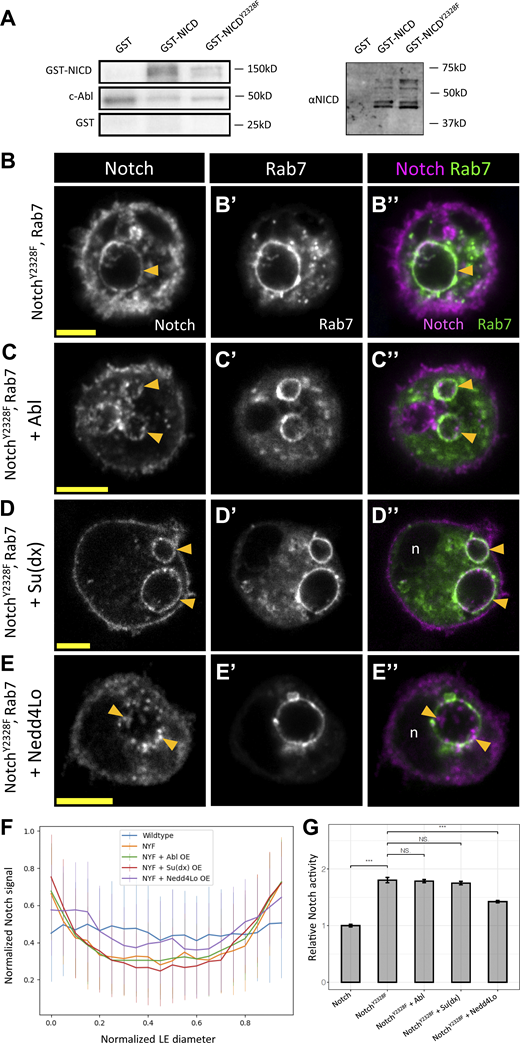
The NICD’s PPxY tyrosine integrates Abl, Su(dx), and Nedd4Lo-mediated regulation of Notch trafficking and signaling at LEs. (A) Left panel: In vitro kinase assay showing that recombinant c-Abl can phosphorylate the NICD, with some activity targeted to the Y2328 residue. Right panel: Western blot showing GST-NICD loading in samples evaluated on left panel. Only the more prevalent degradation products, but not the full-length GST-NICD band shown in the kinase assay panel, were detected with the anti-NICD antibody. (B–E″) Single confocal sections of representative S2 cells showing Notch (indirect immunofluorescence) and Rab7-EYFP. “n” marks the cell nucleus. Transfections shown: (B) NotchY2328F, (C) NotchY2328F + Abl, (D) NotchY2328F + Su(dx), and (E) NotchY2328F + Nedd4Lo. Scale bars = 5 µm. (F) Notch signal profiles across LE diameters in manipulations in B–E. Sample size (# of LEs evaluated): Notch (WT, N = 38), NotchY2328F (N = 43), NotchY2328F + Abl (N = 73), NotchY2328F + Su(dx) (N = 38), and NotchY2328F + Nedd4Lo (N = 52). (G) Relative Notch activity in manipulations in B–E. A t-student means comparison test was performed, and P values <0.05 (*), <0.01 (**), and <0.001(***) are indicated. Source data are available for this figure: SourceData F6.
The NICD’s PPxY tyrosine integrates Abl, Su(dx), and Nedd4Lo-mediated regulation of Notch trafficking and signaling at LEs. (A) Left panel: In vitro kinase assay showing that recombinant c-Abl can phosphorylate the NICD, with some activity targeted to the Y2328 residue. Right panel: Western blot showing GST-NICD loading in samples evaluated on left panel. Only the more prevalent degradation products, but not the full-length GST-NICD band shown in the kinase assay panel, were detected with the anti-NICD antibody. (B–E″) Single confocal sections of representative S2 cells showing Notch (indirect immunofluorescence) and Rab7-EYFP. “n” marks the cell nucleus. Transfections shown: (B) NotchY2328F, (C) NotchY2328F + Abl, (D) NotchY2328F + Su(dx), and (E) NotchY2328F + Nedd4Lo. Scale bars = 5 µm. (F) Notch signal profiles across LE diameters in manipulations in B–E. Sample size (# of LEs evaluated): Notch (WT, N = 38), NotchY2328F (N = 43), NotchY2328F + Abl (N = 73), NotchY2328F + Su(dx) (N = 38), and NotchY2328F + Nedd4Lo (N = 52). (G) Relative Notch activity in manipulations in B–E. A t-student means comparison test was performed, and P values <0.05 (*), <0.01 (**), and <0.001(***) are indicated. Source data are available for this figure: SourceData F6.
To test the functional significance of the PPxY tyrosine, we introduced a tyrosine to phenylalanine substitution to generate NotchY2328F. When transiently transfected into S2 cells, the enrichment of NotchY2328F at the limiting membrane of LEs (Fig. 6 B) was enhanced relative to WT Notch (Fig. 6 F and Table 3). Consistent with its enrichment at the LE membrane, signaling output from NotchY2328F was increased relative to WT Notch (Fig. 6 G). If the PPxY tyrosine provides a molecular target for Abl-mediated antagonism of Notch signaling, then NotchY2328F localization and activity should be insensitive to Abl overexpression. As predicted, neither the increased localization of NotchY2328F to LE membranes nor its elevated signaling output were modified by co-transfection of Abl (Fig. 6, C, F, and G; and Table 3). NotchY2328F localization and activity was also insensitive to Su(dx) overexpression (Fig. 6, D, F, and G; and Table 3), arguing that the Notch Y2328 is required for both the Abl- and Su(dx)-mediated LE internalization and signaling modulation.
In addition to mediating regulation by Abl and Su(dx), the NICD PPxY motif has also been implicated in Nedd4-mediated ubiquitination and degradation of Notch (Sakata et al., 2004; Wilkin et al., 2004). Nedd4 encodes two major isoforms, Nedd4short (Nedd4S) and Nedd4long (Nedd4Lo), which have been suggested to have distinct genetic requirements and cell biological functions (Zhong et al., 2011; Safi et al., 2016; Wasserman et al., 2019). We were therefore curious whether Nedd4 might also participate in Notch LE regulation, perhaps with different isoform specificity. To assess this, we examined the effects of Nedd4 depletion or overexpression on Notch LE localization and signaling in S2 cells. Although neither Nedd4 dsRNA nor expression of the short isoform (Nedd4S) altered Notch signaling (Fig. S3 F; and Fig. S5, A–A″ and D), expression of the long Nedd4 isoform (Nedd4Lo) significantly decreased signaling (Fig. S5 D) and enriched Notch localization to LE lumens (Fig. S5, A–C and Table 3). Consistent with the isoform specificity uncovered in S2 cells, overexpression of Nedd4Lo strongly induced excessive vein formation in 90% of wings, a phenotype consistent with reduced Notch activity, while Nedd4S only rarely perturbed the pattern (Fig. S5, E and F; and Table 1). Nedd4 knockdown also suppressed the ectopic vein formation induced by Abl overexpression (Table 1), suggesting that, like Su(dx), it may act downstream of Abl.

Nedd4Lo promotes Notch internalization into the LE lumen to attenuate signaling. (A–B″) Single confocal sections of representative S2 cells showing Notch (indirect immunofluorescence) and Rab7-EYFP. “n” marks the cell nucleus. Transfections shown: (A) Notch + Nedd4S and (B) Notch + Nedd4Lo. Scale bars = 5 µm. (C) Plot showing profiles of Notch levels across LE diameters in A and B. Sample size (# of LEs evaluated): Notch (WT, N = 38), Notch + Nedd4S (N = 27), and Notch + Nedd4Lo (N = 36). (D) Relative Notch activity in manipulations in A and B. A t-student means comparison test was performed, and P values <0.05 (*), <0.01 (**), and <0.001(***) are indicated. (E and F) en > Nedd4S and en > Nedd4Lo adult wings, respectively. Scale bars = 100 µm.
Nedd4Lo promotes Notch internalization into the LE lumen to attenuate signaling. (A–B″) Single confocal sections of representative S2 cells showing Notch (indirect immunofluorescence) and Rab7-EYFP. “n” marks the cell nucleus. Transfections shown: (A) Notch + Nedd4S and (B) Notch + Nedd4Lo. Scale bars = 5 µm. (C) Plot showing profiles of Notch levels across LE diameters in A and B. Sample size (# of LEs evaluated): Notch (WT, N = 38), Notch + Nedd4S (N = 27), and Notch + Nedd4Lo (N = 36). (D) Relative Notch activity in manipulations in A and B. A t-student means comparison test was performed, and P values <0.05 (*), <0.01 (**), and <0.001(***) are indicated. (E and F) en > Nedd4S and en > Nedd4Lo adult wings, respectively. Scale bars = 100 µm.
Returning to the S2 cells, we asked if the PPxY motif was necessary for Nedd4Lo-mediated regulation of Notch LE localization and signaling. In contrast to our finding that NotchY2328F was resistant to regulation by both Su(dx) and Abl, Nedd4Lo transfection led to a significant (∼20%) reduction in NotchY2328F signaling (Fig. 6 G). Consistent with the reduced signaling, LE luminal NotchY2328F localization was readily detected upon Nedd4Lo transfection (Fig. 6, E–E″ and Table 3). Given that Nedd4Lo reduced WT Notch signaling by ∼40% (Fig. S5 D), the ∼20% reduction in NotchY2328F signaling (Fig. 6 G) suggests that Nedd4Lo regulates Notch via both PPxY-dependent and -independent mechanisms. Together with the previous report of a partial requirement for the PPxY in the Nedd4-mediated ubiquitination of Notch (Sakata et al., 2004), our result offers a logical mechanistic connection between Notch ubiquitination, subcellular localization, and signaling. Altogether, our results highlight LEs and the PPxY motif as versatile regulatory hubs that can integrate multiple inputs to finely modulate Notch signaling output.
Discussion
Endocytic internalization and trafficking of transmembrane signaling receptors play key roles in modulating pathway output (Sigismund et al., 2012; Di Fiore and von Zastrow, 2014; Barbieri et al., 2016; Schmid, 2017). Given the Notch pathway’s distinctive lack of a cytoplasmic signaling cascade, regulation of receptor passage through endosomal compartments provides each cell, whether ligand-stimulated or not, with autonomous control over Notch levels and pathway activity (Fortini and Bilder, 2009; Baron, 2012; Palmer and Deng, 2015; Alfred and Vaccari, 2018; Schnute et al., 2018; Pagliaro et al., 2020; Revici et al., 2022). In this study, we identify the cytoplasmic tyrosine kinase Abl as a novel regulator of Notch trafficking and signaling. Our findings reveal a kinase-dependent role for Abl in promoting the clearance of endocytosed Notch and establish an unanticipated connection between Abl and a regulatory network of ubiquitin ligases that controls the topology, accessibility, and enrichment of Notch at LEs to modulate signaling output. We propose that LEs provide dynamic subcellular hubs, capable of integrating multiple regulatory inputs to finely tune Notch activity to levels optimal for specific cellular and developmental contexts.
Previous work has demonstrated the key role of E3 ubiquitin ligases in controlling Notch dynamics at LEs (Sakata et al., 2004; Wilkin et al., 2004, 2008; Yamada et al., 2011; Shimizu et al., 2014, 2024; Schnute et al., 2022), but the molecular events that control their activity have remained poorly understood (Conner, 2016). At the molecular level, Nedd4 family proteins use their WW domains to recognize and bind PPxY motifs within their substrates (Otte et al., 2003; Fedoroff et al., 2004; Ingham et al., 2004; Sakata et al., 2004; Jennings et al., 2007; Jung et al., 2014), an interaction involved in forming complexes such as Su(dx)/Nedd4-Notch in Drosophila and the analogous human WWP2-NOTCH3 (Sakata et al., 2004; Jennings et al., 2007; Jung et al., 2014). The connections between the ubiquitin ligase network and the Abl kinase uncovered in our study mark the Notch PPxY motif as an important molecular integration point for WW domain–based and tyrosine phosphorylation inputs that modulate Notch subcellular localization and signaling. Although we tried to generate an endogenous NotchY2328F allele via CRISPR/Cas9, the recovered heterozygous females were too sick and infertile to establish a genetic line. However, those flies exhibited a marked reduction in small thoracic bristle density (Sanchez-Luege, 2018), a phenotype suggestive of excessive Notch activity (Hartenstein and Posakony, 1990; Guo et al., 1996). Alternative genetic strategies will therefore be needed to explore how the Notch PPxY motif integrates kinase and ubiquitin ligase inputs to regulate trafficking and signaling in developing tissues.
While protein structure disruptions could underlie the insensitivity of NotchY2328F to LE regulators, we favor a model in which the phosphorylation state of the Notch PPxY motif influences its interaction with and regulation by Nedd4 family members. Prior work has shown that PPxY phosphorylation can either enhance or reduce a particular interaction (Otte et al., 2003; Gao et al., 2006; Liu et al., 2016). For example, phosphorylation of the c-Jun PPxY motif in T cells prevents Nedd4 family ligase binding, thereby protecting the transcription factor from degradation (Gao et al., 2006). c-Abl was implicated as the kinase, which, combined with our findings, hints at a role that might extend to diverse target proteins and biological contexts.
In contrast to the c-Abl/c-Jun relationship, our results suggest Abl-mediated phosphorylation of the Notch PPxY motif potentiates regulation by Nedd4 family ligases. By creating a more favorable interaction platform for Su(dx) or Nedd4Lo recruitment, phosphorylation could increase the probability of ubiquitination patterns that drive Notch into signaling-incompetent endosomal domains. Given that Su(dx) recognizes Notch using a unique WW4 domain absent in other Nedd4 family members (Fedoroff et al., 2004; Ingham et al., 2004), Su(dx) and Nedd4Lo might also have distinct PPxY motif phosphorylation preferences or affinities, enabling them to compete and collaborate in different ways. Therefore, in some situations, the activity of Abl on Notch might rely primarily on Su(dx) or on Nedd4Lo. In others, for example, the pupal wing epithelium, where RNAi knockdown of either Su(dx) or Nedd4 suppressed the ectopic vein phenotype associated with Abl overexpression (Table 1), contributions from multiple Nedd4 family ligases may be required.
Beyond mediating Abl-Nedd4 ligase interactions, the Notch PPxY motif could provide a molecular hub whose phosphorylated versus unphosphorylated states are read and acted upon by additional regulators. These could include tyrosine phosphatases, phosphotyrosine-binding proteins, WW domain–containing proteins, among others. By organizing diverse molecular complexes with different regulatory and signaling capabilities, these interactions could provide highly dynamic control of Notch activity. In addition, because Notch-Abl interactions have also been shown to influence Abl activity (Kannan et al., 2017; Koca et al., 2022), the possibility of multiple layers of feedback regulation offers essentially limitless opportunities for each cell to fine-tune its Notch levels, subcellular localization, and signaling output.
The NICD PPxY motif need not be the only target of Abl. For example, tyrosine phosphorylation of Nedd4 family proteins has been shown to relieve autoinhibitory mechanisms (Mund and Pelham, 2009; Dalton et al., 2011; Persaud et al., 2014). Therefore, Abl could facilitate the LE internalization of Notch by unlocking or enhancing the regulatory potential of Nedd4 ligases in more than one way. While the molecular events that mediate recognition of Nedd4 ligases by tyrosine kinases have not been elucidated, the latter typically use their Src homology (SH) domains to bind other proteins (Nash, 2013). Such interactions could facilitate targeting and tyrosine phosphorylation of NEDD4-1 by c-Src (Persaud et al., 2014), for example. Akin to Src, Abl possesses SH2 and SH3 domains (Colicelli, 2010), and, in particular, SH3 domains have been shown to bind proline-rich motifs in Nedd4 family ligases (Grabs et al., 1997; Baumann et al., 2010; Safi et al., 2016). In Drosophila, Nedd4Lo differs from Nedd4S in the presence of extra proline-rich regions in both its N-terminal and mid domains (Safi et al., 2016). In the case of the mid domain, the proline-rich region separates the WW1 from the WW2 and WW3 domains (Zhong et al., 2011; Safi et al., 2016), an organization similar to the separation of the Su(dx) WW3 and WW4 domains by a proline-rich region (Fedoroff et al., 2004). Hence, the unique molecular structure of certain Nedd4 family members, even at the isoform level, could nucleate specific complexes that interact with Notch in both PPxY-dependent and -independent manners.
In conclusion, we propose that the spatiotemporal patterning of Notch posttranslational modifications offers a versatile regulatory strategy to modulate endosomal trafficking and thereby tune Notch signaling levels to the particular cellular or developmental transition. In the developing wing, the enrichment of Abl and Su(dx) in cells flanking proveins (Fig. S1 K) (Bennett and Hoffmann, 1992; Cornell et al., 1999) suggests that tight regulation of LE trafficking may be critical to attenuating Notch signaling in cells that are exposed to high concentrations of ligand. On the other hand, the ubiquitous Notch trafficking defects observed in ablnull mutant wings, even outside of the vein areas (Fig. S2, A and B), imply that cells can use the endocytic pathway to modulate Notch activation even in the absence of ligand stimulus. LE regulation can thus provide a versatile system to adjust Notch signaling output in both ligand-induced and -independent contexts. Given prior work showing that the direction of Notch signaling modulation by its endocytic regulators can be context dependent (Shimizu et al., 2014), it will be interesting to explore how the Abl-mediated regulatory mechanism uncovered in our study contributes to Notch signaling in other biological contexts. As dysregulated Notch activity is a key feature in oncogenic disorders linked to dysfunction of Abl, Dx, Su(dx), and Nedd4 (Aljedai et al., 2015; Wang et al., 2017; Wen et al., 2017; Liu et al., 2021; Zhang et al., 2023), our study highlights cellular processes and molecular interactions that could be potential targets for therapeutic interventions.
Materials and methods
Drosophila genetics
Flies were raised on standard Drosophila food at 26°C unless otherwise noted. The following lines were used: abl1 (Henkemeyer et al., 1987), abl2 (Henkemeyer et al., 1987), abl-GFP (Nagarkar-Jaiswal et al., 2015), NRE-EGFP (30727; BDSC), Rab7-myc-EYFP (Dunst et al., 2015), en > Gal4, tub > Gal80 ts, UAS-deGradFP (Caussinus and Affolter, 2016), UAS-Abl-GFP (O’Donnell and Bashaw, 2013), UAS-AblK417N-GFP (O’Donnell and Bashaw, 2013), UAS-Flag-Dx (a gift from Spyros Artavanis-Tsakonas, Harvard Medical School, Boston, MA, USA) (Sharma et al., 2023), UAS-Su(dx) (15664; BDSC), UAS-Nedd4Short-Flag (81605; BDSC) (Zhong et al., 2011), UAS-Nedd4Long-Flag (81604; BDSC) (Zhong et al., 2011), UAS-Su(dx) RNAi (67012; BDSC), and UAS-Nedd4 RNAi (34741; BDSC). For UAS-driven genetic manipulations, crosses were established at 18°C, and individual animals were transferred to 26°C at 0 h APF. They were either dissected during early pupal development or allowed to grow to adulthood. To generate heat shock–driven abl clones in wing tissue, either y, w, hs > Flp; ubi-GFP, FRT80B/TM6Tb females were crossed to abl2, FRT80B/TM6Tb males or w, hs > Flp; ubi-RFP, FRT80B/TM6 females were crossed to abl2, Rab7-EYFP, and FRT80B/TM6 males. Parents laid eggs overnight, offspring were allowed to develop for 32 h before heat shock treatment at 37°C for 45 min, and heat-shocked animals were transferred back to 26°C until dissection.
Genotypes used for each figure:
Fig. 1 A; and Fig. 3, C and E: w1118
Fig. 1 B: en > gal4/+; abl2, UAS-deGradFp/abl-GFP
Fig. 1, C, E, and G; Fig. S1, A, D, F, and H; Fig. 2 A; and Fig. S2 A: NRE-GFP/+
Fig. 1, D, F, and H; Fig. S1, B, E, G, I, and J; Fig. 2 B; and Fig. S2 B: NRE-GFP/+; abl1/abl2
Fig. S1 K: abl-GFP/+
Fig. S2, C–E, and G: y, w, hs > Flp;; ubi-GFP, FRT80B/abl2, FRT80B
Fig. S2 F: y, w, hs > Flp;; ubi-RFP, FRT80B/abl2, Rab7-EYFP, FRT80B
Fig. 3 A: Rab7-EYFP/+
Fig. 3 B: abl1/abl2, Rab7-EYFP
Fig. 3, D and F: abl1/abl2
Fig. 4 H: en > gal4/+; UAS-Abl-GFP/+
Fig. 4 I: en > gal4/+; UAS-AblK417N-GFP/+
Fig. S4 H: en > gal4/UAS-Flag-Dx
Fig. S4 I: en > gal4/UAS-Su(dx)
Fig. 5 E: en > gal4/UAS-Nedd4Short-Flag
Fig. 5 F: en > gal4/UAS-Nedd4Long-Flag
Immunostaining of fly tissue, antibodies, and imaging
16–40 h APF wing dissections: pupae were decapitated, fixed in 4% PFA in PBS for 12–24 h at 4°C, washed 3×, and then dissected in PBS. Dissected wings were immediately blocked in 1% normal goat serum in PBT for 30 min at room temperature or overnight at 4°C, incubated overnight at 4°C with primary antibodies in PBT, washed 3× in PBT, incubated overnight with secondary antibodies at 4°C, washed 3× in PBT, and mounted in n-propyl gallate mounting medium. Pupal-stage wings were imaged on a Zeiss LSM 880 confocal microscope (using Zeiss software) using Plan Apochromat 20×/0.8 NA and 63×/1.4 NA objectives. The Airyscan function was used for Notch-Rab7 co-localization experiments.
GFP-tagged proteins were imaged using the endogenous fluorescent signal. Antibodies: mouse anti-NECD (1:100, C458.2H; Developmental Studies Hybridoma Bank [DHSB]), mouse anti-Delta (1:500, C594.9C; DHSB), guinea pig anti-Eps15 (Koh et al., 2007), anti-Hrs (Lloyd et al., 2002) (1:500, gifts from Hugo Bellen, Baylor College of Medicine, Houston, TX, USA), donkey anti-mouse Cy3 (1:2,000, Catalog 715-165-150; Jackson ImmunoResearch), donkey anti-mouse Alexa 488 (1:2,000, Catalogs 715-546-150; Jackson ImmunoResearch), donkey anti-guinea pig Cy3 (1:2,000, Catalog 706-165-148; Jackson ImmunoResearch), and Alexa488 (1:2,000, Catalog 706-545-168; Jackson ImmunoResearch). The acquired images were processed with Image J/Fiji.
Quantification and co-localization analysis of fly tissue images
The area of Notch+ (NECD+) cytoplasmic foci was quantified by measuring the maximal cross-sectional area in the X-Y plane for each structure, using the magic wand tool in Image J/Fiji with a threshold set to 40. To determine the frequency of Notch+ cytoplasmic foci, the number of Notch+ puncta per cell in 28 × 28-µm regions was calculated. These regions encompassed ∼55 and ∼65 cells in intervein and vein areas, respectively. 20 different regions were evaluated per genotype (WT and ablnull) and sub-tissue location (vein and intervein).
Co-localization analysis between Notch and endosomal markers was performed by calculating the Pearson’s correlation coefficient between Notch and endosome channels using the COLOC2 plug-in of Image J/Fiji. Regions of ∼100 cells were evaluated per wing, and 24 different wings were evaluated per genotype (WT and ablnull) and marker (Eps15, Hrs, and Rab7). A t-student means comparison test was performed to assess changes in the abundance of Notch at specific endosomal types (Pearson’s coefficients) across conditions.
Imaging of adult wings
Adult flies were fixed in 70% ethanol for 24 h, dissected in fresh 70% ethanol, and mounted in Permount mounting medium (SP15–100; Thermo Fisher Scientific). Samples were imaged on a Nikon Eclipse Ti2 microscope (using NIS-Elements software) using Plan Apochromat 2×/0.1 NA and Plan Apochromat 10×/0.45 NA objectives. The acquired images were processed with Image J/Fiji.
S2 cell transfection and dsRNA/imatinib treatments
S2 cells (Cat# 6; DGRC, PRID:CVCL-TZ72) were cultured in Schneider’s insect medium (catalog S9895-10X1L; Sigma-Aldrich) supplemented with penicillin and streptomycin at 25°C. For all assays, 2.25 × 10⁶ cells were transfected with dimethyldioctadecylammonium bromide (D2779-10G; Sigma-Aldrich), pMT expression plasmids, dsRNA, and empty vector to equalize the total amount of nucleic acid transfected, up to 1 µg. Transfection was conducted for 30 min, followed by incubation for 24 h at 25°C, before induction with 0.7 mM CuSO4 for 24 h at 25°C.
Plasmid and dsRNA transfection amounts: pMT-Notch (150 ng) (Shimizu et al., 2014), pMT-NotchY2328F (150 ng), pMT-Abl-Myc (250 ng) (Xiong et al., 2009), pMT-Flag-Dx (150 ng, the Dx sequence was subcloned from PMT-Venus-Dx [Shimizu et al., 2014] into a PMT-Flag vector [Tie et al., 2009]), pMT-Flag-Su(dx) (150 ng, the Su[dx] sequence was subcloned from PMT-HA-Su[dx] [Shimizu et al., 2014] into a PMT-Flag vector [Tie et al., 2009]), pMT-Flag-Nedd4S (150 ng) (Zhong et al., 2011), pMT-Flag-Nedd4Lo (150 ng) (Zhong et al., 2011), Abl dsRNA (350 ng), Su(dx) dsRNA (250 ng), Nedd4 dsRNA (250 ng), LacZ dsRNA (250–350 ng), pMT-EYFP-Rab7 (250 ng, a gift from Martin Baron, University of Manchester, Manchester, UK) (Shimizu et al., 2014), and pMT vector (DGRC 1145). Transcription assays also included 2 ng of NRE-Luciferase (Firefly) reporter (a gift from Sarah Bray, Cambridge University, Cambridge, UK) (Bray et al., 2005) and 20 ng of actin-Renilla (Bray et al., 2005) normalizing control. For imatinib mesylate treatment, imatinib mesylate solution in water was added to transfected cells at a final concentration of 50–100 μM at the time of induction.
For dsRNA preparation, target sequences from pMT-Abl-Myc, pMT-Su(dx)-Flag, pcDNA3-Flag-Nedd4Lo (a subcloning product in the assembly of pMT-Flag-Nedd4Lo by Daniela Rotin’s lab) (Zhong et al., 2011; Safi et al., 2016; Wasserman et al., 2019), and pSH 18–34 (for LacZ; Catalog V013222; NovoPro) were PCR-amplified using the following primers: 5′-TAATACGACTCACTATAGGGAGAAAAATTTGTTTGGCCTTTTCAA-3′ and 5′-TAATACGACTCACTATAGGGAGAACGGTCATCCTATATCTTTT-3′ for Abl dsRNA (Rohn et al., 2011), 5′-TAATACGACTCACTATAGGGAGATACATCACCCTCATGACG-3′ and 5′-TAATACGACTCACTATAGGGAGATCATTCCTGGCAGAAGCC-3′ for Su(dx) dsRNA (Wang et al., 2015), 5′-TAATACGACTCACTATAGGGAGAGTCACAATAGTATAGAGGACAA-3′ and 5′-TAATACGACTCACTATAGGGAGAGGTCGTTCTGCAAACTGGTC-3′ for Nedd4 dsRNA 1 (Farny et al., 2008), 5′-TAATACGACTCACTATAGGGAGACGACTTGAAGAGCAGCAACA-3′ and 5′-TAATACGACTCACTATAGGGAGATAGGTTCGTGTGGTTCACCA-3′ for Nedd4 dsRNA 2, and 5′-TAATACGACTCACTATAGGGAGATGTATGAACGGTCTGGTCTTTG-3′ and 5′-TAATACGACTCACTATAGGGAGAAATAAGGTTTTCCCCTGATGCT-3′ for LacZ dsRNA (Tokamov et al., 2021). Transcription of amplified sequences was done using the Ambion MEGAscript kit (Thermo Fisher Scientific), and subsequent purification was done via standard ethanol precipitation.
S2 cell–based subcellular localization and transcription/luciferase assays
For subcellular localization assays, cells were settled on poly-L-lysine–coated slides for 1 h at 25°C, fixed for 15 min in 4% PFA in PBS, washed 3× in PBS, incubated for 1 h at room temperature with primary antibodies in PBT+1% normal goat serum, washed 3× in PBS, incubated with secondary antibodies in PBT for 2 h at room temperature, washed 3× in PBS, mounted in n-propyl gallate mounting medium, and imaged on a Zeiss LSM 880 confocal microscope. The same antibodies used for fly tissue were used for S2 cell staining, and a minimum of 20 cells were imaged and considered for further examination.
For co-localization analysis between Notch and endosomal markers, we determined the Pearson’s coefficients from individual S2 cell, with an average of 20 different cells evaluated per genotype (WT and Abl dsRNA) and per endosomal marker (Eps15, Hrs, and Rab7). A t-student means comparison test was performed to assess changes in the abundance of Notch at specific endosomal types (Pearson’s coefficients) across conditions.
Profiles of Notch distribution across LE diameters were obtained from all LEs > 0.8 µm (N = 25–75) for each condition. Both the Notch signal and the LE diameter were normalized to a 0–1 scale to allow comparisons between experiments (custom Python script available upon request). Upon examination of a large set of Rab7-EYFP+ LEs across 10 different conditions, we defined the limiting membrane domains as 0–0.1 and 0.9–1 and the luminal region as 0.2–0.8 on the 0–1 LE diameter scale. For each individual LE, the average Notch value at the limiting membrane was divided by the average Notch value in the lumen, generating a membrane-to-lumen (M/L) ratio. M/L ratios were calculated for all LEs evaluated in a given condition, and a two-sided Kolmogorov–Smirnov test was performed to compare average M/L ratios across conditions.
Transcription assays were performed at least three times, with each experiment consisting of three biological replicates, and each biological replicate including three technical replicates. Cells were lysed in 100 mM potassium phosphate, 0.5% NP-40, and 1 mM DTT, pH7.8 for 1 h on ice. Lysates were loaded in triplicate into an Autolumat Plus LB 953 luminometer. Firefly and Renilla luciferases were activated in separate reactions using Firefly buffer (10 mM Mg acetate, 100 mM Tris acetate, 1 mM EDTA, 4.5 mM ATP, and 77 µM D-luciferin, pH 7.8) and Renilla buffer (25 mM sodium pyrophosphate, 10 mM Na acetate, 15 mM EDTA, 500 mM Na2SO4, 500 mM NaCl, and 4 mM coelenterazine, pH 5.0), respectively. The ratio of Firefly RLU to Renilla RLU was averaged across technical replicates, and activation values were normalized to Notch activity. A t-student means comparison test was performed to assess changes in relative Notch activity across conditions.
Molecular cloning of pGEX-NICD, pGEX-NICDY2328F, and pMT-NotchY2328F
pMT-NotchY2328F was made by subcloning the XhoI-XbaI NICD fragment from pMT-Notch into pBluescript. The Y2328F point mutation was introduced using QuickChange PCR using the following primers: 5′-AAGCAGCCGCCGAGCTTTGAGGATTGCATCAAG-3 and 5′-CTTGATGCAATCCTCAAAGCTCGGCGGCTGCTT-3′. The mutated XhoI-XbaI fragment, confirmed by sequencing, was cloned back into pMT-Notch to create pMT-NotchY2328F. WT and Y2328F XhoI-NotI NICD fragments were subcloned into the SalI-NotI–digested pGEX-4T-2 plasmid to create the bacterial expression constructs.
In vitro kinase assay
GST-fusion proteins were purified from BL21 Escherichia coli cells (Rebay and Fehon, 2009). Kinase assays were performed using murine c-Abl (P6050S; NEB) (Xiong et al., 2009). The relative intensity of full-length WT and Y2328F GST-NICD bands, as detected on western blots with mouse anti-NICD (1:1,000, C17.9C6; Developmental Studies Hybridoma Bank [DHSB]) antibody and IRDye 800CW goat anti-mouse (1:15,000, 926–32210; LICORbio), was used to estimate comparable amounts of substrate for the reactions. Reactions (20 μl) containing 1 μg of GST-fusion protein, kinase buffer (50 mM Tris-HCl, 10 mM MgCl2, 1 mM EGTA, 2 mM DTT, 0.01% Brij 35, pH 7.5, and 200 μM cold ATP), 1 μl of γ-32P ATP, and 1 μl NEB Abl were incubated for 30 min at 30°C. Samples were run on a 10% polyacrylamide gel, transferred to a PVDF membrane using standard methods, and exposed on a Storm phosphoimager prior to immunoblot analysis (mouse anti-NICD antibody [1:1,000]) to confirm protein loading.
Statistical analysis
Minimum and maximum values are represented as bars in all box plots, with individual data points displayed as dots. In lollipop plots, each dot represents a single data point. For bar graphs, error bars are included. All graphs were generated using RStudio 2024.12.0+467. In the case of LEs’ M/L ratios, average values per condition were calculated on Jupyter Notebook 6.5.4 using Python and are presented in Tables 2 and 3. Data distribution was assessed using histograms, and statistical significance was determined accordingly: for normal distributions, an unpaired two-tailed t test was used; for non-normal distributions, a pairwise two-sided Kolmogorov–Smirnov test was applied.
Online supplemental material
Fig. S1 compares Notch signaling and the establishment of vein pattern in WT versus ablnull wings at 18, 24, 26, and 38 h APF to support the conclusion that Abl is required to limit Notch signaling during wing vein patterning. Fig. S2 shows that abl loss does not generally disrupt endocytic trafficking. Fig. S3 shows that abl knockdown in S2 cells perturbs Notch trafficking and increases signaling. Fig. S4 shows that Abl and Su(dx) cooperate to promote Notch internalization into the LE lumen and limit signaling. Fig. S5 shows that Nedd4Lo, but not Nedd4S, can promote Notch internalization into the LE lumen and limit signaling.
Data availability
All data that support the findings of this study are available from Ilaria Rebay (irebay@uchicago) upon reasonable request.
Acknowledgments
We would like to thank Spyros Artavanis-Tsakonas, Wei Du (University of Chicago, Chicago, IL, USA), and Hitoshi Matakatsu (University of Chicago, Chicago, IL, USA) for fly strains; Sarah Bray, Martin Baron, and Daniela Rotin (University of Toronto, Toronto, Canada) for S2 cell expression plasmids; Hugo Bellen and Rick Fehon (University of Chicago, Chicago, IL, USA) for antibodies; and Lucy Godley (Northwestern University, Evanston, IL, USA) for imatinib mesylate. We also thank Hideyoshi Shimizu and Hitoshi Matakatsu for their advice on pupal wing dissection; Allison Zajac, Jacob Decker, and Jose Velarde for their advice on co-localization analysis; and Xiao Sun, Christine Cao, and Zach Baker for their experimental assistance. We also thank all members of the Rebay Lab, Rick Fehon, Chip Ferguson, Sally Horne-Badovinac, Aaron Turkewitz, and Paschalis Kratsios for their helpful discussions.
Author contributions: J. Miranda-Alban: conceptualization, data curation, formal analysis, investigation, methodology, resources, validation, visualization, and writing—original draft, review, and editing. N. Sanchez-Luege: conceptualization, data curation, formal analysis, investigation, methodology, resources, validation, visualization, and writing—original draft, review, and editing. F.M. Valbuena: investigation and writing—review and editing. C. Rangel: investigation. I. Rebay: conceptualization, funding acquisition, project administration, supervision, validation, and writing—review and editing.