TPX2 is an elongated molecule containing multiple α-helical repeats. It stabilizes microtubules (MTs), promotes MT nucleation, and is essential for spindle assembly. However, the molecular basis of how TPX2 performs these functions remains elusive. Here, we systematically characterized the MT-binding activities of all TPX2 modules individually and in combinations and investigated their respective contributions both in vitro and in cells. We show that TPX2 contains α-helical repeats with opposite preferences for “extended” and “compacted” tubulin dimer spacing, and their distinct combinations produce divergent outcomes, making TPX2 activity highly robust yet tunable. Importantly, a repeat group at the C terminus, R8-9, is the key determinant of the TPX2 function. It stabilizes MTs by promoting rescues in vitro and is critical in spindle assembly. We propose a model where TPX2 activities are spatially regulated via its diverse MT-binding repeats to accommodate its varied functions in distinct locations within the spindle. Furthermore, we reveal a synergy between TPX2 and HURP in stabilizing spindle MTs.
Introduction
The mitotic spindle is a dynamic array of microtubules (MTs) that ensure faithful chromosome segregation during cell division. Spindle assembly is tightly controlled by a variety of MT-associated proteins (MAPs) (Heald and Khodjakov, 2015; Kapoor, 2017; Prosser and Pelletier, 2017; Valdez et al., 2023b).
A key player in spindle assembly is TPX2, which was initially identified in Xenopus as a targeting protein for Xklp2. Depletion of TPX2 from the Xenopus egg extract resulted in a bipolar spindle with decreased MT density and disintegrating poles (Wittmann et al., 1998, 2000). Moreover, TPX2 was the best-characterized Ran-dependent spindle assembly factor in Xenopus, playing significant roles in local MT generation around chromatin (Gruss et al., 2001; Schatz et al., 2003; Trieselmann et al., 2003; Tsai et al., 2003; Brunet et al., 2004). Ran-GTP releases TPX2 from the inhibition of importin α/β. In human cells, knockdown of TPX2 caused mitotic arrest and severe spindle defects, including monopolar spindles, fragmented spindles, and prometaphase-like spindles (Garrett et al., 2002; Gruss et al., 2002; Kufer et al., 2002). In vitro works with purified proteins have demonstrated that TPX2 promotes MT nucleation and stabilizes MTs by promoting rescue (switch from depolymerization to polymerization), suppressing catastrophe (switch from polymerization to depolymerization), and slowing down depolymerization (Schatz et al., 2003; Brunet et al., 2004; Roostalu et al., 2015; Wieczorek et al., 2015; Reid et al., 2016). Despite these advances, the molecular basis of how TPX2 performs these functions remains elusive.
TPX2 is an elongated molecule that consists of multiple α-helical repeats and lacks a defined folded domain (Sanchez-Pulido et al., 2016; Alfaro-Aco et al., 2017). Early in vitro work showed that TPX2 bound preferentially to growing MT ends and to guanosine 5′, α-β-methylene triphosphate (GMPCPP)-stabilized MT lattices (Roostalu et al., 2015; Reid et al., 2016). Later, we and others reported conflicting results, showing that TPX2 displayed biased enrichment toward older regions of GDP-MT lattices (Thawani et al., 2019; Huang et al., 2021). The discrepancy is not trivial, as it affects how we understand the exact mechanism of action of TPX2 on MTs. Given that multiple MT-binding sites reside in the N terminus, central part, or C terminus of TPX2 (Schatz et al., 2003; Trieselmann et al., 2003; Brunet et al., 2004; Zhang et al., 2017), one possible explanation for the discrepancy is that the combined effects of different MT-binding modules are manifested differently under slightly altered conditions. Therefore, systematic characterization of the MT-binding activities of all individual TPX2 modules and combinations and their respective contributions may help resolve this puzzle, but it is currently lacking.
The importance of TPX2’s N-terminal and C-terminal halves differs in vitro and in vivo, further obscuring our understanding of its molecular mechanisms. In vitro experiments with purified proteins showed that a large N-terminal fragment of TPX2 (1–512aa in human) promoted MT nucleation in a bulk assay and at a single MT level, while a large C-terminal fragment of TPX2 (350–747aa in human) failed to do so (Brunet et al., 2004; Wieczorek et al., 2015). However, in the Xenopus egg extract, the minimal fragment retaining the functions of the full-length (FL) protein in spindle assembly and branching nucleation resides in the C-terminal half, while the N-terminal half is dispensable (Brunet et al., 2004; Alfaro-Aco et al., 2017). Moreover, in human cells, the Ran–importin pathway does not affect the localization and possibly also the function of TPX2 (Tsuchiya et al., 2021), although in vitro experiments have shown that importin α/β, which binds to the two nuclear localization sequences (NLSs) of TPX2 (residues 158–161 and 313–315) located within the N-terminal half, can inhibit the MT-binding and nucleation activities of TPX2 (Schatz et al., 2003; Kahn et al., 2015; Roostalu et al., 2015; Eibes et al., 2018; Safari et al., 2021). This further suggests that the C-terminal half rather than the N-terminal half plays a predominant role in vivo; however, the exact underlying mechanism remains poorly understood.
Hepatoma up-regulated protein (HURP) is another Ran-dependent factor that is required for chromatin-mediated spindle MT assembly in Xenopus egg extracts and mammalian cells (Koffa et al., 2006; Silljé et al., 2006; Wong and Fang, 2006; Casanova et al., 2008). During mitosis, it predominantly localizes to and stabilizes the kinetochore–MTs (k-fibers) in the vicinity of chromosomes. Recently, it has been reported that HURP preferentially binds to the GDP-MT lattices and it can stabilize MTs by decreasing the catastrophe frequency and increasing the rescue frequency in vitro (Castrogiovanni et al., 2022). Although HURP and TPX2 share many similarities, whether a functional connection exists between the two proteins is not yet known.
Here, utilizing bioinformatic analysis, in vitro reconstitution, and the auxin-inducible degron (AID) system, we systematically analyzed the MT-binding activities of all individual TPX2 modules and combinations and evaluated their respective contributions both in vitro and in cells. We show that the “extended tubulin dimer spacing”–preferring and “compacted tubulin dimer spacing”–preferring α-helical repeats coexist in the TPX2 molecule, and their distinct combinations lead to different outcomes. Importantly, the functionality of TPX2 is primarily determined by the repeat group R8-9, which exhibits a preference for compacted tubulin dimer spacing and is situated on the C-terminal region of the protein. R8-9 serves to stabilize MTs by facilitating rescues in vitro and plays a critical role in spindle assembly within cells. Based on these results, we propose a model of varied regulation of TPX2 activities at distinct spatial locations within the spindle through its diverse MT-binding repeats. Additionally, comparative analysis demonstrates that TPX2 is a more powerful MT stabilizer than HURP. We further find that TPX2 and HURP collaborate in promoting spindle assembly in cells and work synergistically to stabilize MTs in vitro.
Results
Systematic dissection of the MT-binding activities of all TPX2 modules
Previous computational sequence analyses and structural predictions have shown that the C-terminal part of TPX2 family proteins contained a variable number of α-helical tandem repeats (Sanchez-Pulido et al., 2016; Alfaro-Aco et al., 2017). Nine repeats were found in human TPX2 spanning residues 222–746 (Sanchez-Pulido et al., 2016). In addition, the crystal structure of the Aurora A–binding domain of TPX2 encompassing residues 1–43 has been resolved (Bayliss et al., 2003). To investigate further, we performed a secondary structure analysis on the rest of human TPX2 (residues 50–200) using Jalview (Waterhouse et al., 2009). A similar α-helix was found within this part, spanning residues 126–144 (Fig. S1 A). In this study, we renamed the repeats to include the newly identified one and redefined the repeat boundaries by putting the α-helix in the middle of the sequence instead of in the N terminus as previously reported (Sanchez-Pulido et al., 2016) (Fig. 1 A; and Fig. S1, A and B).

Structural analysis of TPX2 proteins. (A) Sequence alignment of TPX2 in five vertebrate species and secondary structure analysis of human TPX2 using Jalview. The α-helix is marked with a red bar under each repeat. Critical MT-binding residues within human TPX2 repeats identified in this study are marked with red arrowheads. (B) Sequence alignment of 10 tandem repeats in human TPX2. The red bar below indicates a summary of predictions for the α-helix.

Structural analysis of TPX2 proteins. (A) Sequence alignment of TPX2 in five vertebrate species and secondary structure analysis of human TPX2 using Jalview. The α-helix is marked with a red bar under each repeat. Critical MT-binding residues within human TPX2 repeats identified in this study are marked with red arrowheads. (B) Sequence alignment of 10 tandem repeats in human TPX2. The red bar below indicates a summary of predictions for the α-helix.

Systematic dissection of the MT-binding activities of all TPX2 modules. (A) Schematic overview of TPX2 organization with the boundaries of 10 α-helical tandem repeats shown at the bottom. (B and C) Images showing the behavior of indicated GFP-LZ–tagged TPX2 repeats or N99 (green) at 200 nM (B) or 2 µM (C) on dynamic MTs (red) grown in assay buffer containing no KCl. w/o KCl, without KCl. (D) Time-lapse images and the corresponding kymograph showing modest enrichment of 200 nM GFP-LZ-TPX2 R8 (green) at the growing MT end. (E and F) Quantification of intensities of indicated GFP-LZ–tagged TPX2 repeats or N99 at 200 nM (E) or 2 µM (F) on GMPCPP seeds and GDP-MT lattices. n = 13–14 MTs from two experiments. N.D., not detected. (G) Top, images and corresponding kymographs showing the behavior of GFP-LZ-TPX2 R8 or R8-9 (green) at indicated concentrations on dynamic MTs (red). Bottom, corresponding fluorescence intensity profiles of MT (red) and GFP-LZ-TPX2 R8 or R8-9 (green) obtained from a line scan along the MT. (H) Quantification of intensities of GFP-LZ-TPX2 R8 or R8-9 at indicated concentrations on GMPCPP seeds and GDP-MT lattices. n = 16–37 MTs from two experiments. N.D., not detected. Horizontal scale bars, 2 µm; vertical scale bars, 2 min. Data represent mean ± SD.
Systematic dissection of the MT-binding activities of all TPX2 modules. (A) Schematic overview of TPX2 organization with the boundaries of 10 α-helical tandem repeats shown at the bottom. (B and C) Images showing the behavior of indicated GFP-LZ–tagged TPX2 repeats or N99 (green) at 200 nM (B) or 2 µM (C) on dynamic MTs (red) grown in assay buffer containing no KCl. w/o KCl, without KCl. (D) Time-lapse images and the corresponding kymograph showing modest enrichment of 200 nM GFP-LZ-TPX2 R8 (green) at the growing MT end. (E and F) Quantification of intensities of indicated GFP-LZ–tagged TPX2 repeats or N99 at 200 nM (E) or 2 µM (F) on GMPCPP seeds and GDP-MT lattices. n = 13–14 MTs from two experiments. N.D., not detected. (G) Top, images and corresponding kymographs showing the behavior of GFP-LZ-TPX2 R8 or R8-9 (green) at indicated concentrations on dynamic MTs (red). Bottom, corresponding fluorescence intensity profiles of MT (red) and GFP-LZ-TPX2 R8 or R8-9 (green) obtained from a line scan along the MT. (H) Quantification of intensities of GFP-LZ-TPX2 R8 or R8-9 at indicated concentrations on GMPCPP seeds and GDP-MT lattices. n = 16–37 MTs from two experiments. N.D., not detected. Horizontal scale bars, 2 µm; vertical scale bars, 2 min. Data represent mean ± SD.
Next, we set out to analyze the MT-binding activities of all TPX2 modules systematically. 10 repeats and the N-terminal nonrepeat region N99 (residues 1–99) were fused with a dimeric coiled coil (leucine zipper [LZ]) of GCN4 to enhance protein affinity for MTs and with a Strep-GFP tag for imaging and purification. All TPX2 modules purified from HEK293T cells were then examined in the in vitro MT dynamics assays where the assay buffer contained no KCl. At 200 nM, LZ-R1 and LZ-R4 showed strong binding to MT lattices, but the former bound equally well to both GMPCPP-stabilized MT seeds and dynamic GDP-MTs grown from seeds, while the latter showed a previously documented high preference for GMPCPP seeds (Zhang et al., 2017); LZ-R8 showed weak binding to MT lattices but sometimes a modest enrichment at the growing ends; virtually, no MT binding was detected for the remaining fragments at this concentration (Fig. 1, B, D, and E; and Video 1). When the concentration was elevated to 2 µM, LZ-R3, LZ-R5, and LZ-R10 also displayed weak binding to MT lattices and they showed a preference for GMPCPP seeds to different extents, with LZ-R10 being most pronounced; LZ-R8 strongly decorated MT lattices, and its intensity along GDP lattices was ∼2.5-fold higher than that of GMPCPP lattices; even at such a high concentration, LZ-N99, LZ-R2, LZ-R6, LZ-R7, and LZ-R9 were still incapable of binding to MTs (Fig. 1, C and F).
Modest enrichment of LZ-TPX2 R8 at the growing MT end in vitro. MTs were polymerized in the presence of GFP-LZ-TPX2 R8 (200 nM) purified from nocodazole-arrested mitotic HEK293T cells. Images were acquired with a TIRF microscope at 2-s intervals. The video is sped up by 60 times (30 frames/s). Time is shown in the format min:s. Scale bars, 2 μm. Related to Fig. 1 D.
Modest enrichment of LZ-TPX2 R8 at the growing MT end in vitro. MTs were polymerized in the presence of GFP-LZ-TPX2 R8 (200 nM) purified from nocodazole-arrested mitotic HEK293T cells. Images were acquired with a TIRF microscope at 2-s intervals. The video is sped up by 60 times (30 frames/s). Time is shown in the format min:s. Scale bars, 2 μm. Related to Fig. 1 D.
The systematic analysis above revealed that the R8 repeat exhibited a tendency for MT end binding and a preference for GDP-MT lattices in a concentration-dependent manner. Next, we examined the influence of its adjacent repeats on this property. We found that the R8 repeat, in combination with the R9 repeat (LZ-R8-9), could readily bind growing MT plus and minus ends at a low nanomolar concentration (5 nM). Interestingly, R8-9 accumulation was more pronounced on curved MT ends (Fig. 1, G and H; and Video 2). In contrast, R8 alone at the same concentration failed to display any MT localization (Fig. 1, G and H). At concentrations between 50 and 200 nM, R8-9 preferred GDP-MT lattices and showed much stronger binding along MT lattices than R8 alone (Fig. 1, G and H). These results demonstrate that R9 could enhance the MT-binding affinity of R8. It is worth mentioning that a TPX2 fragment, TPX2mini (residues 274–659), which contains R4-9, can localize to growing MT ends in vitro (Roostalu et al., 2015). However, this property was previously attributed to TPX2micro (residues 274–370, corresponding to R4 in this study) (Zhang et al., 2017). Here, we provide direct evidence that it is not the GMPCPP-MT–preferring R4 but the GDP-MT–preferring R8-9 that is responsible for the end-binding property of TPX2.
LZ-TPX2 R8-9 shows strong accumulation on curved MT ends in vitro. MTs were polymerized in the presence of GFP-LZ-TPX2 R8-9 (5 nM) purified from nocodazole-arrested mitotic HEK293T cells. Images were acquired with a TIRF microscope at 2-s intervals. The video is sped up by 60 times (30 frames/s). Time is shown in the format min:s. Scale bars, 2 μm. Related to Fig. 1 G.
LZ-TPX2 R8-9 shows strong accumulation on curved MT ends in vitro. MTs were polymerized in the presence of GFP-LZ-TPX2 R8-9 (5 nM) purified from nocodazole-arrested mitotic HEK293T cells. Images were acquired with a TIRF microscope at 2-s intervals. The video is sped up by 60 times (30 frames/s). Time is shown in the format min:s. Scale bars, 2 μm. Related to Fig. 1 G.
To get further insight into the mode of R8-9 binding to MTs, we first performed flow-in experiments. GMPCPP seeds were elongated in the presence of tubulin for 5 min. Subsequently, the reaction mixture containing LZ-R8-9 and tubulin was flowed into the chamber with pre-assembled dynamic MTs. MT buckling frequently appeared because of the mechanical strain caused by the solution exchange. We noticed that LZ-R8-9 strongly accumulated along the curved regions of GDP-MTs and the growing ends (Fig. 2, A–C). Then, we investigated the localization of R8-9 in MRC5 cells and found that GFP-tagged LZ-R8-9 prominently decorated MTs in interphase. However, upon paclitaxel treatment, its intensity along MTs was dramatically decreased (Fig. 2, D and E; and Video 3). Based on the in vitro and cellular experiments, R8-9 exhibited the lowest affinity for GMPCPP- or paclitaxel-MT lattice, higher for straight GDP-MT lattice, and highest for curved GDP-MTs or MT ends. The binding affinity seemed to correlate with the inter-tubulin dimer spacing of these structures because the GDP-MT lattice had a more compacted spacing than the GMPCPP- or paclitaxel-MTs (Alushin et al., 2014), and protofilaments on interior curvature of curved GDP-MTs or MT ends were, in theory, in an even more compacted state (Ettinger et al., 2016). Therefore, we propose that MTs with relatively compacted tubulin dimer spacing may be the optimal binding site for R8-9.

R8-9 and R4 or R10 displayed opposite preferences for tubulin dimer spacing. (A) Images showing the preferential binding of GFP-LZ-TPX2 R8-9 (5 nM) to curved segments of dynamic GDP-MT lattices and MT end in a flow-in assay. (B) Line-scan intensity profiles of TPX2 R8-9 (green) and MT (red) corresponding to the dashed curved lines in A. (C) Quantification of intensities of 5 nM GFP-LZ-TPX2 R8-9 on straight GDP-MT, curved GDP-MT, MT ends, and GMPCPP-MT. n = 47–50 MTs from two experiments. (D and E) TIRF microscopy images of live MRC5 cells expressing GFP-LZ-TPX2 R8-9 together with mCherry-α-tubulin before (upper panels) or after (lower panels) the addition of 1 µM paclitaxel (D). Quantification of the fluorescence intensities of GFP-LZ-TPX2 R8-9 on MTs without or with paclitaxel treatment (E). n = 4 experiments (∼70 MTs were measured). ***P < 0.001, two-tailed t test (paired). (F–H) Images showing the behavior of GFP-LZ–tagged TPX2 R8-9 (F), R4 (G), and R10 (H) (green) at 200 nM or 2 µM on dynamic MTs (red) in the absence or the presence of 1 µM SiR-tubulin (blue). (I) Quantification of intensities of GFP-LZ–tagged TPX2 R8-9, R4, and R10 at 200 nM or 2 µM on GMPCPP seeds and GDP-MT lattices. n = 20 MTs from two experiments. N.D., not detected. (J) Images showing the behavior of GFP-LZ–tagged TPX2 R8-9 (green) at 200 nM on dynamic MTs (blue) alone or together with mCherry-LZ–tagged TPX2 R4 (red) at 200 nM or 1 µM. (K) Quantification of the intensities of GFP-LZ–tagged TPX2 R8-9 on GMPCPP seeds and GDP-MT lattices. n = 20 MTs from two experiments. Scale bars, 2 μm. Data represent mean ± SD.
R8-9 and R4 or R10 displayed opposite preferences for tubulin dimer spacing. (A) Images showing the preferential binding of GFP-LZ-TPX2 R8-9 (5 nM) to curved segments of dynamic GDP-MT lattices and MT end in a flow-in assay. (B) Line-scan intensity profiles of TPX2 R8-9 (green) and MT (red) corresponding to the dashed curved lines in A. (C) Quantification of intensities of 5 nM GFP-LZ-TPX2 R8-9 on straight GDP-MT, curved GDP-MT, MT ends, and GMPCPP-MT. n = 47–50 MTs from two experiments. (D and E) TIRF microscopy images of live MRC5 cells expressing GFP-LZ-TPX2 R8-9 together with mCherry-α-tubulin before (upper panels) or after (lower panels) the addition of 1 µM paclitaxel (D). Quantification of the fluorescence intensities of GFP-LZ-TPX2 R8-9 on MTs without or with paclitaxel treatment (E). n = 4 experiments (∼70 MTs were measured). ***P < 0.001, two-tailed t test (paired). (F–H) Images showing the behavior of GFP-LZ–tagged TPX2 R8-9 (F), R4 (G), and R10 (H) (green) at 200 nM or 2 µM on dynamic MTs (red) in the absence or the presence of 1 µM SiR-tubulin (blue). (I) Quantification of intensities of GFP-LZ–tagged TPX2 R8-9, R4, and R10 at 200 nM or 2 µM on GMPCPP seeds and GDP-MT lattices. n = 20 MTs from two experiments. N.D., not detected. (J) Images showing the behavior of GFP-LZ–tagged TPX2 R8-9 (green) at 200 nM on dynamic MTs (blue) alone or together with mCherry-LZ–tagged TPX2 R4 (red) at 200 nM or 1 µM. (K) Quantification of the intensities of GFP-LZ–tagged TPX2 R8-9 on GMPCPP seeds and GDP-MT lattices. n = 20 MTs from two experiments. Scale bars, 2 μm. Data represent mean ± SD.
Paclitaxel treatment reduces the affinity of LZ-TPX2 R8-9 for MTs in cells. MRC5 cells were cotransfected with GFP-LZ-TPX2 R8-9 and mCherry-α-tubulin. Paclitaxel was added to the medium for a final concentration of 1 μΜ. Images were acquired with a TIRF microscope in a stream mode (300 ms/frame). The video is sped up by 15 times (50 frames/s). Time is shown in the format sec. Scale bars, 5 μm. Related to Fig. 2 D.
Paclitaxel treatment reduces the affinity of LZ-TPX2 R8-9 for MTs in cells. MRC5 cells were cotransfected with GFP-LZ-TPX2 R8-9 and mCherry-α-tubulin. Paclitaxel was added to the medium for a final concentration of 1 μΜ. Images were acquired with a TIRF microscope in a stream mode (300 ms/frame). The video is sped up by 15 times (50 frames/s). Time is shown in the format sec. Scale bars, 5 μm. Related to Fig. 2 D.
In contrast, judging from their preference for GMPCPP-MTs, R4 and R10 likely preferred MTs with extended tubulin dimer spacing, and the binding affinity was high for R4 but low for R10. Supportively, the previous cryo-EM structure of TPX2micro (R4 in this study) suggests that it antagonizes MT lattice compaction (Zhang et al., 2017). To strengthen the idea that R8-9 and R4 or R10 displayed opposite preferences for tubulin dimer spacing, we performed in vitro dynamics assays in the absence or the presence of SiR-tubulin, a docetaxel-based fluorescent dye that increases MT lattice spacing reversibly. The presence of SiR-tubulin led to a 35–50% reduction in the intensities of LZ-R8-9 along GDP-MTs (Fig. 2, F and I), while intensities of LZ-R4 increased by 70–260% (Fig. 2, G and I). These changes occurred at concentrations ranging from 200 nM to 2 µM compared to conditions without SiR-tubulin. Consistent with the data shown in Fig. 1 B, no binding of LZ-R10 to MTs was detected at 200 nM (Fig. 2 H). At a high concentration of 2 µM, only weak binding to GMPCPP lattices was observed in the absence of SiR-tubulin (Fig. 1 C and Fig. 2 H). However, when SiR-tubulin was present, LZ-R10 binding to GMPCPP-MTs became evident at 200 nM (Fig. 2 H). Furthermore, at 2 µM, its binding to GMPCPP-MTs increased by ∼80% compared to the conditions without SiR-tubulin, and binding along GDP-MTs became apparent (Fig. 2, H and I). We then examined whether R4 could influence the binding of R8-9. We found that LZ-R4 at 200 nM had little impact on the intensity of LZ-R8-9 at 200 nM along GDP-MTs, whereas LZ-R4 at 1 µM reduced the intensity of LZ-R8-9 at 200 nM by ∼50% (Fig. 2, J and K). This suggests that R4 not only favors greater spacing of tubulin dimers but may also promote lattice extension, potentially hindering the binding of R8-9.
Besides R8-9, R4, and R10, our results above revealed that R3 and R5 showed only a slight preference for MTs with extended tubulin dimer spacing with low affinity. For R1, no selectivity for MT geometry was found, and it bound the whole MT with high affinity. The remaining repeats, including R2, R6, and R7, as well as N99, by themselves could be regarded as MT binding–incompetent, at least under our tested conditions. To summarize, our systematic analysis revealed that TPX2 contained a complicated array of repeats that recognize distinct MT lattice spacing (Fig. S2 A).

Schematic overview of MT-binding properties of TPX2 single repeats or repeat combinations. (A) Schematic overview of N99 and all 10 α-helical tandem repeats of TPX2 and summary of their GMPCPP- or GDP-MT–binding activities. (B) Schematic overview of the TPX2 repeat combinations and summary of their MT lattice or end-binding activities.

Schematic overview of MT-binding properties of TPX2 single repeats or repeat combinations. (A) Schematic overview of N99 and all 10 α-helical tandem repeats of TPX2 and summary of their GMPCPP- or GDP-MT–binding activities. (B) Schematic overview of the TPX2 repeat combinations and summary of their MT lattice or end-binding activities.
R4-10 recapitulates the MT-binding characteristics of FL TPX2 in vitro
Given that the extended tubulin dimer spacing–preferring and compacted tubulin dimer spacing–preferring repeats coexist in the TPX2 molecule, we then examined their combined outcome. To this end, we made a series of combined repeats without fusing with an additional LZ and performed the in vitro dynamics MT assays under our standard buffer condition, which contained 50 mM KCl. Under such conditions, R8-9 failed to display any MT localization at 200 nM and showed a weak enrichment at MT ends at 1 µM (Fig. 3, A and H). Similar behavior was observed with R5-9 (Fig. 3, B and H), suggesting that the addition of R5-7 may not improve the binding affinity of R8-9 to MTs. This is expected because R5, R6, and R7 showed relatively weak or undetectable MT binding in the systematic analysis. Further addition of either R4 or R10 to R5-9 could facilitate its MT end enrichment at lower concentrations (200 nM) and dramatically increase its nonuniform patch-like accumulation along GDP lattices at a high concentration (1 µM; compare R5-9 with R5-10 and R4-9; Fig. 3, B–D and H; and Fig. S2 B). These data suggest that the presence of a single extended tubulin dimer spacing–preferring repeat, R4 or R10, would not impair but instead promote the binding of R8-9 to MTs with compacted tubulin dimer spacing. However, R4-10, in which both R4 and R10 were present, behaved distinctly differently. The phenomenon of end enrichment was not observed for R4-10 over a broad range of concentrations from 50 nM to 1 µM (Fig. 3, E–H and Fig. S2 B). Interestingly, R4-10 showed time-dependent accumulation and hence the biased distribution toward older regions of GDP lattices; especially at 50 nM, the progressive increase in the intensity of R4-10 puncta was most evident (Fig. 3, E–G). A similar bias toward older GDP-MT regions was previously reported for FL TPX2 (Thawani et al., 2019; Huang et al., 2021). Collectively, these data suggest that two extended tubulin dimer spacing–preferring repeats, R4 and R10, in combination with one compacted tubulin dimer spacing–preferring module, R8-9, were able to recapitulate the MT-binding characteristics of FL TPX2 in vitro, which further supports the in vitro behavior of FL TPX2 observed by us and others, while also providing insights into the molecular basis underlying TPX2’s preference for “older” MTs.

R4-10 recapitulates the MT-binding characteristics of FL TPX2 in vitro. (A–E) Images and corresponding kymographs showing the behavior of indicated GFP-tagged TPX2 repeat combinations at indicated concentrations on dynamic MTs grown in our standard assay buffer containing 50 mM KCl. Arrows in A indicate the end localization of R8-9. (F) Line-scan intensity profiles of GFP-TPX2 R4-10 (green) and MT (red) corresponding to the white horizontal dashed lines in E. (G) Plots of the average intensity of GFP-TPX2 R4-10 at indicated concentrations on a 2-µm-long segment of GDP-MT as in E (between two vertical dashed lines) against time. The values were normalized to the maximum intensity of 1 µM GFP-TPX2 R4-10. n = 10–20 MTs from two experiments. (H) Quantification of intensities of indicated GFP-tagged TPX2 repeat combinations at 200 nM (top) or 1 µM (bottom) on GMPCPP seeds and GDP-MT lattices. The values were normalized to the intensity of 1 µM GFP-TPX2 R4-10 on GDP-MT lattices. n = 13–14 MTs from two experiments. N.D., not detected. Horizontal scale bars, 2 µm; vertical scale bars, 2 min. Data represent mean ± SD.
R4-10 recapitulates the MT-binding characteristics of FL TPX2 in vitro. (A–E) Images and corresponding kymographs showing the behavior of indicated GFP-tagged TPX2 repeat combinations at indicated concentrations on dynamic MTs grown in our standard assay buffer containing 50 mM KCl. Arrows in A indicate the end localization of R8-9. (F) Line-scan intensity profiles of GFP-TPX2 R4-10 (green) and MT (red) corresponding to the white horizontal dashed lines in E. (G) Plots of the average intensity of GFP-TPX2 R4-10 at indicated concentrations on a 2-µm-long segment of GDP-MT as in E (between two vertical dashed lines) against time. The values were normalized to the maximum intensity of 1 µM GFP-TPX2 R4-10. n = 10–20 MTs from two experiments. (H) Quantification of intensities of indicated GFP-tagged TPX2 repeat combinations at 200 nM (top) or 1 µM (bottom) on GMPCPP seeds and GDP-MT lattices. The values were normalized to the intensity of 1 µM GFP-TPX2 R4-10 on GDP-MT lattices. n = 13–14 MTs from two experiments. N.D., not detected. Horizontal scale bars, 2 µm; vertical scale bars, 2 min. Data represent mean ± SD.
Uncovering functional residues of all 10 TPX2 repeats
To better understand the significance of distinct TPX2 repeats, we then set out to uncover critical residues involved in these MT-binding activities. All 10 repeats were mutated, and the mutants were examined in the in vitro dynamics MT assays (Fig. S3 A). For repeats that displayed MT-binding activities in the systematic analysis, including R1, R3, R4, R5, R8, and R10, they were mutated in the context of a single repeat (Fig. S3 B). For repeats that seemed to be MT binding–incompetent by themselves, including R2, R6, R7, and R9, they were mutated in the context of combined repeats to assess their potential contribution to the MT-binding activities of adjacent repeats. To this end, repeats were grouped as R1-3, R4, R5-7, R8-9, and R10 according to their MT-binding characteristics. Then, R2, R6, R7, and R9 regions individually were mutated in the context of R1-3, R5-7, R5-7, and R8-9 repeat groups, respectively (Fig. S3 C). Since two key residues located in R4, F307 and F334, were previously reported to be important for TPX2–MT interaction (Zhang et al., 2017), we first mutated corresponding phenylalanine residues or other hydrophobic residues in other repeats. If such substitution had no effect, then the conserved positively charged residues within the helix or in its vicinity were chosen (Fig. S3 A). Using this strategy, critical residues, the substitution of which by alanine could dramatically reduce the binding affinity of corresponding repeats or repeat groups for MTs, were identified in all 10 repeats (Fig. S3, A–C and E). In addition, MT binding was hardly observed for the R1-3, R5-7, or R8-9 groups harboring a simultaneous mutation of all component repeats (Fig. S3, D and E), further validating the importance of the residues identified above.

Uncovering functional residues of all 10 TPX2 repeats. (A) Schematic overview of critical residues in all 10 repeats of TPX2 based on mutational analyses, where substitution with alanine significantly reduces MT-binding affinity. (B) Images showing the binding of indicated GFP-LZ–tagged TPX2 single repeats or corresponding mutants on dynamic MTs grown in assay buffer containing no KCl. w/o KCl, without KCl. (C) Images showing the binding of indicated GFP-LZ–tagged TPX2 combined repeats or corresponding mutants harboring a mutation in indicated single repeats on dynamic MTs grown in assay buffer containing no KCl. (D) Images showing the binding of indicated GFP-LZ–tagged TPX2 combined repeats or corresponding mutants harboring a simultaneous mutation of all component repeats on dynamic MTs grown in assay buffer containing no KCl. (E) Quantification of the ratio of indicated mutant fluorescence intensity versus corresponding WT fluorescence intensity on GMPCPP seeds and GDP-MT lattices for experiments shown in B–D. n = 11–14 MTs from two experiments. Scale bars, 2 μm. Data represent mean ± SD.

Uncovering functional residues of all 10 TPX2 repeats. (A) Schematic overview of critical residues in all 10 repeats of TPX2 based on mutational analyses, where substitution with alanine significantly reduces MT-binding affinity. (B) Images showing the binding of indicated GFP-LZ–tagged TPX2 single repeats or corresponding mutants on dynamic MTs grown in assay buffer containing no KCl. w/o KCl, without KCl. (C) Images showing the binding of indicated GFP-LZ–tagged TPX2 combined repeats or corresponding mutants harboring a mutation in indicated single repeats on dynamic MTs grown in assay buffer containing no KCl. (D) Images showing the binding of indicated GFP-LZ–tagged TPX2 combined repeats or corresponding mutants harboring a simultaneous mutation of all component repeats on dynamic MTs grown in assay buffer containing no KCl. (E) Quantification of the ratio of indicated mutant fluorescence intensity versus corresponding WT fluorescence intensity on GMPCPP seeds and GDP-MT lattices for experiments shown in B–D. n = 11–14 MTs from two experiments. Scale bars, 2 μm. Data represent mean ± SD.
The individual contribution of distinct TPX2 repeat groups in vitro
Next, we investigated the individual contributions of the five repeat groups, namely, R1-3, R4, R5-7, R8-9, and R10, to the overall MT-binding activity of TPX2. To address this question, a series of mutants were generated in the context of FL TPX2. For instance, R1, R2, and R3 were simultaneously mutated to disrupt the R1-3 repeat group of FL TPX2, and the resulting protein was referred to as FL123A. Similarly, mutants of other regions were referred to as FL4A, FL567A, FL89A, FL10A. The mutant with all 10 repeats being mutated was referred to as FL1-10A. In vitro dynamics MT assays revealed that compared with the wild-type (WT) FL TPX2, FL123A, FL4A, and FL89A showed substantially reduced affinity for the whole MT, GMPCPP-MT, and GDP-MT, respectively (Fig. 4, A and B), consistent with distinct MT-binding features exhibited by R1-3, R4, and R8-9 per se. Besides the reduced overall affinity for GDP-MT, another pronounced feature of FL89A was that it was nonuniformly distributed and formed obvious nonbinding regions referred to as gaps along GDP-MT (Fig. 4, A and C). Gaps were also seen in the presence of FL4A and FL567A, but fewer and narrower than those in the presence of FL89A, leading to a slight decrease in the average fluorescence intensity on GDP-MT, which suggests that R4 and R5-7 made a minor contribution to GDP-MT binding (Fig. 4, A–C). No significant change was observed for FL10A (Fig. 4, A–C), in line with the low MT-binding affinity of R10 per se possessed. As expected, mutating all 10 repeats (FL1-10A) completely abrogated its MT-binding activity (Fig. 4, A and B). Collectively, these data demonstrate that R1-3, R4, and R8-9 contributed strongly to the overall MT-binding activity of TPX2 in a different manner, while the contribution of R5-7 and R10 was either minor or not clearly presented in vitro.

Individual contribution of distinct TPX2 repeat groups in vitro. (A) Images and corresponding kymographs showing the behavior of 10 nM WT or indicated mutant versions of GFP-TPX2 FL on dynamic MTs grown in our standard assay buffer containing 50 mM KCl. Arrows in images and kymographs indicate gaps along GDP-MT lattices. (B) Quantification of intensities of 10 nM WT or indicated mutant versions of GFP-TPX2 FL on GMPCPP seeds (left) and GDP-MT lattices (right). The values were normalized to the average intensity of GFP-TPX2 FL WT. N.D., not detected. n = 14–49 MTs from two experiments. (C) Quantification of the gap index in the presence of 10 nM WT or indicated mutant versions of GFP-TPX2 FL. The values were calculated by dividing the length of gaps by the length of the entire GDP-MT lattice and averaged over three time points (2, 4, and 8 min). n = 13–17 MTs from two experiments. (D) Quantification of the probability of MT nucleation from GMPCPP seeds at tubulin concentrations ranging from 2 to 8 µM in the presence of 100 nM WT or indicated mutant versions of GFP-TPX2 FL. Reaction in the absence of the TPX2 protein was used as a control. n = 3 experiments (98–224 MTs were measured for each condition). The horizontal dashed line indicates a 50% probability of MT nucleation. (E) Kymographs showing the behavior of 100 nM WT or indicated mutant versions of GFP-TPX2 FL at 4 µM tubulin. (F–I) Quantification of the MT growth rate (F), depolymerization rate (G), catastrophe frequency (H), and rescue frequency (I) in the presence of 100 nM WT or indicated mutant versions of GFP-TPX2 FL at 4 µM tubulin. n = 53–107 events from three experiments (F); n = 36–72 events from three experiments (G); n = 27–66 MTs from three experiments (H); n = 25–37 MTs from three experiments (I). (J) Quantification of the lag time between the end of a shrinking event and the initiation of the MT regrowth (indicated by the vertical dashed lines in E). n = 35–73 events from three experiments. Horizontal scale bars, 2 µm; vertical scale bars, 2 min. Data represent mean ± SD. *P < 0.05; **P < 0.01; ***P < 0.001; n.s., not significant, two-tailed t test (unpaired).
Individual contribution of distinct TPX2 repeat groups in vitro. (A) Images and corresponding kymographs showing the behavior of 10 nM WT or indicated mutant versions of GFP-TPX2 FL on dynamic MTs grown in our standard assay buffer containing 50 mM KCl. Arrows in images and kymographs indicate gaps along GDP-MT lattices. (B) Quantification of intensities of 10 nM WT or indicated mutant versions of GFP-TPX2 FL on GMPCPP seeds (left) and GDP-MT lattices (right). The values were normalized to the average intensity of GFP-TPX2 FL WT. N.D., not detected. n = 14–49 MTs from two experiments. (C) Quantification of the gap index in the presence of 10 nM WT or indicated mutant versions of GFP-TPX2 FL. The values were calculated by dividing the length of gaps by the length of the entire GDP-MT lattice and averaged over three time points (2, 4, and 8 min). n = 13–17 MTs from two experiments. (D) Quantification of the probability of MT nucleation from GMPCPP seeds at tubulin concentrations ranging from 2 to 8 µM in the presence of 100 nM WT or indicated mutant versions of GFP-TPX2 FL. Reaction in the absence of the TPX2 protein was used as a control. n = 3 experiments (98–224 MTs were measured for each condition). The horizontal dashed line indicates a 50% probability of MT nucleation. (E) Kymographs showing the behavior of 100 nM WT or indicated mutant versions of GFP-TPX2 FL at 4 µM tubulin. (F–I) Quantification of the MT growth rate (F), depolymerization rate (G), catastrophe frequency (H), and rescue frequency (I) in the presence of 100 nM WT or indicated mutant versions of GFP-TPX2 FL at 4 µM tubulin. n = 53–107 events from three experiments (F); n = 36–72 events from three experiments (G); n = 27–66 MTs from three experiments (H); n = 25–37 MTs from three experiments (I). (J) Quantification of the lag time between the end of a shrinking event and the initiation of the MT regrowth (indicated by the vertical dashed lines in E). n = 35–73 events from three experiments. Horizontal scale bars, 2 µm; vertical scale bars, 2 min. Data represent mean ± SD. *P < 0.05; **P < 0.01; ***P < 0.001; n.s., not significant, two-tailed t test (unpaired).
We then assayed these mutants for the other functional properties characteristic of FL TPX2. Their abilities to promote nucleation were first examined. GMPCPP seeds were used as nucleation templates, and tubulin was introduced at concentrations ranging from 2 to 8 µM. In the absence of TPX2, MT elongation from GMPCPP seeds was not observed at 2 µM tubulin, but it was seen from ∼50% seeds at 4 µM tubulin and from ∼100% seeds at 8 µM tubulin (Fig. 4 D). Consistent with previous studies (Wieczorek et al., 2015), WT FL-TPX2 strongly promoted MT nucleation, enabling us to observe nucleation at lower tubulin concentrations, with nucleation probability reaching ∼80% and ∼100% at 2 µM tubulin and 4 µM tubulin, respectively (Fig. 4 D). Nucleation probabilities in the presence of FL4A, FL567A, FL89A, and FL10A at each tubulin concentration were similar to that in the presence of WT FL-TPX2, while those in the presence of FL123A and FL1-10A were similar to that in the absence of TPX2 protein (Fig. 4 D). These data suggest that R1-3 made the most significant contribution to the nucleation-promoting activity of TPX2 in vitro, perhaps owing to its strong affinity for the whole MT lattice.
Further analysis of MT dynamics at 4 µM tubulin revealed that WT FL-TPX2 did not affect the growth rate much, but it dramatically reduced the depolymerization rate and catastrophe frequency and increased the rescue frequency, consistent with its established role in stabilizing MTs (Fig. 4, E–I) (Roostalu et al., 2015; Wieczorek et al., 2015; Reid et al., 2016). A similar impact on MT dynamics was observed for FL4A, FL567A, and FL10A (Fig. 4, E–I). However, MT rescues were much less frequent in the presence of FL123A and FL89A than in the presence of WT FL-TPX2 (Fig. 4, E and I). Moreover, a pronounced time lag between the shrinking of MTs to the seeds and the initiation of the MT regrowth was observed in the presence of FL123A (Fig. 4, E and J). This observation aligns with the reduced nucleation probability associated with FL123A (Fig. 4 D). Due to the completely impaired MT-binding affinity of FL1-10A, MT dynamics parameters in its presence were similar to those observed in control conditions without TPX2 protein (Fig. 4, E–J). Collectively, these data suggest that R1-3 and R8-9 are both critical for the stabilization effect of TPX2 in vitro, with the influence of R1-3 being stronger than R8-9.
R8-9 is the key determinant of the TPX2 function in cells
To assess the functional importance of distinct TPX2 repeat groups in cells, we replaced endogenous TPX2 with mCherry-tagged TPX2 variants. Endogenous TPX2 was fused with a mini-AID (mAID)-mClover tag and depleted using the AID system following doxycycline (Dox) and indole-3-acetic acid (IAA) treatment (Nishimura et al., 2009). In parallel, mCherry-tagged TPX2 variants were expressed from the ROSA26 locus by Dox treatment (Fig. S4 A; see the Materials and methods section for details). Equivalent to endogenous TPX2, mCherry-tagged TPX2 WT showed proper spindle localization and was able to rescue the severe spindle defects caused by TPX2 depletion, including monopolar spindle, fragmented spindle, and prometaphase-like spindle, as previously reported (Wittmann et al., 2000; Garrett et al., 2002; Gruss et al., 2002; Huang et al., 2021). Cells expressing WT TPX2 displayed normal bipolar spindle architecture with chromosomes properly aligned at the metaphase plate (Fig. 5, A–C). FL123A, FL4A, FL567A, and FL10A mutants had similar rescue effects. Only a slight decrease in spindle length was observed in FL123A-, FL4A-, and FL567A-expressing cells (Fig. 5, A–C). However, introducing FL89A failed to restore spindle morphology back to the WT state. MT density in the chromatin-proximal regions of the spindle was dramatically reduced in FL89A-expressing cells, as revealed by anti-α-tubulin immunostaining. Additionally, the mitotic index was increased by 6.4-fold, comparable to the level of increase observed in TPX2-depleted cells (Fig. 5, A–D). Of note, a 2.7-fold increase in the mitotic index was observed in FL567A-expressing cells (Fig. 5 D), suggesting that although the contribution of R5-7 was minor in vitro, it somehow played a non-negligible role in cells. Consistent with its totally impaired MT-binding activity in vitro, FL1-10A completely phenocopied the effects of TPX2 depletion (Fig. 5, A–D).

Characterization of different TPX2 variant HeLa knock-in cell lines. (A) Schematic representation of the strategy to construct cell lines of conditional degradation of endogenous TPX2 and rescue with WT or mutant TPX2 via CRISPR/Cas9. Parental cell lines were first generated by introducing 3xHA-OsTIR1 at the AAVS1 locus. Subsequently, the mAID-mClover cassette was introduced into parental cells after the last codon of TPX2, aiming for conditional degradation of endogenous TPX2. Finally, the mCherry-TPX2 WT or mutant cassette was introduced into cells at the ROSA26 locus, aiming for the rescue. Tet-On 3G, Tet-On 3G transactivator; pPGK, phosphoglycerate kinase 1 promoter; pTRE3GS, TRE3GS promoter; Puro, puromycin resistance gene; Hygro, hygromycin resistance gene; BSD, blasticidin S deaminase conferring blasticidin resistance. (B) Immunofluorescence staining of γ-tubulin and DNA (DAPI) in TPX2 WT– or indicated mutant-expressing cells was performed 10 min after incomplete removal of nocodazole with twice rinse in the drug-free medium. (C) Quantification of the number of chromosome-associated γ-tubulin foci in TPX2 WT– or indicated mutant-expressing cells. Data of TPX2 WT and FL89A were replotted from Fig. 5 F. n = 19 cells from two experiments. (D) Immunofluorescence staining of EB1 and DNA (DAPI) in TPX2 WT– or indicated mutant-expressing cells. (E) Quantification of EB1 intensity in the vicinity of chromosomes in TPX2 WT– or indicated mutant-expressing cells. Data of TPX2 WT and FL89A were replotted from Fig. 5 K. n = 15–30 cells from two experiments. (F) Immunofluorescence staining of HURP and DNA (DAPI) in TPX2 WT– or indicated mutant-expressing cells. (G) Quantification of HURP intensity in the vicinity of chromosomes in TPX2 WT– or indicated mutant-expressing cells. Data of TPX2 WT and FL89A were replotted from Fig. 5 M. n = 21–46 cells from two experiments. Scale bars, 2 µm. Data represent mean ± SD.

Characterization of different TPX2 variant HeLa knock-in cell lines. (A) Schematic representation of the strategy to construct cell lines of conditional degradation of endogenous TPX2 and rescue with WT or mutant TPX2 via CRISPR/Cas9. Parental cell lines were first generated by introducing 3xHA-OsTIR1 at the AAVS1 locus. Subsequently, the mAID-mClover cassette was introduced into parental cells after the last codon of TPX2, aiming for conditional degradation of endogenous TPX2. Finally, the mCherry-TPX2 WT or mutant cassette was introduced into cells at the ROSA26 locus, aiming for the rescue. Tet-On 3G, Tet-On 3G transactivator; pPGK, phosphoglycerate kinase 1 promoter; pTRE3GS, TRE3GS promoter; Puro, puromycin resistance gene; Hygro, hygromycin resistance gene; BSD, blasticidin S deaminase conferring blasticidin resistance. (B) Immunofluorescence staining of γ-tubulin and DNA (DAPI) in TPX2 WT– or indicated mutant-expressing cells was performed 10 min after incomplete removal of nocodazole with twice rinse in the drug-free medium. (C) Quantification of the number of chromosome-associated γ-tubulin foci in TPX2 WT– or indicated mutant-expressing cells. Data of TPX2 WT and FL89A were replotted from Fig. 5 F. n = 19 cells from two experiments. (D) Immunofluorescence staining of EB1 and DNA (DAPI) in TPX2 WT– or indicated mutant-expressing cells. (E) Quantification of EB1 intensity in the vicinity of chromosomes in TPX2 WT– or indicated mutant-expressing cells. Data of TPX2 WT and FL89A were replotted from Fig. 5 K. n = 15–30 cells from two experiments. (F) Immunofluorescence staining of HURP and DNA (DAPI) in TPX2 WT– or indicated mutant-expressing cells. (G) Quantification of HURP intensity in the vicinity of chromosomes in TPX2 WT– or indicated mutant-expressing cells. Data of TPX2 WT and FL89A were replotted from Fig. 5 M. n = 21–46 cells from two experiments. Scale bars, 2 µm. Data represent mean ± SD.

R8-9 is the key determinant of the TPX2 function in cells. (A) Immunofluorescence staining of α-tubulin and DNA (DAPI) in TPX2-mAID-mClover/mCherry-TPX2 variant double knock-in HeLa cells treated with Dox and IAA (right panels). TPX2-mAID-mClover (TPX2-mAC) knock-in HeLa cells treated without or with Dox and IAA were used as controls (left panels). (B–D) Quantification of the spindle length (B), the ratio of the average intensity of MTs in the vicinity of chromosomes to that in spindle pole regions (C; not available for TPX2-depleted cells or FL1-10A–expressing cells due to the severe phenotypes such as monopolar spindle and prometaphase-like spindle), and mitotic index (D) in indicated cells for experiments shown in A. N.A., not available. n = 99–129 spindles (B); n = 20–31 spindles (C); n = 3 experiments (1,812–3,166 cells were measured for each condition; D). (E) Immunofluorescence staining of γ-tubulin and DNA (DAPI) in TPX2 WT– or FL89A mutant–expressing cells was performed 10 min after incomplete removal of nocodazole with twice rinse in the drug-free medium. (F) Quantification of the number of chromosome-associated γ-tubulin foci in TPX2 WT– or FL89A mutant–expressing cells. n = 19 cells from two experiments. (G) Scheme of experimental setup for centrinone treatment. (H) Immunofluorescence staining of γ-tubulin and DNA (DAPI) in TPX2 WT– or FL89A mutant–expressing cells treated with centrinone. (I) Quantification of the percentage of bipolar spindles with one centrosome and monopolar spindles. n = 3 experiments (222–410 cells were measured for each condition). (J) Immunofluorescence staining of EB1 and DNA (DAPI) in TPX2 WT– or FL89A mutant–expressing cells. (K) Quantification of EB1 intensity in the vicinity of chromosomes in TPX2 WT– or FL89A mutant–expressing cells. n = 19–20 cells from two experiments. (L) Immunofluorescence staining of HURP and DNA (DAPI) in TPX2 WT– or FL89A mutant–expressing cells. (M) Quantification of HURP intensity in the vicinity of chromosomes in TPX2 WT– or FL89A mutant–expressing cells. n = 35–46 cells from two experiments. Scale bars, 2 μm. Data represent mean ± SD. ***P < 0.001, two-tailed t test (unpaired).
R8-9 is the key determinant of the TPX2 function in cells. (A) Immunofluorescence staining of α-tubulin and DNA (DAPI) in TPX2-mAID-mClover/mCherry-TPX2 variant double knock-in HeLa cells treated with Dox and IAA (right panels). TPX2-mAID-mClover (TPX2-mAC) knock-in HeLa cells treated without or with Dox and IAA were used as controls (left panels). (B–D) Quantification of the spindle length (B), the ratio of the average intensity of MTs in the vicinity of chromosomes to that in spindle pole regions (C; not available for TPX2-depleted cells or FL1-10A–expressing cells due to the severe phenotypes such as monopolar spindle and prometaphase-like spindle), and mitotic index (D) in indicated cells for experiments shown in A. N.A., not available. n = 99–129 spindles (B); n = 20–31 spindles (C); n = 3 experiments (1,812–3,166 cells were measured for each condition; D). (E) Immunofluorescence staining of γ-tubulin and DNA (DAPI) in TPX2 WT– or FL89A mutant–expressing cells was performed 10 min after incomplete removal of nocodazole with twice rinse in the drug-free medium. (F) Quantification of the number of chromosome-associated γ-tubulin foci in TPX2 WT– or FL89A mutant–expressing cells. n = 19 cells from two experiments. (G) Scheme of experimental setup for centrinone treatment. (H) Immunofluorescence staining of γ-tubulin and DNA (DAPI) in TPX2 WT– or FL89A mutant–expressing cells treated with centrinone. (I) Quantification of the percentage of bipolar spindles with one centrosome and monopolar spindles. n = 3 experiments (222–410 cells were measured for each condition). (J) Immunofluorescence staining of EB1 and DNA (DAPI) in TPX2 WT– or FL89A mutant–expressing cells. (K) Quantification of EB1 intensity in the vicinity of chromosomes in TPX2 WT– or FL89A mutant–expressing cells. n = 19–20 cells from two experiments. (L) Immunofluorescence staining of HURP and DNA (DAPI) in TPX2 WT– or FL89A mutant–expressing cells. (M) Quantification of HURP intensity in the vicinity of chromosomes in TPX2 WT– or FL89A mutant–expressing cells. n = 35–46 cells from two experiments. Scale bars, 2 μm. Data represent mean ± SD. ***P < 0.001, two-tailed t test (unpaired).
We further conducted the nocodazole washout experiment to examine the behavior of each mutant during the initial stages of spindle assembly. 10 min after incomplete removal of nocodazole with twice rinse in the drug-free medium, most cells expressing TPX2 WT, FL123A, FL4A, and FL10A contained two centrosome-associated γ-tubulin foci and an average of 5.7–6.2 chromosome–associated γ-tubulin foci (Fig. 5, E and F; and Fig. S4, B and C). Supporting a notable role of R5-7 in mitotic progression, as mentioned above, the average number of chromosome-associated γ-tubulin foci in FL567A-expressing cells was slightly reduced to 4.3. In contrast, cells expressing FL89A and FL1-10A displayed two centrosomal foci, but the number of chromosome-associated γ-tubulin foci dramatically decreased to an average of 0.6 and 0.3, respectively (Fig. 5, E and F; and Fig. S4, B and C). These data further emphasize the significance of R8-9 in the TPX2-related chromosomal MT pathway.
Although mutating the R8-9 module of TPX2 dramatically decreased MT mass in the vicinity of chromosomes, bipolar spindles can still form, suggesting that other mechanisms, for example, the centrosomal MT pathway, could compensate for the partial loss of the TPX2 function. To test this, we removed one centrosome by short-term blocking centrosome duplication with the PLK4 inhibitor centrinone in cells expressing WT TPX2 or FL89A mutant (Fig. 5 G; see the Materials and methods section for details). For WT TPX2-expressing cells that contained one centrosome, we found that only ∼30% of them displayed monopolar spindles, while ∼70% of them formed bipolar spindles, with one centrosome at one spindle pole and no centrosome at the opposite pole (Fig. 5, H and I), which is consistent with previous results, showing that loss of a single centrosome leads to asymmetric bipolar spindles (Dudka et al., 2019; Chinen et al., 2021). In contrast, the vast majority (∼80%) of FL89A mutant–expressing cells that contained one centrosome displayed monopolar spindles (Fig. 5, H and I). Therefore, this one-centrosome system clearly demonstrates that the contribution of TPX2’s R8-9 repeat group to the chromosomal MT pathway is critical for promoting bipolar spindle assembly.
To better understand the phenotype of spindle MT mass reduction associated with the FL89A mutant, we analyzed two MT populations, the dynamic spindle MTs and the stable kinetochore–MTs (k-fibers). The MT plus-end tracking protein EB1 was used to mark the dynamic MTs. Although the punctate localization of EB1 was seen throughout the entire metaphase spindle in WT TPX2-expressing cells, the amount of EB1 puncta was dramatically reduced in the chromatin-proximal regions in FL89A-expressing cells (Fig. 5, J and K). Alternatively, HURP was used to mark the stable k-fibers. In WT TPX2-expressing cells, HURP staining was restricted to MTs close to chromosomes and revealed well-organized k-fibers. In contrast, in FL89A-expressing cells, HURP staining was diminished and less confined to the spindle equator region but more broadly distributed along the entire spindle (Fig. 5, L and M). Parallel analysis of cells expressing other mutants except for FL1-10A revealed no significant change in HURP and EB1 distribution (Fig. S4, D–G). These data suggest that among all 10 repeats, the compacted GDP lattice–preferring repeat R8-9 is crucial for the formation of both the dynamic spindle MT and the stable k-fibers.
TPX2 and HURP cooperate in promoting spindle assembly in cells
Previous work demonstrated that TPX2 and HURP are required for the formation and/or stabilization of k-fiber (Garrett et al., 2002; Gruss et al., 2002; Kufer et al., 2002; Koffa et al., 2006; Silljé et al., 2006; Wong and Fang, 2006); however, it remains unclear whether a functional connection exists between the two proteins. We therefore set out to address this uncertainty by performing immunofluorescence staining assays. In our hands, the phenotypes in untreated HURP knockout (KO) cells were subtle, judging from the spindle shape, the spindle MT mass, and the pole-to-pole distance (Fig. 6, A, C, and D; and Fig. S5 A). When treated with cold for 5 min, the intensity of cold-stable MTs (k-fibers) and the pole-to-pole distance were clearly reduced in HURP KO cells compared with control cells (Fig. 6, B, E, and F), which is consistent with the previous work (Silljé et al., 2006). This suggests that HURP only manifests clear phenotypes under perturbed conditions. Supporting this idea, HURP KO could aggravate the defects caused by TPX2 R8-9A mutation: in the HURP KO/TPX2 FL89A mutant cells, spindles were very short whose length was further decreased by 58% compared with that in the TPX2 FL89A mutant cells (Fig. 6, G and H); the total spindle MT mass was also further reduced (Fig. 6, G and I); and moreover, chromosomes only partly congressed to the spindle equator, resulting in a less compact metaphase plate (Fig. 6, G and J). Therefore, we propose that HURP cooperates with TPX2 in the k-fiber formation and/or stabilization and that HURP plays a more prominent role in the absence of full TPX2 activity than in its presence.

TPX2 and HURP cooperate in promoting spindle assembly in cells. (A) Immunofluorescence staining of HURP, α-tubulin, and DNA (DAPI) in control and HURP KO HeLa cells. (B) Following cold treatment at 0°C for 5 min, the control and HURP KO HeLa cells were fixed and immunostained for HURP, α-tubulin, and DNA (DAPI). (C and D) Quantification of the intensity of spindle MTs (C) and pole-to-pole distance (D) in control and HURP KO HeLa cells. The values in C were normalized to the intensity of control HeLa cells. n = 20–23 cells. (E and F) Quantification of the intensity of cold-stable MTs (E) and pole-to-pole distance (F) in control and HURP KO HeLa cells after cold treatment. The values in E were normalized to the intensity of control HeLa cells. n = 22–25 cells. (G) Immunofluorescence staining of HURP, α-tubulin, and DNA (DAPI) in control and HURP KO cells expressing TPX2 WT (upper panels) or FL89A mutant (lower panels). (H–J) Quantification of pole-to-pole distance (H), normalized spindle MT intensity (I), and the length-to-width ratio of metaphase plate (J) in control and HURP KO cells expressing TPX2 WT or FL89A mutant. The values in I were normalized to the intensity of control cells expressing TPX2 WT. n = 21–52 cells. Scale bars, 2 μm. Data represent mean ± SD. ***P < 0.001; n.s., not significant, two-tailed t test (unpaired).
TPX2 and HURP cooperate in promoting spindle assembly in cells. (A) Immunofluorescence staining of HURP, α-tubulin, and DNA (DAPI) in control and HURP KO HeLa cells. (B) Following cold treatment at 0°C for 5 min, the control and HURP KO HeLa cells were fixed and immunostained for HURP, α-tubulin, and DNA (DAPI). (C and D) Quantification of the intensity of spindle MTs (C) and pole-to-pole distance (D) in control and HURP KO HeLa cells. The values in C were normalized to the intensity of control HeLa cells. n = 20–23 cells. (E and F) Quantification of the intensity of cold-stable MTs (E) and pole-to-pole distance (F) in control and HURP KO HeLa cells after cold treatment. The values in E were normalized to the intensity of control HeLa cells. n = 22–25 cells. (G) Immunofluorescence staining of HURP, α-tubulin, and DNA (DAPI) in control and HURP KO cells expressing TPX2 WT (upper panels) or FL89A mutant (lower panels). (H–J) Quantification of pole-to-pole distance (H), normalized spindle MT intensity (I), and the length-to-width ratio of metaphase plate (J) in control and HURP KO cells expressing TPX2 WT or FL89A mutant. The values in I were normalized to the intensity of control cells expressing TPX2 WT. n = 21–52 cells. Scale bars, 2 μm. Data represent mean ± SD. ***P < 0.001; n.s., not significant, two-tailed t test (unpaired).
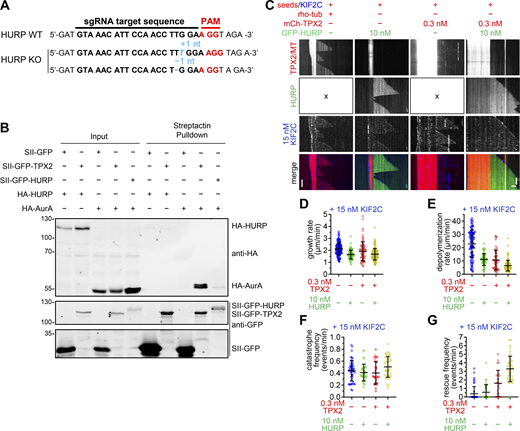
TPX2 and HURP do not interact with each other but synergize in stabilizing MTs in vitro. (A) Sanger sequencing results of the HURP KO HeLa cell line revealed one nucleotide (nt) insertion and one nt deletion. One nt insertion will result in p.L55FfsX2. One nt deletion will result in p.L55WfsX7. sgRNA, single-guide RNA. (B) StrepTactin pull-down assays with extracts of HEK293T cells expressing Strep-GFP, Strep-GFP–tagged TPX2, or Strep-GFP–tagged HURP (bait) together with HA-tagged HURP and HA-tagged Aurora A (prey) analyzed by western blotting with indicated antibodies. HA–Aurora A was used as a positive control for TPX2 binding. (C) Kymographs showing the behaviors of 15 nM SNAP-KIF2C (blue) alone or together with 10 nM GFP-HURP or 0.3 nM mCherry-TPX2, or all three proteins together on dynamic MTs. (D–G) Quantification of the growth rate (D), depolymerization rate (E), catastrophe frequency (F), and rescue frequency (G) for experiments shown in C. n = 84–165 events from two experiments (D); n = 60–119 events from two experiments (E); n = 28–51 MTs from two experiments (F); n = 25–49 MTs from two experiments (G). Horizontal scale bars, 2 µm; vertical scale bars, 2 min. Data represent mean ± SD. Source data are available for this figure: SourceData FS5.

TPX2 and HURP do not interact with each other but synergize in stabilizing MTs in vitro. (A) Sanger sequencing results of the HURP KO HeLa cell line revealed one nucleotide (nt) insertion and one nt deletion. One nt insertion will result in p.L55FfsX2. One nt deletion will result in p.L55WfsX7. sgRNA, single-guide RNA. (B) StrepTactin pull-down assays with extracts of HEK293T cells expressing Strep-GFP, Strep-GFP–tagged TPX2, or Strep-GFP–tagged HURP (bait) together with HA-tagged HURP and HA-tagged Aurora A (prey) analyzed by western blotting with indicated antibodies. HA–Aurora A was used as a positive control for TPX2 binding. (C) Kymographs showing the behaviors of 15 nM SNAP-KIF2C (blue) alone or together with 10 nM GFP-HURP or 0.3 nM mCherry-TPX2, or all three proteins together on dynamic MTs. (D–G) Quantification of the growth rate (D), depolymerization rate (E), catastrophe frequency (F), and rescue frequency (G) for experiments shown in C. n = 84–165 events from two experiments (D); n = 60–119 events from two experiments (E); n = 28–51 MTs from two experiments (F); n = 25–49 MTs from two experiments (G). Horizontal scale bars, 2 µm; vertical scale bars, 2 min. Data represent mean ± SD. Source data are available for this figure: SourceData FS5.
TPX2 and HURP synergize in stabilizing MTs in vitro
To gain mechanistic insight into how TPX2 and HURP work cooperatively, we examined the effects of purified TPX2 and HURP proteins on MT dynamics alone and together in vitro. Although TPX2 and HURP have been examined for their effects on MT dynamics previously (Roostalu et al., 2015; Wieczorek et al., 2015; Reid et al., 2016; Castrogiovanni et al., 2022), a side-by-side comparison is lacking. First, we performed titration experiments using 0.5–10 nM GFP-TPX2 or 10–100 nM GFP-HURP in the background of 30 nM TagBFP-EB3. Analysis of MT plus-end dynamics showed that TPX2 and HURP had little impact on the MT growth rate and catastrophe frequency (Fig. 7, A–C). Although almost no rescues occurred in the presence of 30 nM EB3 alone, with the addition of TPX2, rescue events were readily observed even at a concentration as low as 0.5 nM (Fig. 7, A and D). The rescue frequency increased with increasing TPX2 concentration. Such an effect saturated at or above 2.5 nM; we note, however, that although the rescue frequency was not further enhanced, the depolymerization events became shorter and slower (Fig. 7, A, D, E, and F). In comparison, the rescue frequency in the presence of HURP was not increased or increased just slightly at concentrations between 10 and 50 nM (Fig. 7, A and D). Only at a high concentration (100 nM) could HURP achieve a similar rescue–potentiation effect, as observed with 0.5 nM TPX2 (Fig. 7, A and D). In addition, short episodes of MT shortening were hardly observed at tested HURP concentrations (Fig. 7, A and F), and HURP had a less dramatic effect on slowing down the depolymerization compared with TPX2 (Fig. 7, A and E). Together, these data suggest that TPX2 functions as a strong rescue factor to increase overall MT stability, which is consistent with previous results, while HURP also possesses the ability to promote rescue, albeit much less potent than TPX2. These in vitro results match well with a more predominant role of TPX2 in stabilizing spindle MTs in cells than HURP.

TPX2 and HURP synergize in stabilizing MTs in vitro. (A) Kymographs of MTs grown in the presence of 30 nM TagBFP-EB3 alone (left panels), or together with GFP-TPX2 (middle panels) or GFP-HURP (right panels) at indicated concentrations. (B–F) Quantification of the growth rate (B), catastrophe frequency (C), rescue frequency (D), depolymerization rate (E), and depolymerization length before rescue (F) for experiments shown in A. n = 51–96 events from two experiments (B); n = 12–15 MTs from two experiments (C); n = 12–17 MTs from two experiments (D); n = 47–96 events from two experiments (E); n = 3–61 events from two experiments (F). (G) Kymographs showing the behaviors of 30 nM TagBFP-EB3 together with GFP-HURP or mCherry-TPX2 WT or FL89A mutant at indicated concentrations, or all three proteins together on dynamic MTs. (H–L) Quantification of the growth rate (H), catastrophe frequency (I), rescue frequency (J), depolymerization rate (K), and depolymerization length before rescue (L) for experiments shown in G. Data of 30 nM TagBFP-EB3 alone in H–L were replotted from B–F. n = 44–121 events from two experiments (H); n = 11–22 MTs from two experiments (I); n = 11–24 MTs from two experiments (J); n = 47–183 events from two experiments (K); n = 12–56 events from two experiments (L). (M and N) Quantification of TPX2 intensity (M) and HURP intensity (N) along MT lattices for experiments shown in G. n = 26–60 MTs from two experiments (M); n = 34–60 MTs from two experiments (N). Horizontal scale bars, 2 µm; vertical scale bars, 2 min. Data represent mean ± SD.
TPX2 and HURP synergize in stabilizing MTs in vitro. (A) Kymographs of MTs grown in the presence of 30 nM TagBFP-EB3 alone (left panels), or together with GFP-TPX2 (middle panels) or GFP-HURP (right panels) at indicated concentrations. (B–F) Quantification of the growth rate (B), catastrophe frequency (C), rescue frequency (D), depolymerization rate (E), and depolymerization length before rescue (F) for experiments shown in A. n = 51–96 events from two experiments (B); n = 12–15 MTs from two experiments (C); n = 12–17 MTs from two experiments (D); n = 47–96 events from two experiments (E); n = 3–61 events from two experiments (F). (G) Kymographs showing the behaviors of 30 nM TagBFP-EB3 together with GFP-HURP or mCherry-TPX2 WT or FL89A mutant at indicated concentrations, or all three proteins together on dynamic MTs. (H–L) Quantification of the growth rate (H), catastrophe frequency (I), rescue frequency (J), depolymerization rate (K), and depolymerization length before rescue (L) for experiments shown in G. Data of 30 nM TagBFP-EB3 alone in H–L were replotted from B–F. n = 44–121 events from two experiments (H); n = 11–22 MTs from two experiments (I); n = 11–24 MTs from two experiments (J); n = 47–183 events from two experiments (K); n = 12–56 events from two experiments (L). (M and N) Quantification of TPX2 intensity (M) and HURP intensity (N) along MT lattices for experiments shown in G. n = 26–60 MTs from two experiments (M); n = 34–60 MTs from two experiments (N). Horizontal scale bars, 2 µm; vertical scale bars, 2 min. Data represent mean ± SD.
To investigate whether TPX2 and HURP can modulate each other’s activities, we used two concentrations of mCherry-TPX2, 0.3 and 1.5 nM, while fixing the concentration of GFP-HURP at 10 nM, at which concentration GFP-HURP alone had a little impact on MT dynamics. The growth rate and catastrophe frequency were largely unaffected by the combination of TPX2 and HURP, similar to those observed with each protein alone (Fig. 7, G–I). However, whereas TPX2 alone could stimulate rescues, the addition of HURP led to a further 2–3.5-fold promotion of rescue frequency (Fig. 7, G and J). Moreover, the depolymerization events observed with TPX2 and HURP together were shorter than with TPX2 alone (Fig. 7, G, K, and L). Especially in the situation with 1.5 nM TPX2 and 10 nM HURP, depolymerization events were extremely short and followed by rapid rescues, making MT growth appear semi-processive (Fig. 7, G and L). We also examined the TPX2 FL89A mutant in parallel. Consistent with the results shown in assays with 4 µM tubulin (Fig. 4, E–J), in our standard in vitro dynamics assays with 20 µM tubulin, TPX2 FL89A also displayed impaired rescue activity. Only at high concentrations of 10 and 50 nM could TPX2 FL89A achieve a similar rescue–potentiation effect, as observed with 0.3 and 1.5 nM WT TPX2, respectively (Fig. 7, G and J). Despite this, when added together with HURP, the rescue activity of TPX2 FL89A was improved by 2.6–5.1-fold (Fig. 7, G and J), and the depolymerization events were shorter than in the presence of TPX2 FL89A alone (Fig. 7, G, K, and L). As the combined effect of TPX2 and HURP is much larger than the sum of their individual effects, it suggests that a synergy exists between the MT-stabilizing activities of TPX2 and HURP, regardless of whether TPX2 is WT or FL89A mutant. The synergy between TPX2 FL89A and HURP also explains why HURP KO could exacerbate the spindle defects caused by TPX2 R8-9A mutation in cells. Notably, our pull-down assay revealed no sign of direct interaction between TPX2 and HURP (Fig. S5 B). However, although HURP at 10 nM had little impact on the MT binding of TPX2, WT TPX2 at 1.5 nM and TPX2 FL89A at 10 or 50 nM enhanced the MT binding of HURP by ∼1.5-fold and ∼2-fold, respectively (Fig. 7, M and N). In addition, we found that the combination of TPX2 and HURP led to a higher rescue frequency and a lower depolymerization rate than each of them alone in the presence of KIF2C, an MT depolymerase that induces catastrophes (Fig. S5, C–G). Altogether, our results suggest that TPX2 and HURP act in synergy to stabilize MTs and that the synergy does not depend on the direct interaction between the two proteins.
Discussion
Our study presents a systematic dissection of the MT-binding activities of all TPX2 modules individually and in combinations. We have determined their respective contributions both in vitro and in cells and thereby identify a repeat group R8-9, located at the C terminus, as the key determinant of the TPX2 function. R8-9 prefers compacted tubulin dimer spacing, stabilizes MTs by promoting rescues in vitro, and is critical in spindle assembly in HeLa cells. Additionally, we reveal that TPX2 and HURP work synergistically to stabilize spindle MTs.
Our in vitro experiments demonstrate that three α-helical repeat groups of TPX2, R1-3, R4, and R8-9, showed strong affinity for the whole MT lattices, GMPCPP seeds, and GDP-MT lattices, respectively. Among them, R1-3 made the most significant contribution to the nucleation-promoting activity; both R1-3 and R8-9 contributed strongly to the MT stabilization effect of TPX2 by promoting rescues; and the contribution of R4 to these aspects was limited in vitro. However, in cells, the key determinant of TPX2’s function in spindle assembly is R8-9 but not R1-3, R4, or other repeat regions. Since R1-3 and R4 contain NLSs that interact with importin α/β and importins suppress TPX2 binding to MTs in vitro (Schatz et al., 2003; Roostalu et al., 2015; Safari et al., 2021), it is likely that R1-3 and R4 are at least partially inhibited by importins in cells, which could impede their function in spindle assembly.
Based on the above results, we propose a model of differential regulation of TPX2 activities at different spatial locations within the spindle via its multiple divergent MT-binding α-helical repeats (Fig. 8 A). (1) In the vicinity of chromosomes, local production of Ran-GTP liberates TPX2 from the inhibition of importin α/β, and therefore, TPX2 is in a fully active state, with maximal MT-binding affinities and MT nucleation–promoting and stabilization activities. (2) Near the spindle poles, where the Ran-GTP concentration is low, the MT binding of R1-3 and R4 is inhibited by importin α/β, but TPX2 can still bind MTs via R8-9, which may explain why the localization of TPX2 along the spindle is not affected by either the activation or inactivation of the Ran–GTP pathway in human cells (Tsuchiya et al., 2021). However, due to the impeded function of R1-3, TPX2 plays a limited role in MT nucleation near the spindle poles, which is consistent with its essential role in chromatin-dependent but not centrosome-dependent nucleation pathways (Gruss et al., 2002; Tulu et al., 2006). In addition, the MT stabilization activity of TPX2 is also reduced, which is compatible with previous observations that the spindle pole–localized pool of TPX2 is involved in MT disassembly processes via recruiting severing enzyme katanin or depolymerase KIF2A (Fu et al., 2015; Huang et al., 2021). Altogether, the spatially distinct functions of TPX2, which are linked to a gradient in its activities of promoting MT nucleation and stabilization, match well with the phenomenon that spindle MTs undergo net polymerization in the proximity of chromosomes and depolymerization at spindle poles, namely, poleward flux (Sawin and Mitchison, 1991; Kwok and Kapoor, 2007; Steblyanko et al., 2020; Valdez et al., 2023b). It will be interesting to investigate whether a molecular mechanism of differential spatial regulation similar to the one we describe here for TPX2 may be employed by other spindle-associated MAPs.

Multiple divergent repeats work together to determine the spatial regulation of TPX2 activities and its preference for older MTs. (A) Model for the differential regulation of TPX2 activities at different spatial locations within the spindle. (1) In the vicinity of chromosomes, where the Ran-GTP concentration is high, TPX2 displays maximal MT-binding affinities and MT nucleation–promoting and stabilization activities. (2) Near the spindle poles, where the Ran-GTP concentration is low, MT nucleation–promoting and stabilization activities of TPX2 are limited due to the impeded function of R1-3 and R4 by importin α/β, while TPX2 can still bind MTs via R8-9. (B) Model for the mechanisms underlying TPX2’s preference for older MTs. The sequential binding and interplay between repeats with opposite preferences can alter the structure of MT lattices, allowing more TPX2-binding sites to form over time, ultimately leading to its bias toward older regions of GDP-MT lattices.
Multiple divergent repeats work together to determine the spatial regulation of TPX2 activities and its preference for older MTs. (A) Model for the differential regulation of TPX2 activities at different spatial locations within the spindle. (1) In the vicinity of chromosomes, where the Ran-GTP concentration is high, TPX2 displays maximal MT-binding affinities and MT nucleation–promoting and stabilization activities. (2) Near the spindle poles, where the Ran-GTP concentration is low, MT nucleation–promoting and stabilization activities of TPX2 are limited due to the impeded function of R1-3 and R4 by importin α/β, while TPX2 can still bind MTs via R8-9. (B) Model for the mechanisms underlying TPX2’s preference for older MTs. The sequential binding and interplay between repeats with opposite preferences can alter the structure of MT lattices, allowing more TPX2-binding sites to form over time, ultimately leading to its bias toward older regions of GDP-MT lattices.
It has been previously reported that several MAPs, including kinesin-1, tau, MAP2, MAP7, and CAMSAP3, can regulate MT lattice extension or compaction (Peet et al., 2018; Siahaan et al., 2022; Liu and Shima, 2023; Yue et al., 2023; Shen and Ori-McKenney, 2024). This study demonstrates that α-helical repeats preferring extended tubulin dimer spacing, R4 and R10, and the repeat group preferring compacted tubulin dimer spacing, R8-9, coexist in the TPX2 molecule. The distinct combinations of these repeats result in diverse outcomes. Specifically, R4-9 or R5-10, which contained one repeat favoring extended tubulin dimer spacing and one favoring compacted tubulin dimer spacing, preferentially bound to the growing ends of MTs. This behavior is similar to what was observed with FL TPX2 from the Surrey group (Roostalu et al., 2015). In contrast, R4-10, which contained two repeats favoring extended tubulin dimer spacing and one favoring compacted tubulin dimer spacing, displayed a bias toward older regions of GDP lattices. This finding aligns with observations made with FL TPX2 from our group and the Petry group (Thawani et al., 2019; Huang et al., 2021). It is tempting to speculate that the manifestation of the combined effects of diverse MT-binding repeats in FL TPX2 may differ under slightly altered conditions, thereby providing a plausible explanation for the previously observed seemingly contradictory in vitro behaviors of TPX2 reported by different research groups. Given that both our group and the Petry group have independently observed that TPX2 exhibits a preference for older MTs (Thawani et al., 2019; Huang et al., 2021), we hereby propose a model to elucidate the underlying mechanism of this phenomenon (Fig. 8 B). In our model, R8-9 initiates the targeting of TPX2 to the curved protofilaments at MT ends with compacted tubulin dimer spacing, and R1-3, which shows no preference for MT geometry, binds the lattices concurrently. The subsequent docking of R4 and R10 serves to straighten the curved protofilaments by expanding tubulin dimer spacing, thereby inhibiting the further accumulation of TPX2 at MT ends. The interplay between repeats with contrasting preferences can potentially modify the structure of the MT lattice, resulting in an increased number of TPX2-binding sites. Consequently, TPX2 gradually accumulates over time, leading to a bias toward older regions of GDP-MT lattices. Other mechanisms like oligomerization or phase separation may also account for this phenomenon (King and Petry, 2020).
Here, we show that R8-9, which is important for the MT stabilization activity of TPX2 in vitro, is also essential in spindle assembly in HeLa cells. In contrast, despite the significant contributions of R1-3 and R4 observed in vitro, their functions in cells are limited. These findings align with prior studies conducted on the Xenopus egg extract, indicating that the C-terminal half of TPX2 retains the necessary functions for spindle assembly and branching nucleation, while the N-terminal half is dispensable (Brunet et al., 2004; Alfaro-Aco et al., 2017). It is worth noting that although the minimal fragment responsible for inducing branching MT nucleation in Xenopus egg extracts is α 5–7, equivalent to human R8-10, it has been suggested that this fragment accomplishes its function through binding and activation of γ-TuRC (Alfaro-Aco et al., 2017). Based on our findings that R8-9 possesses intrinsic MT-binding and stabilization activities, it is tempting to speculate that the corresponding regions of Xenopus TPX2 (α 5–6) may exhibit similar activities, which directly contribute to the branching nucleation process.
Our results show that HURP is not essential in normal HeLa cells but plays a prominent role in spindle assembly when TPX2 activity is compromised. These results are consistent with our in vitro data, showing that compared with TPX2, HURP is a much less potent MT stabilizer. However, unlike in human cells, both TPX2 and HURP have previously been reported to be essential for spindle assembly in the Xenopus egg extract (Wittmann et al., 2000; Gruss et al., 2001; Koffa et al., 2006; Casanova et al., 2008). Since the biochemical properties of these two proteins would not be expected to differ much between the human and Xenopus, the discrepancy may be due to their abundance or post-translational modifications in the two systems. Furthermore, we find that TPX2 and HURP cooperate in promoting spindle assembly in HeLa cells and act synergistically in stabilizing MTs in vitro. When we were finalizing this manuscript, a bioRxiv preprint from the Petry lab showed that HURP and TPX2 also work synergistically in the Xenopus system, suggesting that the synergy between these two proteins is conserved across species (Valdez et al., 2023a, Preprint). In this preprint, the cryo-EM structure of a GMPCPP-MT decorated with a human HURP fragment covering the MTBD1 revealed that HURP uses a helix and a loop to bridge lateral tubulin subunits. Previous cryo-EM studies have reported that TPX2 R4 utilizes two flexibly linked elements to bind across both longitudinal and lateral tubulin interfaces simultaneously (Zhang et al., 2017). These structural findings offer insights into the mechanisms by which HURP and TPX2 contribute to the stabilization of MTs, with HURP enhancing lateral interactions between protofilaments and TPX2 stabilizing protofilaments in both lateral and longitudinal orientations. Together with the potential for multiple other α-helical repeats of TPX2 to adopt a similar binding mode to R4, these may further explain our observations that TPX2 has a much stronger MT stabilization activity than HURP in vitro. Future structural studies of FL TPX2 and other individual repeats capable of MT binding will be required to help understand how multiple repeats are coordinated in the MT lattices, which may shed further light on the mechanisms underlying the MT stabilization and nucleation-promoting activities of TPX2.
Materials and methods
DNA constructs
Human TPX2 (NM_012112), HURP (NM_014750.5), and Aurora A (NM_001323303.2) were amplified from HeLa cDNA. EB3 (NM_001303050.2) and KIF2C (NM_006845.4) were gifts from Anna Akhmanova (Utrecht University, Utrecht, Netherlands). FL TPX2 and its truncations were cloned into pTT5-based (52326; Addgene) Strep-EGFP/mCherry-C1 and/or pTT5 Strep-EGFP/mCherry-LZ-C1 vectors. HURP was cloned into pTT5-Strep-EGFP-C1 and 3×HA-C1 vectors. KIF2C was cloned into a pTT5-Strep-SNAP-C1 vector. EB3 was cloned into a pTT5-Strep-TagBFP-C1 vector featuring a flexible linker, 5′-AQAGGSGGAGSGGEGAVDG-3′, positioned between the fluorescent tag and the EB3 protein. Aurora A was cloned into a pTT5 3×HA-C1 vector.
Cell culture and transfection
All cell lines were cultured in DMEM/F12 (1:1; Biosharp) supplemented with 10% FBS, 100 U/ml penicillin, and 100 µg/ml streptomycin, and kept at 37°C in 5% CO2. TransIT-LT1 (Mirus) was used to transfect plasmids into HeLa (RRID: CVCL_0030) or MRC5 (RRID: CVCL_0440) cells for KO, knock-in, immunofluorescence, and live-cell imaging; polyethylenimine (PEI; Polysciences) was used to transfect plasmids into HEK293T (RRID: CVCL_0063) cells for protein purification and pull-down experiments.
Antibodies
The following primary antibodies were used: rabbit polyclonal antibodies against GFP (50430-2-AP, RRID: AB_11042881; Proteintech), HURP (12038-1-AP, RRID: AB_10665363; Proteintech), and α-tubulin (11224-1-AP, RRID: AB_2210206; Proteintech); and mouse monoclonal antibodies against γ-tubulin (MA1-19421, RRID: AB_1075282; Thermo Fisher Scientific), EB1 (610535, RRID: AB_397892; BD Biosciences), and HA (66006-2-Ig, RRID: AB_2881490; Proteintech).
The following secondary antibodies were used for western blotting: IRDye 800CW goat anti-rabbit (926-32211, RRID: AB_621843; LI-COR) and IRDye 800CW goat anti-mouse (926-32210, RRID: AB_621842; LI-COR). The following secondary antibodies were used for immunofluorescence staining: goat anti-rabbit Alexa Fluor 647 (A-21244, RRID: AB_2535812; Thermo Fisher Scientific), goat anti-mouse Alexa Fluor 647 (A-21235, RRID: AB_2535804; Thermo Fisher Scientific), goat anti-rat Alexa Fluor 647 (A-21247, RRID: AB_141778; Thermo Fisher Scientific), goat anti-rat Alexa Fluor 594 (A-11007, RRID: AB_10561522; Thermo Fisher Scientific), and goat anti-rabbit Alexa Fluor 488 (A-11034, RRID: AB_2576217; Thermo Fisher Scientific).
Generation of KO cell lines
To generate the HURP KO HeLa cell line, cells grown on 6-well plates were transfected with 2 μg PX459 bearing single-guide RNA (5′-GTAAACATTCCAACCTTGGA-3′) and selected with 8 µg/ml puromycin for 2 days. 4–5 days after removal of puromycin, cells were diluted in 96-well plates to isolate single-cell colonies. Positive clones were screened by immunofluorescence and PCR genotyping. The HURP KO stable cell line generated in this way was used in experiments shown in Fig. 6, A and B. It is noteworthy, however, that for experiments shown in Fig. 6 G, TPX2-mAID-mClover/mCherry-TPX2 WT or FL89A stable cell lines were transiently transfected with PX459 bearing single-guide RNA for HURP, followed by puromycin selection, with the single-clone screening step omitted.
For genotyping of a HURP KO stable HeLa cell line, HURP KO genotyping forward primer (5′-GTGTTCTCTGTGGTAAGCCCA-3′) and HURP KO targeting sequence reverse primer (5′-AAAGGCTTTTGCCTTAAAGACAGT-3′) were used.
Generation of auxin (IAA)- and Dox-inducible cell lines
We took a three-step approach to establish cell lines for the auxin-inducible degradation of endogenous TPX2 and Dox-inducible expression of mCherry-tagged TPX2 WT or variants. We first generated the Tet-3xHA-OsTIR1-puro parental HeLa cell line at the AAVS1 locus. Subsequently, the TPX2 locus was further tagged with the mAID-mClover-hydro cassette at the C terminus in the parental cell line via CRISPR/Cas9; the resulting cell line aiming for degradation of endogenous TPX2 was described previously (Huang et al., 2021). Finally, the pTK630 plasmid (114697; Addgene) was modified to generate the donor construct for the inducible expression of BSD-Step-mCherry-TPX2 WT or mutants at the ROSA26 locus in the TPX2-mAID-mClover (TPX2-mAC) cell line. For this, 2 µg donor construct and 1 μg PX330 bearing single-guide RNA (5′-TTGCAGCTCGCGCCGGTTTT-3′) were cotransfected into TPX2-mAC HeLa cells grown on 6-well plates. 2 days after transfection, cells were selected with 10 µg/ml blasticidin for 2 wk, followed by serial dilution after withdrawing drug selection. The positive clones with proper expression levels of mCherry-TPX2 WT or variants following Dox treatment, as assessed by immunofluorescence staining, were chosen for further analysis.
To degrade endogenous TPX2 and express mCherry-TPX2 WT or variants, the cell lines were first treated with 2 µg/ml Dox for 24 h and then with 2 µg/ml Dox and 500 µM IAA for 12 h before fixation (Fig. 5, A, E, J, and L; Fig. 6 G; and Fig. S4, B, D and F).
Protein expression and purification from the HEK293T cell
For protein overexpression in HEK293T cells, pTT5-Strep-EGFP-C1 and/or pTT5-Strep-EGFP-LZ-C1 vectors were used for TPX2 FL and truncations, pTT5-Strep-EGFP-C1 was used for HURP, the pTT5-Strep-SNAP-C1 vector was used for KIF2C, and the pTT5-Strep-TagBFP-linker-C1 vector was used for EB3.
Generally, HEK293T cells grown on 15-cm dishes were transfected with 20–30 µg DNA per dish using PEI. Cells were treated with 200 ng/ml nocodazole overnight before harvesting. 36 h after transfection, the medium was removed from dishes, and cells were collected with cold PBS (4°C, 10 ml for each 15-cm dish) into 15-ml falcon tubes quickly. Cells were centrifuged at 1,000× rpm, 4°C for 10 min, to remove the supernatant, and the pellets were lysed in 900 μl lysis buffer (50 mM Hepes, 300 mM NaCl, and 0.5% Triton X-100, pH 7.4) containing protease inhibitors (Roche) for 10 min on ice. The cell lysate was centrifuged at 14,000× rpm, 4°C for 20 min, and the supernatant was incubated with 60–100 μl StrepTactin beads (28935599; Cytiva) at 4°C for 45 min. After removal of the supernatant by centrifuging at 3,000× rpm, 4°C for 1 min, beads were washed with 1 ml lysis buffer four times and 1 ml wash buffer A (50 mM Hepes, 150 mM NaCl, and 0.01% Triton X, pH 7.4) two times. Finally, proteins were eluted with 60–100 μl elution buffer (50 mM Hepes, 150 mM NaCl, 0.01% Triton X-100, and 2.5 mM desthiobiotin, pH 7.4), snap-frozen, and stored at −80°C.
To purify Strep-SNAP-KIF2C, cells were collected and lysed as described above. After incubation with the supernatant, beads were washed with lysis buffer four times and wash buffer A two times as described above. Subsequently, to label SNAP-tag proteins, beads were incubated with 100 μl wash buffer A containing 10 μM SNAP-Surface Alexa Fluor 647 (S9136S; NEB) at 4°C for 1 h in darkness. After extensive washing with lysis buffer four times and wash buffer B (50 mM Hepes, 300 mM NaCl, and 0.01% Triton X, pH 7.4) two times, proteins were eluted with 60 μl elution buffer containing 300 mM instead of 150 mM NaCl.
Pull-down assays
For StrepTactin pull-down assays, HEK293T cells seeded on 6-well plates were cotransfected with 1 µg Strep-GFP–tagged bait construct and 1 µg HA-tagged prey construct (2 µg total DNA) using PEI. 36 h after transfection, cells were collected and lysed in 100 μl lysis buffer for 5 min on ice. The cell lysate was centrifuged at 14,000× rpm, 4°C for 20 min, and the supernatant was incubated with 10 μl StrepTactin beads at 4°C for 45 min. Subsequently, beads were washed with lysis buffer four times. Protein samples were separated by SDS–PAGE and transferred onto the nitrocellulose membrane (Cytiva). Western detection was carried out using the Odyssey infrared imaging system (LI-COR Biosciences).
In vitro MT dynamics assays
Double-cycled GMPCPP-MT seeds were made as described previously (Gell et al., 2010). Briefly, 8.25 μl tubulin reaction mixture in MRB80 buffer (80 mM PIPES, 1 mM EGTA, and 4 mM MgCl2, pH 6.8), which contained 14 µM unlabeled porcine brain tubulin (Cytoskeleton), 3.6 µM biotin-tubulin (Cytoskeleton), 2.4 µM rhodamine-tubulin (Cytoskeleton), and 1 mM GMPCPP (Jena Biosciences), was incubated at 37°C for 30 min. Then, MTs were pelleted by centrifugation in Airfuge (Beckman) at ∼28 psi for 5 min. After carefully removing the supernatant, the pellet was resuspended in 6 μl MRB80 buffer and depolymerized on ice for 20 min. Subsequently, a second round of polymerization was performed at 37°C for 30 min in the presence of freshly supplemented 1 mM GMPCPP. MT seeds were then pelleted as described above and resuspended in 50 μl MRB80 buffer containing 10% glycerol, snap-frozen, and stored at −80°C.
In vitro MT dynamics assays were performed following the procedure previously described (Wang et al., 2024). The assay flow chambers were made of plasma-cleaned glass coverslips and microscope slides. The coverslip surface was functionalized by sequentially incubating with 0.2 mg/ml poly(L-lysine)–poly(ethylene glycol)–biotin (Susos AG) and 1 mg/ml NeutrAvidin (Invitrogen) in MRB80 buffer. GMPCPP seeds were then attached to coverslip via biotin–NeutrAvidin links, followed by blocking with 1 mg/ml κ-casein. The reaction mixture, which consisted of purified protein and MRB80 buffer containing 20 µM porcine brain tubulin, 0.5 µM rhodamine-tubulin, 1 mM GTP, 0.2 mg/ml κ-casein, 0.1% methylcellulose, and oxygen scavenger mix (50 mM glucose, 400 µg/ml glucose oxidase, 200 µg/ml catalase, and 4 mM DTT), was added to the chamber after centrifugation in Airfuge at ∼28 psi for 5 min. The flow chamber was sealed with vacuum grease and imaged immediately at 30°C using a total internal reflection fluorescence (TIRF) microscope.
For assays aiming to characterize the MT-binding properties of individual TPX2 modules and assays aiming to uncover the functional residues of all 10 repeats (Fig. 1, B–D and G; Fig. 2, A, F–H, and J; and Fig. S3, B–D), KCl was excluded from the reaction buffer.
For assays aiming to generate curved MTs (Fig. 2 A), GMPCPP seeds were first elongated in the presence of 20 µM tubulin for 5 min. Then, the reaction mixture containing 5 nM purified GFP-LZ-TPX2 R8-9 and 10 µM tubulin quickly flowed into the chamber with pre-assembled dynamic MTs. MT buckling frequently appeared because of the mechanical strain caused by the solution exchange.
For assays aiming to study the MT nucleation–promoting activities (Fig. 4 D), the concentration of tubulin was reduced to 2, 4, and 8 µM, while the concentration of rhodamine-tubulin was reduced to 0.06, 0.12, and 0.24 µM, respectively. Analyses of MT dynamics in the presence of 4 µM tubulin, 0.12 µM rhodamine-tubulin, and indicated TPX2 WT or mutants are shown in Fig. 4, E–J.
For assays with mCherry-TPX2 proteins (Fig. 2 J, Fig. 7 G, and Fig. S5 C), rhodamine-tubulin was excluded from the reaction mixture.
For assays in Fig. 2, F–H and J, 1 μM SiR-tubulin (Cytoskeleton) was included in the reaction mixture.
TIRF microscopy
TIRF microscopy was performed on Nikon Eclipse Ti2-E with the perfect focus with the Nikon CFI Apo TIRF 100× 1.49 NA oil objective, Prime 95B camera (Photometrics), and SOLE laser engine (four lasers: 405, 488, 561, and 638 nm; Omicron), and controlled by NIS-Elements software (Nikon). Images were magnified with a 1.5× intermediate lens on Ti2-E before being projected onto the camera. The resulting pixel size is 73.3 nm/pixel. Stage-top incubator INUBG2E-ZILCS (Tokai Hit) was used to keep cells at 37°C or in vitro samples at 30°C. The imaging medium (DMEM/F12 supplemented with 10% FBS, 100 U/ml penicillin, and 100 µg/ml streptomycin) was prewarmed in a water bath at 37°C.
OptoSplit III beamsplitter (Cairn Research Ltd.) was used for simultaneous imaging of green and red fluorescence. Stream acquisition was used for simultaneous imaging of green and red fluorescence in vivo. The sequential acquisition was used for three-color imaging experiments.
Immunofluorescence
Cells seeded on coverslips in 24-well plates were fixed using different methods. For staining of α-tubulin and HURP, cells were sequentially fixed in −20°C methanol for 5 min and 4% formaldehyde in PBS for 5 min at room temperature. For staining of γ-tubulin and EB1, cells were fixed with −20°C methanol for 10 min. Then, cell membranes were permeabilized with 0.15% Triton X 100 in PBS, and subsequent blocking and antibody labeling steps were performed in PBS supplemented with 2% BSA and 0.05% Tween-20. The permeabilizing, blocking, and labeling steps were performed at room temperature. Finally, coverslips were sequentially rinsed with 70% and 100% ethanol, air-dried, and mounted on glass slides with VECTASHIELD Mounting Medium (Vector Laboratories). Slides were stored at −20°C.
Images were captured using Nikon Ni-U with 60× 1.40 NA oil objective equipped with a DS-Qi2 camera (Nikon).
Nocodazole washout assays
Cells cultured on coverslips in 24-well plates were firstly treated with 2 µg/ml Dox for 24 h and then with 2 µg/ml Dox, 500 µM IAA, and 200 ng/ml nocodazole for another 12 h. 10 min before fixation, cells were released from nocodazole treatment with twice rinse in the drug-free medium.
Images were captured using Nikon Eclipse Ti2-E with Nikon Ni-U with 100× 1.40 NA oil objective equipped with a Prime 95B camera (Photometrics).
Cold treatment
Cells were seeded on coverslips in a 24-well plate for 18 h. The plate was cooled in an ice-water bath for 5 min, followed by immunofluorescence staining of cold-resistant spindle MTs (Fig. 6 B).
Centrinone treatment
As illustrated in Fig. 5 G, cells seeded on coverslips in 24-well plates were treated with 150 nM centrinone for 48 h, aiming to remove one centrosome, and with 2 µg/ml Dox and 500 µM IAA for 24 h, aiming for the degradation of endogenous TPX2 and expression of mCherry-tagged TPX2 WT or variants. Thymidine (2 mM) block and release were also performed before fixation to enrich the mitotic cells.
Computational sequence analysis
Image analysis and processing
For measurement of the intensity of indicated proteins in the in vitro assays, a 5-pixel-wide linear regions of interest (ROI) was drawn along the MT immediately after flow-in (Fig. 2 C) or after 8 min of GDP-MT growth from seed when the signals of indicated proteins reached a plateau (Fig. 1, E, F, and H; Fig. 2, I and K; Fig. 3 H; Fig. 4 B; Fig. 7, M and N; and Fig. S3 E). For plots of the intensity of GFP-TPX2 R4-10 against time (Fig. 3 G), a 2-µm-long segment of GDP-MT, as illustrated in Fig. 3 E (between two vertical dashed lines), was tracked for 3 min with a time interval of 3 s.
For measurement of the ratio of the average intensity of MTs in the vicinity of chromosomes to that in spindle pole regions, polygon ROIs were selected to cover the regions near chromosomes and spindle pole, respectively (Fig. 5 C).
For measurement of the intensity of EB1 and HURP in the vicinity of chromosomes, a polygon ROI was selected to cover the region near chromosomes (Fig. 5, K and M; and Fig. S4, E and G).
For measurement of the intensity of spindle MTs without or with cold treatment, a polygon ROI was selected to cover the spindle (Fig. 6, C, E, and I).
Kymograph analysis and various quantifications were performed in ImageJ. Plots were generated using GraphPad Prism (RRID:SCR_002798) and Excel (Microsoft). Images were prepared for publication using ImageJ (RRID:SCR_003070) and Adobe Photoshop (RRID:SCR_014199).
Statistical analysis
Statistical analysis was performed with Excel (Microsoft). P values were determined by an unpaired two-tailed t test except for Fig. 2 E (paired two-tailed t test). *P < 0.05; **P < 0.01; ***P < 0.001; n.s., not significant. Data distribution was assumed to be normal, but this was not formally tested.
Online supplemental material
Fig. S1 shows the structural analysis of TPX2 proteins. Fig. S2 shows the schematic overview of MT-binding properties of TPX2 single repeats or repeat combinations. Fig. S3 uncovers the functional residues of all 10 TPX2 repeats. Fig. S4 characterizes the different TPX2 variant HeLa knock-in cell lines. Fig. S5 shows that TPX2 and HURP do not interact with each other but synergize in stabilizing MTs in vitro. Video 1 shows the modest enrichment of LZ-TPX2 R8 at the growing MT end in vitro. Video 2 shows the strong accumulation of LZ-TPX2 R8-9 on curved MT ends in vitro. Video 3 shows that paclitaxel treatment reduces the affinity of LZ-TPX2 R8-9 for MTs in cells.
Data availability
The data are available from the corresponding author upon reasonable request.
Acknowledgments
We thank Anna Akhmanova for sharing reagents.
K. Jiang was supported by grants from the National Natural Science Foundation of China (32370735, 32070705) and the Fundamental Research Funds for the Central Universities (2042022dx0003 and 2042023kf0212).
Author contributions: Z. Liang: conceptualization, investigation, methodology, visualization, and writing—original draft. J. Huang: conceptualization, investigation, methodology, visualization, and writing—original draft. Y. Wang: investigation, methodology, visualization, and writing—original draft. S. Hua: conceptualization, methodology, visualization, and writing—original draft, review, and editing. K. Jiang: conceptualization, funding acquisition, methodology, supervision, visualization, and writing—original draft, –review, and editing.