Skip to Main Content
Skip Nav Destination
1-20 of 99
Follow your search
Access your saved searches in your account

Would you like to receive an alert when new items match your search?
Close Modal
Sort by
Journal Articles
Images
Figure 1. Sites, agonists, and cycle. (a) Ligand binding sites. Side view of an acetylcholine binding protein, homologous to the AChR extracellular domain (PDB ID: 3WIP; Olsen et al., 2014). Sites are at subunit interfaces. The agonist (ACh, yellow) is surrounded by a cluster of aromatic residues (green). In endplate AChRs, the principal subunit (white) is α and the complementary subunit is δ, ε (adult), or γ (fetal). Bottom right: Top-view schematic of endplate AChR subunits (neurotransmitter binding sites, red). (b) Agonist structures. The principal nitrogen is blue. (c) Cyclic activation scheme for a receptor having one functional binding site. Horizontal, agonist binding and vertical, receptor activation (“gating”). R, resting state (low affinity and closed channel); R*, active state (high affinity and open channel); A, agonist. Boxed, equilibrium constants and free-energy changes (in the direction of the arrow). KdR and KdR*, resting and active equilibrium dissociation constants; E0 and E1, un- and mono-liganded gating equilibrium constants.
Published: 11 January 2019
Figure 1. Sites, agonists, and cycle. (a) Ligand binding sites. Side view of an acetylcholine binding protein, homologous to the AChR extracellular domain (PDB ID: 3WIP ; Olsen et al., 2014 ). Sites are at subunit interfaces. The agonist (ACh, More about this image found in Sites, agonists, and cycle. (a) Ligand binding sites. Side view of an acet...
Images
Figure 2. Binding site structures (x-ray). (a) AChBP with ACh (top; PDB ID: 3WIP; Olsen et al., 2014) or nicotine (bottom; PDB ID: 1UW6; Celie et al., 2004). Dashed lines are H-bonds; red dot is a structural water. (b) α4β2 AChR with nicotine (top; PDB ID: 5KXI; Morales-Perez et al., 2016) or docked ACh (bottom). In both structures, before equilibration the agonist tail points toward the complementary subunit, but after equilibration it is flipped only in α4β2 (Table 1).
Published: 11 January 2019
Figure 2. Binding site structures (x-ray) . (a) AChBP with ACh (top; PDB ID: 3WIP ; Olsen et al., 2014 ) or nicotine (bottom; PDB ID: 1UW6 ; Celie et al., 2004 ). Dashed lines are H-bonds; red dot is a structural water. (b) α4β2 AChR with More about this image found in Binding site structures (x-ray) . (a) AChBP with ACh (top; PDB ID: 3WIP ...
Images
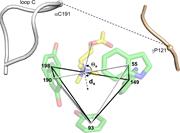
Figure 3. Binding site structural parameters. Pocket volume was calculated as that of the pyramid formed by joining the centers of the five aromatic rings (front face, white). Distances are between the agonist’s principal nitrogen (Fig. 1 b) and the pocket center (dx) or the five ring centers (d93, d149, d190, d198, and d55), and between loop C and the complementary subunit backbone (dloopC). Angle Θa is the agonist’s orientation. Not shown: angles Θs (pocket skew), ΘW (between indole planes), Θp (between pyramid and pore axes), and density of water in the pocket. PDB ID: 3WIP; residue numbers are for endplate AChRs.
Published: 11 January 2019
Figure 3. Binding site structural parameters. Pocket volume was calculated as that of the pyramid formed by joining the centers of the five aromatic rings (front face, white). Distances are between the agonist’s principal nitrogen ( Fig. 1 b ) More about this image found in Binding site structural parameters. Pocket volume was calculated as that o...
Images
Figure 4. RMSD of the protein backbone. The backbone equilibrates within ∼10 ns. Most of the residual fluctuations are from loop F.
Published: 11 January 2019
Figure 4. RMSD of the protein backbone. The backbone equilibrates within ∼10 ns. Most of the residual fluctuations are from loop F. Figure 4. RMSD of the protein backbone. The backbone equilibrates within ∼10 ns. Most of the residual More about this image found in RMSD of the protein backbone. The backbone equilibrates within ∼10 ns. Mos...
Images
Figure 5. Pocket volume and dx. Resting, brown and active, green. (a) Top: Pocket volume. With all agonists, α−γ is the smallest (AR and AR*). At all sites, AR* is smaller than AR (all agonists) and pocket volume is smallest with TMA. Bottom: dx. Distance between the agonist’s principal nitrogen and the pocket center is approximately twofold smaller in AR* versus AR (all sites and agonists). (b) Example dx distributions. Each panel shows results from two MD trajectories (α−γ).
Published: 11 January 2019
Figure 5. Pocket volume and dx . Resting, brown and active, green. (a) Top: Pocket volume. With all agonists, α−γ is the smallest (AR and AR*). At all sites, AR* is smaller than AR (all agonists) and pocket volume is smallest with TMA. Bottom: More about this image found in Pocket volume and dx . Resting, brown and active, green. (a) T...
Images
Figure 6. Water density. The number of water molecules was counted in spheres of radii 5, 10, and 20 Å, with the origin at the pocket center (α−γ). There is no significant difference between AR and AR* conformations or between agonists. The 20 Å values are the same as for the bulk solution (dashed line, 1 molecule per Å3 or 29.8 g/cm3).
Published: 11 January 2019
Figure 6. Water density. The number of water molecules was counted in spheres of radii 5, 10, and 20 Å, with the origin at the pocket center (α−γ). There is no significant difference between AR and AR* conformations or between agonists. The 20 Å More about this image found in Water density. The number of water molecules was counted in spheres of rad...
Images
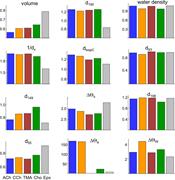
Figure 7. Resting versus active α−γ pocket metrics. Distances are AR*/AR ratios and angles are AR* – AR differences. Left and center columns: Metrics that differ significantly between AR* and AR. For ACh-class agonists (colored bars), in R* pocket volume is ∼40% smaller and 1/dx is ∼50% smaller. For Epx (gray), in R* pocket volume is 22% smaller and 1/dx is 37% smaller. Right column: Metrics that are the same in R and R*.
Published: 11 January 2019
Figure 7. Resting versus active α−γ pocket metrics . Distances are AR*/AR ratios and angles are AR* – AR differences. Left and center columns: Metrics that differ significantly between AR* and AR. For ACh-class agonists (colored bars), in R* More about this image found in Resting versus active α−γ pocket metrics . Distances are AR*/...
Images
Figure 8. Energy–structure correlations. (a) Linear correlations between experimental binding energy and binding site metrics (ACh, CCh, TMA, and Cho; all sites; AR and AR*). The highest correlation is with dx. (b) Pearson’s correlation coefficients by agonist (dashed lines, P < 0.0001 significance threshold).
Published: 11 January 2019
Figure 8. Energy–structure correlations. (a) Linear correlations between experimental binding energy and binding site metrics (ACh, CCh, TMA, and Cho; all sites; AR and AR*). The highest correlation is with dx. (b) Pearson’s correlation More about this image found in Energy–structure correlations. (a) Linear correlations between experimenta...
Images
Figure 9. Resting versus active α−γ neurotransmitter binding site. (a) For all agonists, the active pocket (AR*, green) is smaller than the resting pocket (AR, brown; Fig. 3). (b) AR* versus AR with ACh. In the active state, the agonist’s quaternary nitrogen (blue dot) is closer to the pocket center (black dot) and the agonist’s tail (red arrow) points away from the complementary subunit. (c) With ACh, in AR* versus AR, the tryptophan pair is closer to and αY190 is further from the quaternary nitrogen of ACh (blue dot). (d) In AR* versus AR, loop C in the α subunit is displaced outward, but loop E in the γ subunit is the same. The pore axis is approximately vertical.
Published: 11 January 2019
Figure 9. Resting versus active α−γ neurotransmitter binding site. (a) For all agonists, the active pocket (AR*, green) is smaller than the resting pocket (AR, brown; Fig. 3 ). (b) AR* versus AR with ACh. In the active state, the agonist’s More about this image found in Resting versus active α−γ neurotransmitter binding site. (a) For all agoni...
Images
Figure 10. Affinity, efficacy, and efficiency. In each plot, y-axis values are free energies from electrophysiology experiments and x-axis values are distances from equilibrated structures. Open symbols, AR; closed symbols, AR*. (a) Distance between the agonist’s principal nitrogen (Fig. 1 b) and the pocket center (Fig. 3) is correlated linearly with agonist binding energy (Eq. 6; slope = 26.3 ± 1.6 Å · kcal/mol; y-intercept = 2.8 ± 0.6 kcal/mol). (b) Relative efficacy correlates with the active–resting difference in 1/dx. (c) The dx ratio, AR*/AR, predicts energy efficiency (within ∼10%). The higher efficiency of α−γ versus α-δ/ε (lines mark means) and the lower efficiency of Epx are apparent.
Published: 11 January 2019
Figure 10. Affinity, efficacy, and efficiency . In each plot, y-axis values are free energies from electrophysiology experiments and x-axis values are distances from equilibrated structures. Open symbols, AR; closed symbols, AR*. (a) Distance More about this image found in Affinity, efficacy, and efficiency . In each plot, y-axis values are free e...
Images
Figure 11. CRCs. Symbols are from electrophysiology experiments, and solid lines are calculated from dx values. Inset: CRCs for two agonists that were not used in the energy–dx correlation (Fig. 10 a). See Fig. 1 b for agonist structures.
Published: 11 January 2019
Figure 11. CRCs. Symbols are from electrophysiology experiments, and solid lines are calculated from dx values. Inset: CRCs for two agonists that were not used in the energy–dx correlation ( Fig. 10 a ). See Fig. 1 b for agonist structures. More about this image found in CRCs. Symbols are from electrophysiology experiments, and solid lines are ...
Journal Articles
Images
Figure 1. Cysteine reactive cross-linkers dimerize subunits. (A) Model of the hP2X1R showing the location of the G30C mutation (black spheres). The three subunits are shown in gray, light blue, and light pink. (B) Chemical structures of BMB and BM(PEG)2. The lower panel shows how BM(PEG)2 can cross-link two cysteine residues. (C and D) Representative blots from HEK293F cells transfected with hP2X1 C349A (C) and G30C C349A (D), treated with 3.2 U/ml−1 apyrase, then cysteine-reactive cross-linker or DMSO (apyrase only). Cells transfected with C349A (C) showed intense bands at ∼55 kD but did not show any distinct bands at ∼110 kD in any condition, indicating no dimerization of these subunits. Cells transfected with G30C C349A (D) showed robust bands at ∼55 kD and faint bands at ∼110 kD in apyrase only. The intensity of the ∼55-kD band decreased and the intensity of the ∼110-kD band increased with the addition of the cysteine cross-linkers, suggesting dimerization of the subunits.
Published: 09 January 2019
Figure 1. Cysteine reactive cross-linkers dimerize subunits. (A) Model of the hP2X1R showing the location of the G30C mutation (black spheres). The three subunits are shown in gray, light blue, and light pink. (B) Chemical structures of BMB More about this image found in Cysteine reactive cross-linkers dimerize subunits. (A) Model of the hP2X1R...
Images
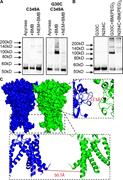
Figure 2. Cross-linking can be prevented by cysteine residue blockade. (A) Representative blots from HEK293F cells transfected with hP2X1 C349A and G30C C349A, treated with 3.2 U/ml apyrase only, apyrase then BMB, or apyrase then NEM followed by BMB. Cells transfected with C349A showed intense bands at ∼55 kD but did not show any distinct bands at ∼110 kD in any condition, indicating no dimerization of these subunits. Cells transfected with G30C C349A showed the intensity of the ∼55 kD band decreased and the intensity of the ∼110 kD band increased with the addition of BMB, suggesting dimerization of the subunits. Prior treatment with NEM showed no enhancement of the ∼110 kD band in the presence of BMB. This shows that NEM treatment prevents BMB from accessing the introduced cysteine residue and inhibits dimerization. The outline shows lanes taken from different membranes. (B) Example blots from cells transfected with either G30C C349A or N284C C349A, and treated with either apyrase only or apyrase with BM(PEG)2. The mutation N284C did not show an enhancement of the ∼110 kD band with BM(PEG)2 treatment, suggesting these residues cannot be cross-linked. The dotted line indicates where lanes have been removed for clarity. (C) Homology models of two hP2X1 N284C receptors, showing that N284C (gray sticks) from two separate receptors could be within ∼13 Å of each other without the receptors clashing, as shown by line, while G30C were ∼51 Å apart. The two models were arranged manually to minimize the N284-N284 and G30-G30 distances while keeping the central axes of both models perpendicular to the membrane plane.
Published: 09 January 2019
Figure 2. Cross-linking can be prevented by cysteine residue blockade. (A) Representative blots from HEK293F cells transfected with hP2X1 C349A and G30C C349A, treated with 3.2 U/ml apyrase only, apyrase then BMB, or apyrase then NEM followed by More about this image found in Cross-linking can be prevented by cysteine residue blockade. (A) Represent...
Images
Figure 3. Specific amino-terminal cysteine residues form cross-links. (A) Representative blots from HEK293F cells transfected with hP2X1 C349A, R25C, N26C, K27C, K28C, V29C, or G30C treated with 3.2 U/ml apyrase, then BMB or DMSO (apyrase only). Of the mutants tested, only R25C and G30C showed strong enhancement of the ∼110 kD band with BMB treatments. This suggests that only R25C and G30C can dimerize within 10.9 Å. Outlines show images were taken from the same blot, while the dotted line shows where lanes have been removed for clarity. (B) Histogram showing the average percentage dimer present for the above mutants tested with all three cross-linkers. This shows that only R25C and G30C show ∼60% dimerization with BMB or BM(PEG)2 treatments. (*, P < 0.05; **, P < 0.01; ***, P < 0.001; n = 3–5).
Published: 09 January 2019
Figure 3. Specific amino-terminal cysteine residues form cross-links. (A) Representative blots from HEK293F cells transfected with hP2X1 C349A, R25C, N26C, K27C, K28C, V29C, or G30C treated with 3.2 U/ml apyrase, then BMB or DMSO (apyrase only). More about this image found in Specific amino-terminal cysteine residues form cross-links. (A) Representa...
Images
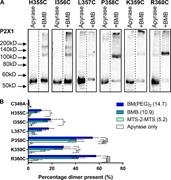
Figure 4. Specific carboxyl-terminal cysteine residues form cross-links. (A) Representative blots from HEK293F cells transfected with hP2X1 C349A H355C, I356C, L357C, P358C, K359C, or R360C treated with 3.2 U/ml apyrase, then BMB or DMSO (apyrase only). Of the mutants tested, only P358C and R360C showed strong enhancement of the ∼110 kD band with BMB treatments. This suggests that only these residues can dimerize within 10.9 Å. Boxes show images were taken from the same blot while the the dotted line shows where lanes have been removed for clarity. (B) Histogram showing the average percentage dimer present for the above mutants tested with all three cross-linkers. This shows that only P358C and R360C show 40–60% dimerization. (*, P < 0.05; **, P < 0.01; ***, P < 0.001; ****, P < 0.0001; n = 3–5).
Published: 09 January 2019
Figure 4. Specific carboxyl-terminal cysteine residues form cross-links. (A) Representative blots from HEK293F cells transfected with hP2X1 C349A H355C, I356C, L357C, P358C, K359C, or R360C treated with 3.2 U/ml apyrase, then BMB or DMSO More about this image found in Specific carboxyl-terminal cysteine residues form cross-links. (A) Represe...
Images
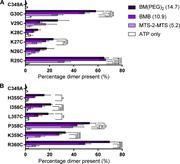
Figure 5. Specific amino and carboxyl-terminal cysteine residues form cross-links with ATP pretreatment. (A) Histogram showing the average percentage dimer present for R25C to G30C tested with all three cross-linkers in the presence of 300 µM ATP. This shows that only R25C and G30C show 40–60% dimerization. (*, P < 0.05; **, P < 0.01; ***, P < 0.001; ****, P < 0.0001, n = 3–5). (B) Histogram showing the average percentage dimer present for H355C to R360C tested with all three cross-linkers in the presence of 300 µM ATP. This shows that only P358C and R360C show 40–60% dimerization. (*, P < 0.05; **, P < 0.01; ***, P < 0.001; ****, P < 0.0001; n = 3–5).
Published: 09 January 2019
Figure 5. Specific amino and carboxyl-terminal cysteine residues form cross-links with ATP pretreatment. (A) Histogram showing the average percentage dimer present for R25C to G30C tested with all three cross-linkers in the presence of 300 µM More about this image found in Specific amino and carboxyl-terminal cysteine residues form cross-links wit...
Images
Figure 6. Visualization of cross-links on structural models. (A) TM1 of the hP2X1R in the closed state and residues 25–29 mutated to cysteines with BMB (10.9 Å) as cross-linker. (B) Cartoon representation of TM1 and N-terminal region (one subunit) for an ab initio model with residues 25 in cross-linking distance of the hP2X1R in the closed state (gray) and the hP2X1R in the ATP-bound state homology model (black). Main chain atoms for the residues 25–29 are shown as spheres, colored in rainbow order; zoom-in box refers to the superimposition of the N-terminal region. (C) Cartoon representation of TM1 and N-terminal region (trimer) for the ab initio model of the hP2X1R in the closed state (gray) and the hP2X1R in the ATP-bound state homology model (black). (D) Same representation as C but with TM2 and C-terminal region added. (E) Transmembrane region of the hP2X1R G30C homology model in the closed state viewed along the membrane. The N-terminal TM-helices are shown in blue, C-terminal TM helices in white. The C30 side-chain is shown as spheres with the cysteine sulfur atom in yellow. The red double arrows indicate the actual C30-C30 sulfur-sulfur distance as derived from the homology model (28 Å), and the C30-C30 sulfur-sulfur distance that is required to accommodate a G30C-G30C cross-link (12 Å). (F) As in E, but rotated by 90°, view perpendicular to the membrane from the intracellular side.
Published: 09 January 2019
Figure 6. Visualization of cross-links on structural models. (A) TM1 of the hP2X1R in the closed state and residues 25–29 mutated to cysteines with BMB (10.9 Å) as cross-linker. (B) Cartoon representation of TM1 and N-terminal region (one More about this image found in Visualization of cross-links on structural models. (A) TM1 of the hP2X1R i...

or Create an Account

Close Modal
Close Modal