Skip to Main Content
Skip Nav Destination
1-20 of 62
Follow your search
Access your saved searches in your account

Would you like to receive an alert when new items match your search?
Close Modal
Sort by
Images
Published: 16 August 2019
Figure 1. The central role of pDCs and the produced IFN-I in promoting inflammatory and autoimmune diseases. IFN-I and IFN-III are produced by pDCs in response to signals delivered by TLR7 and/or TLR9 in response to the sensing of self–nucleic More about this image found in The central role of pDCs and the produced IFN-I in promoting inflammatory a...
Images
Published: 16 August 2019
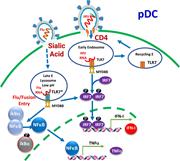
Figure 2. CD4-mediated endocytosis of HIV-1 leads to persistent/repeated IFN-I induction in pDCs. HIV-1/CD4 traffics predominantly to early and recycling endosomes, where HIV-1 genomic RNA interacts with TLR7 to activate MYD88, NFκB, IRF7, and More about this image found in CD4-mediated endocytosis of HIV-1 leads to persistent/repeated IFN-I induct...
Images
Published: 16 August 2019
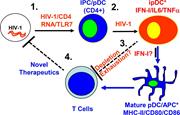
Figure 3. Induction of inflammatory or immature pDCs (ipDCs) during chronic HIV-1 infection. HIV-1 activates pDCs via CD4-dependent endocytosis and HIV-1 RNA-mediated TLR7 activation (1). Persistent activation of pDCs by HIV-1 leads to More about this image found in Induction of inflammatory or immature pDCs (ipDCs) during chronic HIV-1 inf...
Journal Articles
Journal Articles
Images
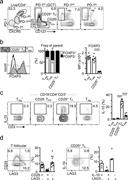
Figure 1. Identification of IL-10–producing CD25+ FOXP3− human TF cells in human tonsils. (a) Flow cytometric plots showing gating strategy to identify the indicated populations. (b) Flow cytometric plots and quantification (n = 8) showing percentage of FOXP3+ cells and FOXP3 mean fluorescence intensity (MFI) within the indicated subset according to panel a. Data are representative of 10 independent experiments. (c) Flow cytometric plots and quantification of PMA/ionomycin-stimulated tonsillar cell suspensions showing IL-10 expression in the indicated subset (n = 9). Data are representative of 10 experiments. (d) Flow cytometric plots and quantification showing LAG3 and CD25 expression in total TF cells (n = 14; left), and IL-10 and LAG3 in CD25+ TF cells (n = 5; right). Data are representative of five independent experiments. In all graphs, bars represent medians, and each dot represents a single tonsil donor. ****, P ≤ 0.0001, nonparametric Mann–Whitney U test.
Published: 17 June 2019
Figure 1. Identification of IL-10–producing CD25+ FOXP3 human TF cells in human tonsils. (a) Flow cytometric plots showing gating strategy to identify the indicated populations. (b) Flow cytometric plots and quantification (n = 8) showing More about this image found in Identification of IL-10–producing CD25+ FOXP3 human ...
Images
Figure 2. Human CD25+ TF cells repress T cell proliferation. (a) Volcano plot showing Affymetrix RNA microarrays comparing gene expression between IL-10–producing and nonproducing TF cells (n = 3). (b) Flow cytometric plots showing coexpression of CADM1 with IL-10 or FOXP3 in PMA/ionomycin-stimulated tonsillar cell suspensions in the indicated subset (n = 5). Data are representative of two independent experiments. (c and d) Flow cytometric plots and quantification of proliferating CD4+CD25− responder T cells according to dilution of the cytoplasmic fluorescent dye CTV after 3 d of α-CD3 and α-CD28 stimulation in the presence or absence of T reg cells (n = 10), CD25+ TF cells (n = 8), and CD25− TFH cells (n = 5; c) or T reg cells (n = 3), CADM1+CD25+ TF cells (n = 3), and CADM1−CD25− T cells (n = 3; d). Bars represent medians, and each dot represents the mean value of cultures set up in triplicate from a single donor. Data are representative of five (c) and two (b and d) independent experiments. ns, not significant; **, P ≤ 0.01; ***, P ≤ 0.001, nonparametric Mann–Whitney U test (c, left panel) and two-way ANOVA (c, right panel, and d).
Published: 17 June 2019
Figure 2. Human CD25+ TF cells repress T cell proliferation. (a) Volcano plot showing Affymetrix RNA microarrays comparing gene expression between IL-10–producing and nonproducing TF cells (n = 3). (b) Flow cytometric plots showing More about this image found in Human CD25+ TF cells repress T cell proliferation. (a...
Images
Figure 3. Human CD25+ TF cells may be peripherally induced and express high CTLA4 but low IL-2 production. (a) Bisulfite sequencing of the 11 CpG islands of the FOXP3 CNS2 locus with 12 representative clones per population and per donor (filled circle, methylated; open circle, demethylated). (b) Flow cytometric plots and quantification showing HELIOS expression in the indicated cell subsets (n = 8). Data are representative of three independent experiments. (c) Flow cytometric plots and quantification (n = 8) showing CTLA4 expression in the indicated cell subset. Data are representative of five independent experiments. (d and e) Flow cytometric plots and quantification showing gating strategy (d) and IL-2 expression of PMA/ionomycin-stimulated tonsillar cell suspensions in the indicated subset (n = 8; e). Data are representative of two independent experiments. In all graphs, bars represent medians, and each dot represents a single donor. **, P ≤ 0.01; ***, P ≤ 0.001, nonparametric Mann–Whitney U test. FSCA, forward scatter.
Published: 17 June 2019
Figure 3. Human CD25+ TF cells may be peripherally induced and express high CTLA4 but low IL-2 production. (a) Bisulfite sequencing of the 11 CpG islands of the FOXP3 CNS2 locus with 12 representative clones per population and per donor (filled More about this image found in Human CD25+ TF cells may be peripherally induced and ...
Images
Figure 4. Human CD25+ TF cells’ transcriptome resembles that of murine TFR cells. (a) Flow cytometric plots showing the gating strategy used to FACS-purify each of the indicated cell subsets. (b) Heatmap analysis of RNA-seq data showing differentially expressed genes in CD25+ TF cells compared with the indicated T cell populations (log2 value of counts per million) extracted from the tonsils of three individuals. (c) Selected transcripts from panel b in the indicated subsets (RNA counts per million [CPM]). (d) Flow cytometric plots and quantification (n = 8) of the indicated proteins. Data are representative of at least three independent experiments. In all graphs, bars represent medians; each dot represents a single tonsil donor. ***, P ≤ 0.001, nonparametric Mann–Whitney U test.
Published: 17 June 2019
Figure 4. Human CD25+ TF cells’ transcriptome resembles that of murine TFR cells. (a) Flow cytometric plots showing the gating strategy used to FACS-purify each of the indicated cell subsets. (b) Heatmap analysis of RNA-seq data showing More about this image found in Human CD25+ TF cells’ transcriptome resembles that of...
Images
Figure 5. Human CD25+ TF cells repress TFH cells and induction of IgE switching. (a and b) Flow cytometric plots (a) and quantification (n = 8; b) of CTV-labeled-TFH cells, cocultured with memory B cells with or without CD25+ TF cells, showing expression of the indicated proteins after 3 d. Upper panels are representative data for a single donor, and lower panels are pooled values from different donors and experiments. Data in each panel is representative of at least five independent experiments. (c) Flow cytometric plots and quantification of CTV-labeled TFH cells, cocultured with or without CD25+ TF cells, showing expression of the indicated proteins after 3 d of α-CD3 and α-CD28 stimulation. (d) Quantification of plasma cell (CD27+ CD38+) differentiation (n = 25) or proliferation (n = 12) from memory B cells cocultured with TFH cells, CD25+ TF cells, or both in the presence of SEB (500 ng/ml), IL-4, and IL-13 (40 ng/ml) for 7 d. (e) IgG (n = 10) or IgE (n = 14) in coculture supernatants of cocultures as in panel d. Data were normalized to values from cultures without T cells. Data in d and e were pooled from eight independent experiments. (f and g) Quantification of γGLTs (top) or εGLTs via qPCR in naive B cells incubated with TFH cells with or without CD25+ TF cells (n = 19; f), and naive B cells cocultured with CD25+ TF cells in the presence or absence of an IL-10 blocking antibody (n = 10; g). GLT expression values were calculated using the ΔΔCT method and were normalized to RPL13A levels, then normalized to the untreated control. Data were pooled from five independent experiments. Bars represent means of three technical replicates (b and c) or medians (d–g), each dot represents a single tonsil donor, and error bars represent standard deviations. ns, not significant; *, P ≤ 0.05; **, P ≤ 0.01; ***, P ≤ 0.001; ****, P ≤ 0.0001, two-tailed Student’s t test (b, top panels, and c–g) and nonparametric paired Wilcoxon test (b, bottom panels). All data are representative of at least three independent experiments. MFI, mean fluorescence intensity; RU, relative units.
Published: 17 June 2019
Figure 5. Human CD25+ TF cells repress TFH cells and induction of IgE switching. (a and b) Flow cytometric plots (a) and quantification (n = 8; b) of CTV-labeled-TFH cells, cocultured with memory B cells with or without CD25+ TF cells, showing More about this image found in Human CD25+ TF cells repress TFH cells and...
Images
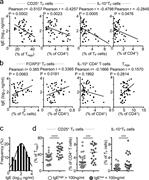
Figure 6. Tonsillar CD25+ TF cells inversely correlate to total IgE in the serum. (a and b) Pearson correlation analyses between serum total IgE and the frequency of the indicated cell subset in tonsil (n = 49). Data are representative of two independent experiments that were pooled together. (c) Histogram showing the frequency distribution of serum total IgE (log10 ng/ml) from 49 children (mean = 2.07). (d) Quantification of the frequency of the indicated cell subset from tonsil donors with high (>100 ng/ml) or low (<100 ng/ml) total serum IgE titers. Bars represent medians, and dots represent individual tonsil donors (n = 49). Data are representative of two independent experiments that were pooled together. ***, P ≤ 0.001; ****, P ≤ 0.0001, nonparametric Mann–Whitney test U test.
Published: 17 June 2019
Figure 6. Tonsillar CD25+ TF cells inversely correlate to total IgE in the serum. (a and b) Pearson correlation analyses between serum total IgE and the frequency of the indicated cell subset in tonsil (n = 49). Data are representative of two More about this image found in Tonsillar CD25+ TF cells inversely correlate to total...
Journal Articles
Images
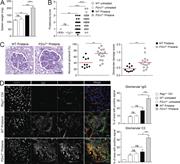
Figure 1. Increased lupus nephritis severity in P2rx7−/− mice. (A) Spleen weight of untreated WT (n = 7), P2rx7−/− (n = 6), pristane-treated WT (n = 19), and P2rx7−/− (n = 18) mice. (B) Proteinuria score of pristane-treated WT and P2rx7−/− mice. Each dot represents an individual mouse, and horizontal lines represent median values. WT untreated (n = 8), P2rx7−/− untreated (n = 8), WT pristane (n = 47), P2rx7−/− pristane (n = 53). (C) Representative pristane-induced glomerular injury in periodic-acid-Schiff–stained kidney sections (bar, 50 µm) with proportion of affected glomeruli (left graph) and glomerular injury score (right graph). WT pristane (n = 10), P2rx7−/− pristane (n = 15). (D) Confocal microscopy of kidneys stained for IgG (green) and complement C3 (red) to detect glomerular immune deposits. Rag1−/− mice were used as negative control for IgG staining (bars, 20 µm). Histograms show means ± SEM for glomerular IgG (top) and C3 depositions (bottom) of three independent experiments. Rag1−/− Ctrl (n = 2), WT untreated (n = 3), P2rx7−/− untreated (n = 3), WT pristane (n = 8), P2rx7−/− pristane (n = 10). All data are from mice at 33 wk after injection. Two-tailed Mann–Whitney U test. *, P < 0.05; **, P < 0.01; ***, P < 0.001; ****, P < 0.0001. ns, not significant.
Published: 17 January 2019
Figure 1. Increased lupus nephritis severity in P2rx7−/− mice. (A) Spleen weight of untreated WT (n = 7), P2rx7−/− (n = 6), pristane-treated WT (n = 19), and P2rx7−/− (n = 18) mice. (B) Proteinuria score of pristane-treated WT and P2rx7−/− More about this image found in Increased lupus nephritis severity in P2rx7−/− ...
Images
Figure 2. Increased serum autoantibodies and splenic plasma cells in P2rx7−/− mice. (A) Serum Ig isotype concentrations in untreated (n = 6 for IgM and IgA, n = 16 for total IgG, n = 12 for IgG subclasses) and pristane-treated (n = 15 for IgM and IgA, n = 40 for total IgG, n = 15 for IgG subclasses) mice by ELISA. Mean ± SEM are shown. Two-tailed nonparametric Mann–Whitney U test. (B) Representative immunofluorescence of HEp-2 cells and relative distribution of ANA IgG staining patterns with sera from pristane-treated WT and P2rx7−/− mice. Bar, 50 µm. The number in the circle indicates the number of analyzed mice. Fisher's exact test with χ2. (C) ELISA (QUANTA-Lite ANA) for the semiquantitative detection of self-reactive IgG. Each dot represents an individual mouse, and horizontal lines represent median values. MRL/lpr sera were used as positive controls. MRL/lpr (n = 5), WT untreated (n = 11), P2rx7−/− untreated (n = 11), WT pristane (n = 29), P2rx7−/− pristane (n = 33). Two-tailed Mann–Whitney U test. Distribution of sera from the indicated mice as nonreactive or reactive in the assay is shown. (D) Absolute number of IgG-secreting cells by ELISPOT assay in spleens from the indicated mice. Mean ± SEM of three independent experiments. WT untreated (n = 4), P2rx7−/− untreated (n = 4), WT pristane (n = 7), P2rx7−/− pristane (n = 9). (E) Representative contour plots, relative frequency and absolute number of splenic plasma cells gated as TCRβ−CD138+CD44+ cells from untreated WT (n = 6) and P2rx7−/− (n = 5) mice and treated WT (n = 17) and P2rx7−/− (n = 16) mice. Two-tailed Mann–Whitney U test. Mean ± SEM are shown in bar graphs. *, P < 0.05; **, P < 0.01; ***, P < 0.001; ****, P < 0.0001. ns, not significant.
Published: 17 January 2019
Figure 2. Increased serum autoantibodies and splenic plasma cells in P2rx7−/− mice. (A) Serum Ig isotype concentrations in untreated (n = 6 for IgM and IgA, n = 16 for total IgG, n = 12 for IgG subclasses) and pristane-treated (n = 15 for IgM More about this image found in Increased serum autoantibodies and splenic plasma cells in P2rx7...
Images
Figure 3. Increased GC reaction and Tfh cells in P2rx7−/− mice. (A) Representative contour plots for PNA and Fas staining on gated CD19+B220+ splenocytes, and frequency and absolute number in untreated (n = 12) and treated (n = 37) WT as well as P2rx7−/− mice. (B) Representative images of spleen sections from pristane-treated WT and P2rx7−/− mice stained with anti-IgD, -CD4, –GL-7, and –PD-1 antibodies (bar, 100 µm) and inset zooming on GC cells (bar, 50 µm). The number of GCs per field at 10-fold magnification in individual mice (n = 5) and GC areas in WT (n = 22) and P2rx7−/− (n = 37) mice are shown in right panels. Two-tailed Mann–Whitney U test. Mean ± SEM are shown in bar graphs. (C) Representative contour plots and frequency and absolute number of CXCR5+ICOS+ (untreated WT, n = 10; P2rx7−/−, n = 9; treated WT, n = 30; and P2rx7−/−, n = 34 mice) and CXCR5+PD-1+ (untreated WT, n = 9; P2rx7−/−, n = 8; treated WT, n = 17; and P2rx7−/−, n = 22 mice) cells within gated TCRβ+CD4+ splenocytes. Bar graphs: mean ± SEM. Two-tailed Mann–Whitney U test. (D) Representative contour plots for CCR7 and PD-1 among CXCR5+ CD4 T cells, and frequency of CCR7lo/–PD-1hi CD4 Tfh cells in the spleen of indicated mice. WT untreated (n = 8), P2rx7−/− untreated (n = 13), WT pristane (n = 10), P2rx7−/− pristane (n = 17). Two-tailed Mann–Whitney U test. Each dot in graphs represents an individual mouse, and horizontal lines represent median values. *, P < 0.05; **, P < 0.01; ***, P < 0.001; ****, P < 0.0001. ns, not significant.
Published: 17 January 2019
Figure 3. Increased GC reaction and Tfh cells in P2rx7−/− mice. (A) Representative contour plots for PNA and Fas staining on gated CD19+B220+ splenocytes, and frequency and absolute number in untreated (n = 12) and treated (n = 37) WT as well as More about this image found in Increased GC reaction and Tfh cells in P2rx7−/−...
Images
Figure 4. Impaired primary, secondary, and memory responses to NP-OVA in P2rx7−/− mice. (A) Scheme of the immunization protocol and time points of analysis. (B) Frequency and absolute number of CXCR5+ICOS+ Tfh cells in the draining lymph nodes from untreated or immunized WT and P2rx7−/− mice at 1 wk after s.c. injection of NP-OVA in MF59 (WT unimmunized, n = 5; P2rx7−/− unimmunized, n = 5; WT NP-OVA, n = 8; P2rx7−/− NP-OVA, n = 8), representative contour plots of staining with human CLIP and OVA tetramers, and statistics of OVA tetramer positive cells (n = 4). (C) Frequency and absolute number of GC B cells (same samples as above) gated as PNAhiB220+ among CD19+ B cells (upper bar graphs) and of NP-positive GC B cells (lower bar graphs) with representative contour plots. (D) Frequency and absolute number of NP-positive GC B cells in the spleen of the indicated mice within secondary response to NP-OVA. WT unimmunized (n = 2), P2rx7−/− unimmunized (n = 2), WT NP-OVA (n = 4), and P2rx7−/− NP-OVA (n = 4). Absolute number of NP-specific IgG secreting cells in the spleen (WT NP-OVA, n = 8; and P2rx7−/− NP-OVA, n = 9) and BM (WT NP-OVA, n = 7; and P2rx7−/− NP-OVA, n = 8) of immunized mice. (E) Frequency of OVA tetramer positive cells among CD4+ T cells (n = 5) and absolute number of NP-specific IgG secreting cells in the spleen of the indicated mice. WT and P2rx7−/− no recall (n = 4), WT and P2rx7−/− NP-OVA (n = 5). Unpaired Student’s t test. Each dot in graphs represents an individual mouse, and horizontal lines represent median values. *, P < 0.05; **, P < 0.01. ns, not significant.
Published: 17 January 2019
Figure 4. Impaired primary, secondary, and memory responses to NP-OVA in P2rx7−/− mice. (A) Scheme of the immunization protocol and time points of analysis. (B) Frequency and absolute number of CXCR5+ICOS+ Tfh cells in the draining lymph nodes More about this image found in Impaired primary, secondary, and memory responses to NP-OVA in P2rx...
Images
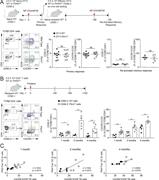
Figure 5. Selective expansion of P2rx7−/− Tfh cells upon pristane injection but not conventional immunization. (A) Scheme of the adoptive transfer and immunization experiment; representative plots of donor CD4+ and CXCR5+ICOS+ T cells within transgenic cells recovered from the draining lymph nodes of recipient mice 1 wk after primary immunization and frequency of recovered donor cells within individual mice after primary immunization (10 mice per group) and secondary response (five mice per group; mean ± SEM). (B) Scheme of the adoptive transfer and pristane administration experiment; representative plots of CD90.2+ donor CD4+ T cells from spleen at 2 mo after transfer, frequency of recovered donor CXCR5+ICOS+ CD4+ T cells within individual mice at 1, 2, and 4 mo after injection of pristane (mean ± SEM). Each dot in graphs represents an individual mouse. Two-tailed Mann–Whitney U test. *, P < 0.05; **, P < 0.01. (C) Correlation between GC B cells and donor Tfh cell frequencies at the indicated time points. The correlation coefficient r and the respective P value were calculated with nonparametric Spearman test. Each dot in graphs represents an individual mouse.
Published: 17 January 2019
Figure 5. Selective expansion of P2rx7−/− Tfh cells upon pristane injection but not conventional immunization . (A) Scheme of the adoptive transfer and immunization experiment; representative plots of donor CD4+ and CXCR5+ICOS+ T cells within More about this image found in Selective expansion of P2rx7−/− Tfh cells upon ...
Images
Figure 6. P2X7-mediated control of PSGL-1 down-regulation and IFN-γ secretion in pristane-treated mice. (A) Frequency of PNA+Fas+ GC splenic B cells (untreated WT, n = 3; P2rx7−/−, n = 3; and Icos−/−P2rx7−/−, n = 3; pristane-treated WT, n = 9; P2rx7−/−, n = 9; and Icos−/−P2rx7−/−, n = 5). (B) Serum ANA IgG detection by ELISA (MRL/lpr, n = 2; untreated WT, n = 4; P2rx7−/−, n = 4; and Icos−/−P2rx7−/−, n = 5; pristane-treated WT, n = 9; P2rx7−/−, n = 10; and Icos−/−P2rx7−/−, n = 10). (C) Proteinuria score (untreated WT, n = 3; P2rx7−/−, n = 3; and Icos−/−P2rx7−/−, n = 4; pristane-treated WT, n = 8; P2rx7−/−, n = 8; and Icos−/−P2rx7−/−, n = 8) in the indicated mice at 33 wk after pristane injection. Each dot represents an individual mouse, and horizontal lines represent median values. (D) Representative contour plots for PSGL-1 and CD62L on splenic CD4+ T cells, frequency and absolute number (mean ± SEM) of PSGL1lo/−CD62L− cells from untreated WT (n = 12), P2rx7−/− (n = 10), Icos−/−P2rx7−/− (n = 5), treated WT (n = 38), P2rx7−/− (n = 37), and Icos−/−P2rx7−/− (n = 8) mice. (E) Contour plots show representative intracellular staining for IL-21, IL-17, and IFN-γ on gated CD4+ICOS+PSGL1lo/− cells from spleens of treated WT and P2rx7−/− mice. Statistics from three independent experiments are shown (mean ± SEM, untreated mice, n ≥ 4; treated mice, n ≥ 8). Two-tailed Mann–Whitney U test. *, P < 0.05; **, P < 0.01; ***, P < 0.001; ****, P < 0.0001. ns, not significant.
Published: 17 January 2019
Figure 6. P2X7-mediated control of PSGL-1 down-regulation and IFN-γ secretion in pristane-treated mice . (A) Frequency of PNA+Fas+ GC splenic B cells (untreated WT, n = 3; P2rx7−/−, n = 3; and Icos−/−P2rx7−/−, n = 3; pristane-treated WT, n = 9; More about this image found in P2X7-mediated control of PSGL-1 down-regulation and IFN-γ secretion in pris...
Images
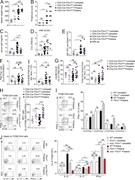
Figure 7. Increased PIL severity and IFN-γ secretion by ICOS+PSGL-1lo/− CD4 T cells in mice with conditional deletion of P2rx7 in T cells. (A) Spleen weight of untreated CD4-Cre P2rx7WT/WT (n = 5), CD4-Cre P2rx7fl/fl (n = 12), pristane-treated CD4-Cre P2rx7WT/WT (n = 21), and CD4-Cre P2rx7fl/fl (n = 15) mice. (B) Proteinuria score. (C) Serum IgG concentration. (D) Semiquantitative detection of self-reactive IgG by ELISA (QUANTA-Lite ANA) in the same mice. (E–G) Absolute numbers of IgG-secreting cells (E) and frequencies and absolute numbers of CD19+B220+PNA+ Fas+ (F) and TCRβ+CD4+CXCR5+ICOS+ (G) cells in the spleen of the same mice. (H) Representative contour plots for ICOS and PSGL-1 staining among CD4+ T cells from spleen and frequency of IFN-γ secreting cells within the ICOS+PSGL-1lo/− CD4+ T cells of the same mice. Each dot represents an individual mouse; median or mean ± SEM is shown. Two-tailed Mann–Whitney U test. (I) Representative contour plots for ICOS and PSGL-1 staining among CD4+ T cells from the spleen of pristane-treated WT and P2rx7−/− mice, and frequency of IFN-γ–secreting cells within the indicated subsets of untreated and treated mice. Statistics from three independent experiments are shown. Mean ± SEM (untreated mice, n ≥ 4; treated mice, n ≥ 8). (J) Representative contour plots for intracellular staining of IL-21, IL-17, and IFN-γ in CD4+ T cells from spleen of pristane-treated WT, P2rx7−/−, and Icos−/−P2rx7−/− mice and statistics of frequencies. Mean ± SEM (n = 2 independent experiments with at least five mice). Student’s t test. *, P < 0.05; **, P < 0.01; ***, P < 0.001; ****, P < 0.0001. ns, not significant.
Published: 17 January 2019
Figure 7. Increased PIL severity and IFN-γ secretion by ICOS+PSGL-1lo/− CD4 T cells in mice with conditional deletion of P2rx7 in T cells. (A) Spleen weight of untreated CD4-Cre P2rx7WT/WT (n = 5), CD4-Cre P2rx7fl/fl (n = 12), pristane-treated More about this image found in Increased PIL severity and IFN-γ secretion by ICOS+PSGL-1lo...
Images
Figure 8. P2X7-mediated caspase activation and Gsdmd cleavage in Tfh cells. (A) Time monitoring of YO-PRO-1 uptake after stimulation with BzATP in ICOS−PD-1− and ICOS+PD-1+ cells within CXCR5+ CD4+ T cells from spleen of WT and P2rx7−/− mice at 33 wk after pristane administration and frequency of responding cells in the two subsets from WT mice (n = 14). (B) Analysis by flow cytometry and statistics of caspase activation in purified WT and P2rx7−/− Tfh cells upon stimulation with BzATP as indicated (n = 4). (C) Representative Western blot of full-length and caspase-cleaved Gsdmd (FL and Nterm, respectively), and actin on the same cells as in B, either untreated or stimulated with BzATP. A shorter exposure for GsdmFL is shown. Histograms show the statistics of GsdmdNterm relative expression normalized on GsdmFL in the indicated conditions (n = 3). Bar graphs: mean ± SEM. Two-tailed Mann–Whitney U test. *, P < 0.05; **, P < 0.01; ***, P < 0.001; ****, P < 0.0001. ns, not significant.
Published: 17 January 2019
Figure 8. P2X7-mediated caspase activation and Gsdmd cleavage in Tfh cells. (A) Time monitoring of YO-PRO-1 uptake after stimulation with BzATP in ICOSPD-1 and ICOS+PD-1+ cells within CXCR5+ CD4+ T cells from spleen of WT and P2rx7−/− mice at More about this image found in P2X7-mediated caspase activation and Gsdmd cleavage in Tfh cells. (A) Time...

or Create an Account

Close Modal
Close Modal