Skip to Main Content
Skip Nav Destination
1-20 of 113
Follow your search
Access your saved searches in your account

Would you like to receive an alert when new items match your search?
Close Modal
Sort by
Journal Articles
Images
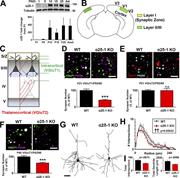
Figure 1. Impaired synaptic connectivity in α2δ-1–deficient cortex. (A) Top: Western blot of α2δ-1 expression from WT cortex and hippocampus from postnatal day (PND) 1 to adult. Tubulin: loading control. Bottom: α2δ-1 expression as fold change from P1 (n = 3 mice per age). (B) Diagram of a mouse coronal brain slice including area V1. Layer I is the S/Z where IHC analyses were performed. Dendrites from this region are primarily from neurons whose cell bodies reside in LII/III. (C) Schematic of excitatory synaptic input to area V1. (D) Top: IHC images of pre- (VGluT1), post- (PSD95), and colocalized (white arrowheads) synaptic puncta from V1 of P21 WT and α2δ-1 KO mice. Bottom: Intracortical synapse quantification as percentage of WT (n = 3 mice per genotype). One-way ANOVA with Tukey’s multiple comparisons post hoc test. (E) Top: Thalamocortical synapse staining shown with pre- (VGluT2), post- (PSD95), and colocalized (white arrowheads) synaptic puncta from V1 of P21 WT and α2δ-1 KO mice. Bottom: Quantification of thalamocortical synapses as percentage of WT (n = 3 mice per genotype). One-way ANOVA. Error bars represent SEM. (F) IHC staining from area V1 at P40 showing VGluT1/PSD95 intracortical synapses in WT and α2δ-1 KO (n = 3 mice per genotype). Nested ANOVA. (G) Representative camera lucida drawings from LII/III pyramidal neurons in P21 WT and α2δ-1 KO. (H) Sholl analysis results show morphological complexity in P21 WT and α2δ-1 KO neurons (n = 4 neurons/mouse; three mice/genotype). ††, P = 0.00023; ANCOVA. (I) Total number of intersections measured via Sholl analysis (left) and total length of the dendritic arbor (right) compared between P21 WT and α2δ-1 KO neurons. Unpaired two-tailed t test. Error bars represent SEM. Bars: (D, E, F) 2 µm; (G) 50 µm. ***, P < 0.0001.
Published: 27 July 2018
Figure 1. Impaired synaptic connectivity in α2δ-1–deficient cortex. (A) Top: Western blot of α2δ-1 expression from WT cortex and hippocampus from postnatal day (PND) 1 to adult. Tubulin: loading control. Bottom: α2δ-1 expression as fold change More about this image found in Impaired synaptic connectivity in α2δ-1–deficient cortex. (A) Top: Western...
Images
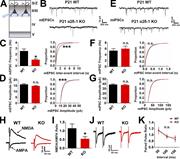
Figure 2. Lack of α2δ-1 results in decreased excitatory synaptic function. (A) Recordings were made from LII/III pyramidal neurons in V1 at P21. (B) mEPSC traces from WT and α2δ-1 KO pyramidal neurons. (C and D) Frequency (C, left), interevent interval (C, right), and amplitude (D) of mEPSCs from WT and α2δ-1 KO neurons (n = total of 12 cells from three animals/genotype). Left: Two-tailed t test. Right: Kolmogorov–Smirnov test. (E) mIPSC traces from WT and α2δ-1 KO pyramidal neurons. (F and G) Frequency (F, left), interevent interval (F, right), and amplitude (G) of mIPSCs from WT and α2δ-1 KO neurons (n = total of 10 cells from three animals/genotype). Left: Two-tailed t test. Right: Kolmogorov–Smirnov test. (H) Traces of NMDA-only and AMPA-only evoked currents from WT and α2δ-1 KO pyramidal neurons. (I) Quantification of NMDA/AMPA ratio between WT and α2δ-1 KO (n = total of 12 cells from three to four animals/genotype). Two-tailed t test. Error bars represent SEM. (J) Traces from paired pulse recordings from WT and α2δ-1 KO neurons. (K) Comparison of PPR between WT and α2δ-1 KO (n = total of 12 cells from three to four animals/genotype). One-way ANCOVA. Error bars represent SEM. *, P < 0.05; ***, P < 0.0001.
Published: 27 July 2018
Figure 2. Lack of α2δ-1 results in decreased excitatory synaptic function. (A) Recordings were made from LII/III pyramidal neurons in V1 at P21. (B) mEPSC traces from WT and α2δ-1 KO pyramidal neurons. (C and D) Frequency (C, left), More about this image found in Lack of α2δ-1 results in decreased excitatory synaptic function. (A) Recor...
Images
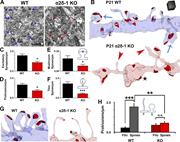
Figure 3. Ultrastructural analysis reveals that α2δ-1 promotes synapse and spine maturation. (A) Electron micrographs from P21 V1 WT and α2δ-1 KO brains. Arrows, excitatory synapses. Bar, 1 µm. (B) ssEM 3D reconstructions of LI dendrites from P21 WT and α2δ-1 KO V1. Red, excitatory postsynaptic densities; blue arrows, mushroom spines; red arrowheads, nonsynaptic filopodia; black star, bulged region of dendritic shaft. Cube, 0.5 µm3. (C–F) Densities calculated from reconstructions of excitatory synapses (C), protrusions (D), mushroom spines (E), and thin spines (F). E and F show the width (W) and length (L) measurements used in spine identification (n = 4 dendrites/animal; three animals per genotype). Two-tailed t test. Error bars represent SEM. (G) Spines in the WT and filopodia in the α2δ-1 KO. (H) Comparison of filopodia (F) and spine (S) densities between the WT and α2δ-1 KO (n = 4 dendrites/animal; three animals per genotype). One-way ANOVA with Tukey’s multiple comparisons post hoc test. *, P < 0.05; **, P < 0.001; ***, P < 0.0001.
Published: 27 July 2018
Figure 3. Ultrastructural analysis reveals that α2δ-1 promotes synapse and spine maturation. (A) Electron micrographs from P21 V1 WT and α2δ-1 KO brains. Arrows, excitatory synapses. Bar, 1 µm. (B) ssEM 3D reconstructions of LI dendrites from More about this image found in Ultrastructural analysis reveals that α2δ-1 promotes synapse and spine matu...
Images
Figure 4. α2δ-1 promotes synapse and spine development cell autonomously. (A) Schematic for in utero electroporation. (B) Confocal image of P21 V1. Cre+ neurons in LII/III express RTm. Dendrites were imaged in the S/Z. (C) Workflow for analysis with Imaris. (D) 3D confocal images (top) and Imaris reconstructions (bottom) of RTm+ dendrites from WT and α2δ-1 cKO brains. Pre- (VGluT1), post- (PSD95), and colocalized synaptic puncta in close proximity to the dendrite are shown. (E) Density of total spines, mature and intermediate spines, VGluT1, PSD95, and excitatory synapses between WT and α2δ-1 cKO dendrites (four dendrites/animal; three animals per condition). Two-tailed t test. (F) 3D confocal images (top) and Imaris reconstructions (bottom) of RTm+ dendrites from WT and α2δ-1 cKO brains. Pre- (VGluT1), post- (NR1), and colocalized synaptic puncta in close proximity to the dendrite are shown. (G) Density of NR1 and colocalized VGluT1/NR1 synapses of WT and α2δ-1 cKO dendrites (six dendrites/animal; three animals per condition). Two-tailed t test. Error bars represent SEM. Bars: (B) 200 µm; (C) 1 µm; (D and F, top) 2 µm; (D and F, bottom) 1 µm. *, P < 0.05; ***, P < 0.0001.
Published: 27 July 2018
Figure 4. α2δ-1 promotes synapse and spine development cell autonomously. (A) Schematic for in utero electroporation. (B) Confocal image of P21 V1. Cre+ neurons in LII/III express RTm. Dendrites were imaged in the S/Z. (C) Workflow for More about this image found in α2δ-1 promotes synapse and spine development cell autonomously. (A) Schema...
Images
Figure 5. TSP stimulates synaptogenesis via postsynaptic α2δ-1. (A) Mouse cortical neuron purification and TSP2 treatment timeline. (B) Cortical dendrites from α2δ-1 Het or KO mouse pups. Cells were treated with TSP2-containing or deficient growth media as well as the α2δ-1 ligand gabapentin. Colocalized pre- (VGluT1) and postsynaptic (Homer) puncta reveal sites of excitatory synapses (yellow arrowheads). (C) Density of excitatory synapses shown as fold change compared with α2δ-1 Het GM only (n = 30 cells per condition; two independent experiments). (D) Mating strategy to generate four genotypes (G1–G4) needed to determine site of action of α2δ-1 for synaptogenesis. (E) Cortical neuron plating scheme for α2δ-1/GFP experiments. (F) GFP+ cortical neuron dendrites from α2δ-1 Het or KO mouse pups. Cells were treated with TSP2-containing or -deficient growth media. Colocalized pre- (Bassoon) and postsynaptic (Homer) puncta reveal sites of excitatory synapses (yellow arrowheads). (G) Density of excitatory synapses shown as fold change compared with α2δ-1 Het/Het GM only (n = 30 cells per condition; two independent experiments). One-way ANOVA with Tukey’s multiple comparisons post hoc test. Bars, 5 µm. Error bars represent SEM. *, P < 0.05; **, P < 0.001; ***, P < 0.0001.
Published: 27 July 2018
Figure 5. TSP stimulates synaptogenesis via postsynaptic α2δ-1. (A) Mouse cortical neuron purification and TSP2 treatment timeline. (B) Cortical dendrites from α2δ-1 Het or KO mouse pups. Cells were treated with TSP2-containing or deficient More about this image found in TSP stimulates synaptogenesis via postsynaptic α2δ-1. (A) Mouse cortical n...
Images
Figure 6. TSP-induced synapse formation requires Rho GTPase Rac1. (A) Rat cortical neuron purification and TSP2 treatment timeline. (B) Rat cortical neurons transfected with a pX601 vector containing saCas9 and sgRNA identified by HA expression. The pX601-only control (top) did not include an sgRNA sequence. Neurons were treated with TSP2-containing or deficient growth media. Colocalized pre- (VGluT1) and postsynaptic (PSD95) puncta reveal sites of excitatory synapses (yellow arrowheads). (C) Excitatory synapse density on HA+ neurons (n = 30 cells per condition; two independent experiments). (D) GFP+ rat cortical neuron dendrites. After transfection with an shRNA-expressing vector (with a scrambled shRNA sequence [shScr] as a control), neurons were treated with TSP2-containing or -deficient growth media. Colocalized pre (Bassoon) and postsynaptic (Homer) puncta reveal sites of excitatory synapses (yellow arrowheads). (E) Excitatory synapse density on GFP+ neurons (n = 30 cells per condition; two independent experiments). Error bars represent SEM. (F and G) Same scheme as D and E except using shRNA against the Rho GEFs Kalirin-7, Tiam1, and β-Pix. One-way ANOVA with Tukey’s multiple comparisons post hoc test. Bars, 5 µm. *, P < 0.05; ***, P < 0.0001.
Published: 27 July 2018
Figure 6. TSP-induced synapse formation requires Rho GTPase Rac1. (A) Rat cortical neuron purification and TSP2 treatment timeline. (B) Rat cortical neurons transfected with a pX601 vector containing saCas9 and sgRNA identified by HA More about this image found in TSP-induced synapse formation requires Rho GTPase Rac1. (A) Rat cortical n...
Images
Figure 7. Rac1 promotes synaptic development and spinogenesis downstream of α2δ-1. (A) Schematic for organotypic slice culture/biolistic transfection. GFP+ dendrites (blue) are imaged at high magnification by confocal microscopy to capture spine morphology. (B) 3D confocal images (top) and Imaris reconstructions (bottom) of GFP+ dendrites in the S/Z of organotypic slices at DEV19 (i.e., P21) from Rac1f/f mice. Slices were transfected with cDNAs expressing GFP only or GFP plus Cre, α2δ-1 overexpression (OE), or α2δ-1 overexpression and Cre. Pre- (VGluT1), post- (PSD95), and colocalized (yellow) synaptic puncta in close proximity to the dendrite are shown. (C and D) Spine (C) and excitatory synapse (D) density from Rac1f/f dendrites (n = 12–18 dendrites per construct compiled from two independent experiments). One-way ANOVA with Dunnett’s multiple comparisons post hoc test (using GFP as control). Error bars represent SEM. Bars: (A, main) 50 µm; (A, inset) 5 µm; (B, top) 3 µm; (B, bottom) 1 µm. *, P < 0.05; ***, P < 0.0001.
Published: 27 July 2018
Figure 7. Rac1 promotes synaptic development and spinogenesis downstream of α2δ-1. (A) Schematic for organotypic slice culture/biolistic transfection. GFP+ dendrites (blue) are imaged at high magnification by confocal microscopy to capture spine More about this image found in Rac1 promotes synaptic development and spinogenesis downstream of α2δ-1. (A...
Images
Figure 8. α2δ-1 and Rac1 work in concert to rescue synapses and spines in α2δ-1–null cortex. (A) 3D confocal images (top) and Imaris reconstructions (bottom) of GFP+ dendrites in the S/Z of DEV19 (i.e., P21) organotypic slices from α2δ-1 Het or KO mice. Slices were transfected with GFP to visualize dendritic morphology. Pre- (VGluT1), post- (PSD95), and colocalized (yellow) synaptic puncta in close proximity to the dendrite are shown. (B) α2δ-1–variant constructs used in the rescue experiment. (C) Same format as A but with all images taken from α2δ-1 KO mice. Slices were transfected with GFP plus either α2δ-1 (overexpression construct; OE), α2δ-1 R351T, or α2δ-1 ΔTM. (D) Spine (top) and excitatory synapse (bottom) density from α2δ-1 Het or KO dendrites. n = 12–24 dendrites per construct compiled from two independent experiments. (E) Same format as C, but slices were transfected with either fast-cycling (FC) Rac1 or FC Rac1 plus α2δ-1 ΔTM. (F) Spine (top) and excitatory synapse (bottom) density from α2δ-1 KO dendrites. n = 12–24 dendrites per construct compiled from two independent experiments. One-way ANOVA with Dunnett’s multiple comparisons post hoc test (using KO as control). Error bars represent SEM. Bars: (A, C, and E, top) 3 µm; (A, C, and E, bottom) 1 µm. *, P < 0.05; ***, P < 0.0001.
Published: 27 July 2018
Figure 8. α2δ-1 and Rac1 work in concert to rescue synapses and spines in α2δ-1–null cortex. (A) 3D confocal images (top) and Imaris reconstructions (bottom) of GFP+ dendrites in the S/Z of DEV19 (i.e., P21) organotypic slices from α2δ-1 Het or More about this image found in α2δ-1 and Rac1 work in concert to rescue synapses and spines in α2δ-1–null ...
Images
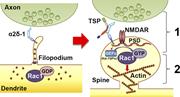
Figure 9. Model for α2δ-1’s dual role in promoting synapse and spine development. Early on, α2δ-1 is present on filopodia seeking contact with axonal partners. Rac1 is predominantly bound to GDP, rendering it inactive. After TSP binding, (1) α2δ-1 at the postsynaptic surface brings together pre- and postsynaptic components to form synapses; and (2) the C terminus of α2δ-1 triggers intracellular signaling via GEFs to stimulate GTP binding to Rac1, promoting actin reorganization to facilitate spine maturation.
Published: 27 July 2018
Figure 9. Model for α2δ-1’s dual role in promoting synapse and spine development. Early on, α2δ-1 is present on filopodia seeking contact with axonal partners. Rac1 is predominantly bound to GDP, rendering it inactive. After TSP binding, (1) More about this image found in Model for α2δ-1’s dual role in promoting synapse and spine development. Ea...
Images
Figure 1. Distribution and dynamics of actin blobs in dendrites. (A) Distribution of LifeAct (green) expressed by ppk-GAL4 in dendritic arbors of class IV da neurons marked by ppk-CD4-tdTomato (magenta). Arrows indicate high LifeAct signals in proximal dendrites, and arrowheads indicate these in terminal dendrites. (B) A terminal dendrite was straightened (top) to show uneven distribution of LifeAct signals. LifeAct intensities normalized to tdTomato intensities were shown along the shaft (bottom). x axis, μm; y axis, AU. (C) Time series images show actin blob propagation in the retrograde direction (see also Video 1). (C′) Kymograph shows changes of LifeAct intensities along the dendritic shaft (x axis) and time (0–66 s; y axis). (D–F) Time series images show anterograde movement of an actin blob (D; Video 2), the passage of an actin blob through a branching site indicated by asterisks (E; Video 3), and actin blob splitting (F; Video 4). (G) Bar graph shows percentages (y axis) of actin blobs versus velocities with a 0.2-µm/min increment (x axis). In total, 404 actin blobs in 164 dendrites of nine neurons in five experiments were recorded. (H) Bar graphs compare percentages (left; dot represents a neuron) and velocities (μm/min; right; dot represents a blob) of actin blobs between anterograde (Antero) and retrograde (Retro) propagation. In total, 152 actin blobs from nine neurons for retrograde and 160 actin blobs in nine neurons for anterograde were recorded. (I) Comparing actin blob numbers (in 10 µm; left; dot represents a dendrite segment) and velocities (μm/min; right) in nonterminal (Non-termi; 156 actin blobs from 50 dendrites) and terminal (Termi; 248 actin blobs from 69 dendrites) dendrites. (J) Comparing actin blob numbers in 10-µm terminal dendrites in early third (72 h AEL; replicate of terminal dendrites in I) and mid–third instar (96 h AEL; 15 dendrites from three neurons). Significance was determined using Student’s t test. ***, P < 0.001. Error bars represent SEM.
Published: 24 July 2018
Figure 1. Distribution and dynamics of actin blobs in dendrites. (A) Distribution of LifeAct (green) expressed by ppk-GAL4 in dendritic arbors of class IV da neurons marked by ppk-CD4-tdTomato (magenta). Arrows indicate high LifeAct signals in More about this image found in Distribution and dynamics of actin blobs in dendrites. (A) Distribution of...

or Create an Account

Close Modal
Close Modal