1-20 of 119157
Follow your search
Access your saved searches in your account

Would you like to receive an alert when new items match your search?
Close Modal
Sort by
Journal Articles
Images
Quantitative affinity proteomics identifies SQSTM1/p62 as an interaction partner of the CUL3 adaptor SHKBP1. (A) Workflow of the first set of proteomics experiments using the neddylation inhibitor MLN4924 to enrich unstable CRL targets (left) and cartoon representation of drug treatment mechanism (right). Cells were treated with MLN4924 (10 μM) or vehicle for 16 h. (B) Workflow of the second set of proteomics experiments using tandem UBA domain fusions to SHKBP1 to enrich ubiquitinated substrates (left) and model of ligase trap (right). Cells stably expressing the corresponding construct were treated with MG-132 (20 μM) for 2 h. (C) Workflow of the third set of proteomics experiments using the SHKBP1F44A CUL3 binding–deficient mutant to reduce CRL complex components in IP compared with SHKBP1WT (left) and corresponding model (right). (D–F) Volcano plots from the three SILAC MS proteomics experiments, showing log2 (fold changes of protein abundance in heavy/light samples) vs. statistical significance (–log10 [P value]). Proteins whose change was below the cutoff (fold change < 1.2) are indicated in gray. Those above the cutoff with P values above 0.05 are shown in green, and those with P values below 0.05 are shown in purple.
Published: 06 February 2026
Figure 1. Quantitative affinity proteomics identifies SQSTM1/p62 as an interaction partner of the CUL3 adaptor SHKBP1. (A) Workflow of the first set of proteomics experiments using the neddylation inhibitor MLN4924 to enrich unstable CRL targets More about this image found in Quantitative affinity proteomics identifies SQSTM1/p62 as an interaction pa...
Images
SHKBP1 interacts with p62 under resting conditions and upon blockade of neddylation and proteasomal degradation. (A) Western blot analysis of whole-cell lysates (WCL) and α-GFP immunoprecipitates from HeLa cells cotransfected with HA-p62 and GFP-SHKBP1 or GFP EV as a control. (B) Western blot analysis of WCL and α-GFP IP from HeLa cells cotransfected with GFP-p62 and HA-SHKBP1 or HA EV as a control. (C and D) Western blot analysis of WCL and α-GFP IP to assess the interaction between SHKBP1 and exogenous (C) or endogenous p62 (D). HeLa cells were transfected with GFP-SHKBP1 in combination with HA-p62 (C) or alone (D), and treated with DMSO or the proteasome inhibitor MG-132 (20 μM) for 2 h or MLN4924 (10 μM) for 16 h. (E) HeLa cells were cotransfected with GFP-p62 and mScarlet-i-SHKBP1, treated with DMSO or the proteasome inhibitor MG-132 (20 μM) for 2 h or MLN4924 (10 μM) for 16 h, and then observed under confocal microscope 24 h after transfection. Scale bars: 10 μm. EV, empty vector. Source data are available for this figure: SourceData F2.
Published: 06 February 2026
Figure 2. SHKBP1 interacts with p62 under resting conditions and upon blockade of neddylation and proteasomal degradation. (A) Western blot analysis of whole-cell lysates (WCL) and α-GFP immunoprecipitates from HeLa cells cotransfected with More about this image found in SHKBP1 interacts with p62 under resting conditions and upon blockade of ned...
Images
WD domain of SHKBP1 interacts with the PB1 domain of p62. (A) Domain map of SHKBP1 and truncations used in this paper. (B) Representative live-cell images showing localization of full-length (FL) and truncated forms of SHKBP1. HeLa cells were transfected with the indicated GFP-tagged SHKBP1 construct and observed by confocal microscopy 24 h after transfection. Scale bars: 10 μm. (C) Western blot analysis of α-GFP IP of lysates from HeLa cells cotransfected with HA-CUL3 and either the indicated GFP-SHKBP1 truncation or GFP EV as a control. (D) Western blot analysis of α-GFP IP of lysates from HeLa cells cotransfected with HA-p62 and either the indicated GFP-SHKBP1 truncation or GFP EV as a control. (E) Domain map of p62 and truncations used in this paper. (F) Representative live-cell images showing localization of p62 truncations. HeLa cells were transfected with the indicated GFP-tagged p62 construct and observed by confocal microscopy 24 h after transfection. Scale bars: 10 μm. (G) Western blot analysis of α-GFP IP of lysates from HeLa cells cotransfected with HA-SHKBP1 and the indicated GFP-p62 construct. (H) AlphaFold 3 structural prediction of the interaction between SHKBP1-WD domain (magenta) and p62 (green). Electrostatic interactions (blue) indicated between p62 residues K7, R18, D92, D93, and R96 and SHKBP1 residues R357, K359, D360, D362, and E367 (pink), respectively. ipTM = 0.73, pTM = 0.54. (I) Western blot analysis of α-GFP IP of lysates from HeLa cells cotransfected with the indicated FLAG-SHKBP1 and GFP-p62 constructs. (J) Quantification of FLAG-SHKBP1 from GFP IP samples to assess the strength of interaction between p62 and SHKBP1, with band intensities normalized to FLAG-SHKBP1 levels in whole-cell lysate (WCL) and to GFP-p62 levels in IP (n = 3). Exact P values (****P < 0.0001) indicated from two-way ANOVA with Tukey’s post hoc test. (K) Representative live-cell images showing localization of p62 point mutants. HeLa cells were transfected with the indicated GFP-tagged p62 construct and observed by confocal microscopy 24 h after transfection. Scale bars: 10 μm. EV, empty vector; FL, full-length. Source data are available for this figure: SourceData F3.
Published: 06 February 2026
Figure 3. WD domain of SHKBP1 interacts with the PB1 domain of p62. (A) Domain map of SHKBP1 and truncations used in this paper. (B) Representative live-cell images showing localization of full-length (FL) and truncated forms of SHKBP1. HeLa More about this image found in WD domain of SHKBP1 interacts with the PB1 domain of p62. (A) Domain map o...
Images
SHKBP1 inhibits p62 oligomerization without affecting its ubiquitination state. (A) Western blot analysis of in vivo ubiquitination assay. WT or SHKBP1 KO HeLa cells were cotransfected with His-ubiquitin and either GFP-p62 or GFP EV, and OE group represents WT cells that were also cotransfected with FLAG-SHKBP1. 24 h after transfection, cells were treated with MG-132 (20 μM) for 2 h and subjected to His pull-down using Ni-NTA agarose and western blot. (B) Western blot analysis of whole-cell lysates (WCL) from WT, SHKBP1 KO, and FLAG-SHKBP1–OE HeLa cells. (C) Representative live-cell images showing p62 body formation. WT or SHKBP1 KO HeLa cells were transfected with GFP-p62 either alone (left) or in combination with mScarlet-i-SHKBP1 (right, where OE refers to SHKBP1 OE in WT cells, and RE (rescue) refers to SHKBP1 OE in KO cells) and imaged using confocal microscopy 24 h after transfection. Scale bars: 20 μm. (D) Quantification of the average p62 body size of images shown in (C) from three independently plated samples. n = 51 (KO), 43 (WT), 37 (OE), and 35 (RE). Exact P values indicated (****P < 0.0001) from one-way ANOVA with Tukey’s post hoc test. (E) Western blot analysis of WCL from WT or SHKBP1 KO HeLa cells after DSP cross-linking. Cells were treated with MG-132 (0.5 μM) for 12 h, cross-linked with 0.4 mg/ml DSP at 4°C for 2 h, and lysed in IP lysis buffer with 1% SDS. The lysates were mixed with reducing or nonreducing loading buffer (i.e., with or without β-mercaptoethanol) and were analyzed by western blot. (F) Quantification of the ratio of intensities of monomeric to total p62. Intensities were normalized to the WT without the MG-132 treatment group. n = 6. Exact P values indicated (****P < 0.0001) from two-way ANOVA. EV, empty vector.
Published: 06 February 2026
Figure 4. SHKBP1 inhibits p62 oligomerization without affecting its ubiquitination state. (A) Western blot analysis of in vivo ubiquitination assay. WT or SHKBP1 KO HeLa cells were cotransfected with His-ubiquitin and either GFP-p62 or GFP EV, More about this image found in SHKBP1 inhibits p62 oligomerization without affecting its ubiquitination st...
Images
SHKBP1 decreases the fluidity of cellular p62 bodies. (A) WT and SHKBP1 KO HeLa cells were transfected with GFP-p62 alone or in combination with mScarlet-i-SHKBP1. 24 h later, cells were subjected to live-cell imaging by confocal microscopy and analysis by FRAP. Shown is a representative image for each condition. A prebleach image is provided along with a time course of postbleach images (postbleach time indicated in min). Scale bars: 2 μm. (B) Quantification of the fluorescence recovery rates of GFP-p62 from FRAP experiments. Data were analyzed with GraphPad Prism using nonlinear regression (curve fit), shown as mean ± standard deviation (SD). n = 3 for each group from three independent experiments. (C) Quantification of the half-life of fluorescence recovery of GFP-p62 from FRAP experiments. n = 20 for each group from three independent experiments. Exact P values indicated from one-way ANOVA with Tukey’s post hoc test. (D) Western blot analysis of the whole-cell lysates (WCL) from three HEK293T cell lines stably expressing endogenously tagged p62 using mNG: SHKBP1 WT, SHKBP1 KO, and SHKBP1 WT with transient overexpression (OE) of a large amount of FLAG-SHKBP1. The hollow arrowhead indicates the FLAG-SHKBP1, and the solid arrowhead indicates untagged (endogenous) SHKBP1. (E) Western blot analysis of WCL, FT, and anti-mNeonGreen IP to assess the interaction between SHKBP1 and endogenously tagged p62 in a HEK293T cell line stably expressing mNG-p62 and transfected with a small amount of FLAG-SHKBP1. For the p62 blot, asterisks denote background bands from p62 antibody and the solid arrowhead indicates mNG11-tagged p62. For the SHKBP1 blot, hollow arrowhead indicates the FLAG-SHKBP1, and the solid arrowhead indicates untagged (endogenous) SHKBP1. FT, flow-through. (F) Representative live-cell images showing single particle tracking of endogenous mNG-p62 by confocal microscopy. HEK293T cell lines stably expressing mNG-p62 were transfected with either mScarlet-i (in both SHKBP1 KO and SHKBP1 WT backgrounds) or mScarlet-i-SHKBP1 (in SHKBP1 WT background, “OE”). Tracked p62 bodies are indicated by magenta circles, and movement tracks are shown by colored lines. Scale bars: 5 μm. (G) Quantification of the mean speed of tracked p62 bodies in SHKBP1 KO, WT, and OE conditions. n = 200–300 p62 bodies collected from three independently plated samples. Exact P values indicated from one-way ANOVA with Tukey’s post hoc test. (H) Representative live-cell images showing endogenous p62 body shapes. HEK293T stable cell lines were transfected with the indicated mScarlet-i constructs and observed by confocal microscopy 24 h after transfection. Scale bars: 5 μm. (I–L) Quantification of mNG-p62 body roundness, solidity, circularity, and aspect ratio. n = 1,000–1,300 p62 bodies collected from three independently plated samples. Exact P values indicated from one-way ANOVA with Tukey’s post hoc test. Source data are available for this figure: SourceData F5.
Published: 06 February 2026
Figure 5. SHKBP1 decreases the fluidity of cellular p62 bodies. (A) WT and SHKBP1 KO HeLa cells were transfected with GFP-p62 alone or in combination with mScarlet-i-SHKBP1. 24 h later, cells were subjected to live-cell imaging by confocal More about this image found in SHKBP1 decreases the fluidity of cellular p62 bodies. (A) WT and SHKBP1 KO...
Images
SHKBP1 inhibits Keap1 aggregation and clearance via p62 bodies. (A) Western blot analysis of co-IP experiments for endogenous p62. Lysates were from WT HeLa cells, SHKBP1 KO HeLa cells, and HeLa cells transfected with mScarlet-i-SHKBP1 (OE). (B) Quantification of Keap1 from p62-IP to demonstrate the interaction between endogenous p62 and Keap1, with band intensities normalized to actin levels (n = 3). Exact P values indicated from one-way ANOVA with Tukey’s post hoc test. (C) Western blot analysis of whole-cell lysates (WCL) from WT and SHKBP1 KO HeLa cells treated with As(III) (10 µM) for the indicated times. (D) Quantification of Keap1 protein levels, with band intensities normalized to actin levels (n = 5). Exact P values indicated (****P < 0.0001) from two-way ANOVA. (E) Confocal microscopy analysis of WT and KO SHKBP1 HeLa cells cotransfected with GFP-p62 and miRFP-Keap1 and treated with As(III) (10 µM) for 4 h or with DMSO as a control. Scale bars: 20 μm. (F and G) Quantification of Keap1 aggregate size (F) and p62 body size (G) in WT and SHKBP1 KO HeLa cells after As(III) treatment (representative images shown in 6E). n = 11 images from three independently plated samples. Exact P values indicated from unpaired two-tailed Student’s t test. (H) Confocal microscopy analysis of HeLa cells cotransfected with GFP-p62 and miRFP-Keap1, with or without mScarlet-i-SHKBP1, and treated with As(III) (10 µM) for 4 h or with DMSO as a control. Scale bars: 20 μm. (I and J) Quantification of p62 body size (I) and the percentage of cells containing Keap1 aggregates (J) in control of SHKBP1-OE HeLa cells with or without As(III) treatment (representative images shown in 6H). n = 8–12 images from three independently plated samples. Exact P values indicated from two-way ANOVA. (K) Immunofluorescence (IF) analysis of endogenous p62 and Keap1 in WT and SHKBP1 KO HeLa cells by confocal microscopy. Cells were treated with As(III) (10 µM) for indicated times. Scale bars: 10 μm; 5 μm (zoomed-in images). (L–N) Quantification of Keap1 aggregate size (L), p62 body size (M), and colocalization of Keap1 and p62 (N) in WT and SHKBP1 KO HeLa cells with As(III) treatment for the indicated times (representative images shown in 6K). n = 13–18 images from three independently plated samples. Exact P values indicated (****P < 0.0001) from two-way ANOVA with Tukey’s post hoc test. Source data are available for this figure: SourceData F6.
Published: 06 February 2026
Figure 6. SHKBP1 inhibits Keap1 aggregation and clearance via p62 bodies. (A) Western blot analysis of co-IP experiments for endogenous p62. Lysates were from WT HeLa cells, SHKBP1 KO HeLa cells, and HeLa cells transfected with mScarlet-i-SHKBP1 More about this image found in SHKBP1 inhibits Keap1 aggregation and clearance via p62 bodies. (A) Wester...
Images
SHKBP1 KO enhances Nrf2 nuclear translocation. (A) IF analysis of endogenous Nrf2 in WT and SHKBP1 KO HeLa cells by confocal microscopy. Nuclei were stained with DAPI (magenta). Cells were treated with As(III) (10 µM) for the indicated times. Scale bars: 15 μm. (B) Quantification of nuclear levels of Nrf2 in WT and SHKBP1 KO HeLa cells with As(III) treatment for the indicated times (representative images shown in (A)). n = 9 images each including ∼30 cells from three independently plated samples. Exact P values indicated (****P < 0.0001) from two-way ANOVA with Tukey’s post hoc test. (C) Western blot analysis of cytosolic and nuclear fractions from WT and SHKBP1 KO HeLa cells treated with As(III) (10 µM) for the indicated times. Tubulin and Histone H3 are used to qualitatively assess the purity of each fraction. (D) Quantification of nuclear Nrf2 protein levels, with band intensities normalized to Histone H3 levels (n = 3). Exact P values indicated from two-way ANOVA. (E) Role of SHKBP1 in the p62-Keap1-Nrf2 pathway. Source data are available for this figure: SourceData F7.
Published: 06 February 2026
Figure 7. SHKBP1 KO enhances Nrf2 nuclear translocation. (A) IF analysis of endogenous Nrf2 in WT and SHKBP1 KO HeLa cells by confocal microscopy. Nuclei were stained with DAPI (magenta). Cells were treated with As(III) (10 µM) for the indicated More about this image found in SHKBP1 KO enhances Nrf2 nuclear translocation. (A) IF analysis of endogeno...
Journal Articles
Images
Images
Images
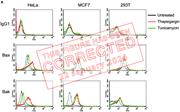
ER stress induces Bax and Bak conformational changes and oligomerization at the ER. (A) ER stresses induce the conformational changes of Bax and Bak. HeLa, MCF7, and 293T cells were treated with thapsigargin (Thap; 2 µM) or tunicamycin (Tuni; 5 µg/ml) for 36 h. Cells were fixed in 0.25% paraformaldehyde in PBS for 5 min. Cells were incubated with a control antibody (mouse IgG1) and conformation-sensitive antibodies against Bax or Bak, followed by incubation with FITC-conjugated secondary antibody. (B) ER stress induces Bax oligomerization at the ER. Wild-type MEFs were treated with brefeldin A (BFA; 10 µg/ml), Thap (2 µM), or Tuni (10 µg/ml) for 24 h. Cells were resuspended in hypotonic buffer A and disrupted. 5 mM BMH cross-linking reagent was added to cross-link the oligomerized proteins. Cells were subjected to subcellular fractionation to obtain the HM and LM fractions. 20 µg of total protein was separated on a 4–12% gradient NuPAGE gel. A polyclonal anti-Bax antibody was used to detect Bax. COX IV and calnexin are shown as indicators of the purity of the fractionation and as loading controls.
Published: 05 February 2026
Figure 2. ER stress induces Bax and Bak conformational changes and oligomerization at the ER. (A) ER stresses induce the conformational changes of Bax and Bak. HeLa, MCF7, and 293T cells were treated with thapsigargin (Thap; 2 µM) or tunicamycin More about this image found in ER stress induces Bax and Bak conformational changes and oligomerization at...
Images
ER stress induces Bax and Bak conformational changes and oligomerization at the ER. (A) ER stresses induce the conformational changes of Bax and Bak. HeLa, MCF7, and 293T cells were treated with thapsigargin (Thap; 2 µM) or tunicamycin (Tuni; 5 µg/ml) for 36 h. Cells were fixed in 0.25% paraformaldehyde in PBS for 5 min. Cells were incubated with a control antibody (mouse IgG1) and conformation-sensitive antibodies against Bax or Bak, followed by incubation with FITC-conjugated secondary antibody. (B) ER stress induces Bax oligomerization at the ER. Wild-type MEFs were treated with brefeldin A (BFA; 10 µg/ml), Thap (2 µM), or Tuni (10 µg/ml) for 24 h. Cells were resuspended in hypotonic buffer A and disrupted. 5 mM BMH cross-linking reagent was added to cross-link the oligomerized proteins. Cells were subjected to subcellular fractionation to obtain the HM and LM fractions. 20 µg of total protein was separated on a 4–12% gradient NuPAGE gel. A polyclonal anti-Bax antibody was used to detect Bax. COX IV and calnexin are shown as indicators of the purity of the fractionation and as loading controls.
Published: 05 February 2026
Figure 2. ER stress induces Bax and Bak conformational changes and oligomerization at the ER. (A) ER stresses induce the conformational changes of Bax and Bak. HeLa, MCF7, and 293T cells were treated with thapsigargin (Thap; 2 µM) or tunicamycin More about this image found in ER stress induces Bax and Bak conformational changes and oligomerization at...
Journal Articles
Journal Articles
Journal Articles
Journal Articles