1-20 of 106839
Follow your search
Access your saved searches in your account

Would you like to receive an alert when new items match your search?
Close Modal
Sort by
Journal Articles
Images
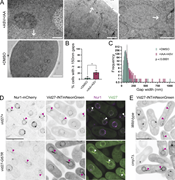
MTs undergo a centrosomal to non-centrosomal transition during GBE. (A–C) MTs marked with Jupiter:GFP at level of centrosomes 20 min pre-GBE (A), at GBE onset (B), and 20 min into GBE (C). Arrows point to centrosomal MT. (A′–C′) Perinuclear MT pools (green) at 20 min pre-GBE (A′), at onset (B′), and 20 min into GBE (C′). (A′’–C′′) Orthogonal projection of MT and nuclei in epithelium 20 min before GBE (A′′), at onset (B′′), and 20 min into GBE (C’’). (A‴–C‴) Line scan intensity plot for MT as denoted in the lines (blue = 2 μm above nuclear midplane, red = at nuclear midplane) shown in A′′, B′′, and C′′, respectively. (D) Normalized intensity of centrosomal MTs at 0 and 20 min GBE; n = 150 centrosomes for each time point, k = 3 embryos. (E) Normalized intensity of perinuclear MTs at 0 and 20 min GBE; n = 80 and 73 perinuclear regions for 0 and 20 min, respectively, k = 3 embryos. (F) Normalized intensity of apical MTs at 0 and 20 min; n = 396 and 377 regions for 0 and 20 min, respectively, k = 3 embryos. (G) Stable perinuclear MT pools indicated by brightly stained acetylated MT (green) around nuclei (DAPI, magenta). (H) Still frames showing FRAP of α-tubulin:GFP at centrosomes (top) and perinuclear region (bottom). Time is indicated in seconds; photobleaching was performed at 0 s. Circle or rectangle in magenta indicates the photobleached region. (H′) Fluorescence recovery profile for centrosome and perinuclear regions. (H′′) Halftime of recovery for centrosomal vs perinuclear α-tubulin:GFP (mean ± SEM). (H‴) Immobile fraction for centrosomal vs perinuclear α-tubulin:GFP (mean ± SEM). For (H′–H‴), n = 11 FRAP regions for each plot, k = 11 embryos. Scale bar = 5 μm for (A′) and (G), 3 μm for (A) and (A′′), and 2 μm for (H). All scatter plots show the mean ± SD. Statistical significance was calculated using the Mann–Whitney U-test. **P < 0.01 and ****P < 0.0001.
Published: 11 December 2025
Figure 1. MTs undergo a centrosomal to non-centrosomal transition during GBE. (A–C) MTs marked with Jupiter:GFP at level of centrosomes 20 min pre-GBE (A), at GBE onset (B), and 20 min into GBE (C). Arrows point to centrosomal MT. (A′–C′) More about this image found in MTs undergo a centrosomal to non-centrosomal transition during GBE. (A–C) ...
Images
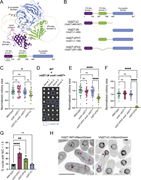
Compromising Patronin function disrupts ncMT pools and severely impedes nuclear dispersion. (A) Still frames showing MT depletion and detachment from nuclei in Patronin shRNA (Patronin) embryos compared to control. (B) Quantitation highlighting the depletion of perinuclear MT intensities in Patronin embryos compared to control at GBE onset; n = 60 perinuclear regions for each background at 0 min and n = 61 and 59 perinuclear regions for control and Patronin measurements, respectively, at 20 min, k = 3 embryos each. (C) Apical–basal view of MTs and nuclei in control (top) and Patronin (bottom) embryos at 0 and 20 min, showing decreased apical MT networks after Patronin disruption. Arrows point to apical MT. (D) Still frame showing MT enrichment at centrosomal regions in Patronin embryos as compared to control embryos. (E) MT intensities at centrosomes in control and Patronin embryos at 0 and 20 min, indicating enhanced centrosomal MT at both time points; n = 200 and 150 centrosomal regions for control and Patronin, respectively, at 0 min, and n = 200 and 149 centrosomal regions for control and Patronin, respectively, at 20 min, k = 3 embryos for each background. (F) Maximum-intensity projections of nuclei with color-codes based on distance from cell apices in control and Patronin embryos at onset and 20 min into GBE. (G) Comparison of the fraction of nuclei present in the apical 10 μm of cells in control and Patronin embryos indicating inhibited nuclear dispersion on disruption of ncMT; n = 263 and 605 nuclei from k = 3 embryos for control and Patronin, respectively. (H) Fraction of nuclei present in the apical-most 2 μm of the cell (apical exclusion zone) in control and Patronin embryos; n = 455 and 833 nuclei in control and Patronin, respectively at 0 min and n = 483 and 605 nuclei in control and Patronin, respectively, at 20 min, k = 3 embryos for each background. (I) Mean nuclear speed in control and Patronin embryos. (J) Percent of active nuclei as detected by the mean squared displacement (MSD) metric. (I and J)n = 546 and 291 measured nuclei for control and Patronin, respectively, k = 3 embryos each background. Scale bar = 10 μm for (F), 5 μm for (A, C, and D). Fig. 2, A, C, D, and F; Fig. 5 E; Fig. 3, C, D, and F; Fig. 5 H; and Fig. 7 C, control images/plots reproduced for comparison purposes. All scatter plots show the mean ± SD. Statistical significance was calculated using the Mann–Whitney U-test. ns, not significant. ****P < 0.0001.
Published: 11 December 2025
Figure 2. Compromising Patronin function disrupts ncMT pools and severely impedes nuclear dispersion. (A) Still frames showing MT depletion and detachment from nuclei in Patronin shRNA (Patronin) embryos compared to control. (B) Quantitation More about this image found in Compromising Patronin function disrupts ncMT pools and severely impedes nuc...
Images
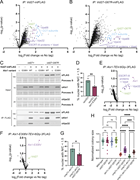
Disrupting CLASP function compromises formation of ncMT perinuclear baskets and nuclear orientation and dispersion. (A) Still frames comparing perinuclear MTs in control and CLASP shRNA (CLASP) embryos reveal depleted MTs and detachment from nuclei. (B) Scatter plot of perinuclear MT intensities at GBE onset after CLASP disruption; n = 60 and 42 perinuclear regions for control and CLASP, respectively, k = 3 embryos each background. (C) Orthogonal projection showing depleted MTs (green) in CLASP embryos and defective nuclear positioning as compared to control. Arrows mark apical MTs and arrowheads mark centrosomal MTs, respectively. (D) Still frames showing enhanced centrosomal MTs and depleted perinuclear MTs in CLASP embryos compared to control. (E) Quantitation reveals enhanced MT intensities at centrosomes in CLASP as compared to control at 0 and 20 min GBE; n = 200 centrosomal regions for each background, k = 3 control embryos and k = 4 CLASP embryos. (F) Maximum-intensity projection of nuclei color-coded for position from cell apices in control and CLASP embryos. (G) Orthogonal projection of cells and nuclei in control and CLASP embryos showing apically collapsed and deformed nuclei in CLASP embryos. (H) Fraction of nuclei in apical 10 μm of cell showing nuclear crowding in apical regions in CLASP embryos; n = 236 and 258 for control and CLASP, respectively, from k = 3 embryos. (I) Still image of nucleus displaying misaligned groove after CLASP disruption. (J) Fraction of nuclei invading the apical exclusion zone in control and CLASP embryos; n = 455 and 340 nuclei for control and CLASP, respectively, at 0 min and n = 483 and 378 nuclei for control and CLASP, respectively, at 20 min, k = 3 embryos each. (K) Percent of active nuclei as detected by MSD in control and CLASP embryos. (L) Peak nuclear speeds in control and CLASP embryos. (M) Mean nuclear speeds in control and CLASP embryos. (J–L), n = 546 and 427 measured nuclei in control and CLASP, respectively, k = 3 embryos for each background. (M) Scale bar = 5 μm in A, C, D, G, I, and 10 μm in F. Fig. 3, A, C, and D; Fig. 7, A and C; Fig. 2, C and D; and Fig. 5 H reproduced for comparison purposes. All scatter plots show the mean ± SD. Statistical significance was calculated using the Mann–Whitney U-test. ****P < 0.0001.
Published: 11 December 2025
Figure 3. Disrupting CLASP function compromises formation of ncMT perinuclear baskets and nuclear orientation and dispersion. (A) Still frames comparing perinuclear MTs in control and CLASP shRNA (CLASP) embryos reveal depleted MTs and More about this image found in Disrupting CLASP function compromises formation of ncMT perinuclear baskets...
Images
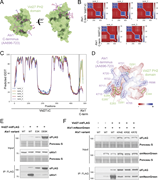
Quantitation of centrosomal MTs in CLASP and Patronin embryos reveals an antagonistic relationship between centrosomal and ncMT networks. (A) γ-tubulin:GFP intensities vary in control, Patronin, and CLASP embryos. (B) Quantification of γ-tubulin:GFP in control, Patronin, and CLASP embryos at 0 and 20 min GBE; n = 150 for control and Patronin, and 200 centrosomes for CLASP at 0 min and n = 88, 150 and 172 centrosomes for control, Patronin and CLASP, respectively, at 20 min; control and Patronin k = 3 and CLASP k = 4 embryos. (C) Still images showing the localization of Patronin:GFP in control and CLASP embryos at 0 and 20 min GBE, highlighting the absence of perinuclear Patronin in CLASP embryos. (D) Perinuclear Patronin:GFP intensities in control and CLASP embryos 5 min before GBE onset showing depleted perinuclear intensities in CLASP embryos; n = 75 perinuclear regions from k = 3 embryos for each background. (E) Still images showing Patronin:GFP enrichment at centrosomes (5 μm below cell apices) in CLASP embryos unlike in control embryos (same control as Fig. 5 A and Fig. 7 A, 0 min at 5 μm), arrows mark centrosomal Patronin. (F) Centrosomal Patronin:GFP intensities at 0 and 20 min show upregulated centrosomal Patronin in CLASP compared to the control embryos; n = 150 centrosomes and k = 3 embryos for each background. Scale bar = 5 μm. All scatter plots show the mean ± SD. Statistical significance was calculated using the Mann–Whitney U-test. ns, not significant. ****P < 0.0001.
Published: 11 December 2025
Figure 4. Quantitation of centrosomal MTs in CLASP and Patronin embryos reveals an antagonistic relationship between centrosomal and ncMT networks. (A) γ-tubulin:GFP intensities vary in control, Patronin, and CLASP embryos. (B) Quantification More about this image found in Quantitation of centrosomal MTs in CLASP and Patro...
Images
γ-tubulin–disrupted embryos have enhanced Patronin intensities. (A) Still frames revealing upregulated Patronin:GFP throughout the GBE in γ-tubulin37C shRNA (γ-tub) embryos as compared to control embryos. (B) Centrosomal Patronin:GFP intensities in control and γ-tub embryos; n = 150 centrosomal regions from k = 3 embryos for each background. (C) Perinuclear Patronin:GFP intensities in control and γ-tub embryos; n = 75 perinuclear regions from k = 3 embryos for each background. (D) Orthogonal view of MT natural log intensity heatmap showing enhanced MT bundles in γ-tub embryos compared to control. (E) Cross-section of MTs (green) and nuclei (magenta) showing enhanced and persistent perinuclear MT in γ-tub embryos as compared to control. (F) Centrosomal MT intensities in control and γ-tubulin37C embryos; n = 200 and 150 centrosomal regions for control and γ-tub, respectively, k = 4 for control and k = 3 γ-tub embryos. (G) Perinuclear MT intensities showing enriched MT pools in γ-tub perinuclear regions as compared to controls; n = 45 perinuclear regions k = 3 embryos for each background. (H) Orthogonal views of MT and nuclei showing MT bundles still shift apically in γ-tub embryos (arrows). Fig. 2 C; Fig. 3 C; Fig. 5, A and H; and Fig. 7, C and F control images/plots reproduced for comparison purposes. Scale bar = 5 μm. All scatter plots show the mean ± SD. Statistical significance was calculated using the Mann–Whitney U-test. ****P < 0.0001.
Published: 11 December 2025
Figure 5. γ-tubulin–disrupted embryos have enhanced Patronin intensities. (A) Still frames revealing upregulated Patronin:GFP throughout the GBE in γ-tubulin37C shRNA (γ-tub) embryos as compared to control embryos. (B) Centrosomal Patronin:GFP More about this image found in γ-tubulin–disrupted embryos have enhanced Patronin intensi...
Images
Nuclear behaviors after γ-tub disruption. (A) Nuclei color-coded for apical–basal position in control and γ-tub embryos. (B) Fraction of nuclei in apical 10 μm of cell in control and γ-tubulin embryos; n = 263 and 273 nuclei for control and γ-tub, respectively, k = 3 embryos each background. (C) Mean nuclear speeds in control and γ-tub embryos. (D) Peak nuclear speeds in control and γ-tub embryos; n = 546 and 612 in control and γ-tub, respectively, from k = 3 embryos for each background. (E) Percent of active nuclei as detected by MSD in control and γ-tub embryos. (C and E) n = 546 and 1,223 nuclei in control and γ-tub, respectively, from k = 3 embryos for each background. Scale bar = 10 μm. Statistical significance was calculated using the Mann–Whitney U-test. *P < 0.05, ****P < 0.0001.
Published: 11 December 2025
Figure 6. Nuclear behaviors after γ-tub disruption. (A) Nuclei color-coded for apical–basal position in control and γ-tub embryos. (B) Fraction of nuclei in apical 10 μm of cell in control and γ-tubulin embryos; n = 263 and 273 nuclei for More about this image found in Nuclear behaviors after γ-tub disruption. (A) Nuclei colo...
Images
EB1 function is required for nuclear dispersion and the ncMT shift towards apical regions. (A) Cross-section of MTs (green) and nuclei (magenta) showing enhanced and persistent perinuclear MTs in ΕΒ1 shRNA (ΕΒ1) embryos compared to control. (B) Perinuclear MT intensity measurements showing enriched MT pools in perinuclear regions in ΕΒ1 embryos; n = 60 and 48 for control and EB1, respectively, at 0 min, and n = 61 and 52 perinuclear regions in control and EB1, respectively, at 20 min from k = 3 embryos for each background. (C) Orthogonal views of MT and nuclei showing perinuclear MT bundles fail to shift apically in ΕΒ1 embryos. (D) Measurement of apical MT intensities at 0 and 20 min suggesting a failure of apical MT enrichment in EB1 embryos; n = 796 and 614 apical regions for 0 and 20 min, respectively, from k = 3 embryos. (E) Centrosomal MT intensities are enhanced when ΕΒ1 function is compromised; n = 200 and 150 centrosomal regions for control and EB1, respectively, from k = 4 embryos for control and k = 3 embryos for EB1. (F) Enhanced perinuclear Patronin:GFP in EB1 embryos (arrow) as compared to control embryos. (G) Perinuclear Patronin:GFP intensities are enhanced in ΕΒ1 embryos as compared to control embryos; n = 75 perinuclear regions from k = 3 embryos for each background. (H) Fraction of nuclei in the apical 10 μm of the cell in control and ΕΒ1 embryos. Error bars indicate the standard error of mean; n = 263 and 288 nuclei for control and EB1, respectively, from k = 3 embryos for each background. (I) Fraction of nuclei invading the apical exclusion zone in control and EB1 embryos; n = 455 and 434 nuclei in control and EB1, respectively, at 0 min and n = 483 and 469 nuclei in control and EB1, respectively, at 20 min from k = 3 embryos for each background. (J) Maximum-intensity projections of nuclei color coded for distance from cell apices in control and ΕΒ1 embryos. (K) Percent of active nuclei as detected by MSD. (L) Mean nuclear speeds in control and EB1 embryos. (K and L), n = 546 and 383 nuclei in control and EB1, respectively, from k = 3 embryos for each background. (M) Model of MT network transitions during GBE, showing that a centrosomal MT network transitions to a ncMT network during GBE with the aid of EB1, CLASP, and Patronin function while nuclei are driven into deeper cell regions. Scale bar = 10 μm for (J) and 5 μm for (A, C, and F). Fig. 2 C; Fig. 3 C; Fig. 5, A and H; Fig. 7, C and F; and Fig. 4 E control images/plots reproduced for comparison purposes. All scatter plots show the mean ± SD. Statistical significance was calculated using the Mann–Whitney U-test. ns, not significant. *P < 0.05, **P < 0.01, ***P < 0.001, and ****P < 0.0001.
Published: 11 December 2025
Figure 7. EB1 function is required for nuclear dispersion and the ncMT shift towards apical regions. (A) Cross-section of MTs (green) and nuclei (magenta) showing enhanced and persistent perinuclear MTs in ΕΒ1 shRNA (ΕΒ1) embryos compared to More about this image found in EB1 function is required for nuclear dispersion and the ncMT shift towards ...
Journal Articles
Images
Establishing a dynamic imaging platform to follow subcellular events throughout parasite’s 48-h life cycle. (A) Schematic representation of the genetic reporter. mRuby was fused to histone H2B for nuclear labeling, while mNeon was linked to an apicoplast-specific TP for organelle targeting. The T2A sequence facilitates ribosomal skipping during translation, enabling the expression of two separate proteins driven by a single promoter. (B) Representative fluorescence live microscopy images of the H2B-mRuby/TP-mNeon transgenic parasite line at different stages of its life cycle. Images were captured as Z-stacks (total 21 slices of 0.5 μm each) at 100× and are displayed as maximum intensity projection. Apicoplast is green, and nucleus is distinctly labeled in red. DNA staining with SiR-DNA (blue) confirms nuclear localization of the mRuby signal. The scale bar is 2.5 μm. (C) Workflow for long-term live imaging and biogenesis analysis, highlighting sample preparation and microscopy optimization, followed by automated image processing and analysis.
Published: 10 December 2025
Figure 1. Establishing a dynamic imaging platform to follow subcellular events throughout parasite’s 48-h life cycle. (A) Schematic representation of the genetic reporter. mRuby was fused to histone H2B for nuclear labeling, while mNeon was More about this image found in Establishing a dynamic imaging platform to follow subcellular events throug...
Images
Dynamic imaging reveals morphological details, kinetics, physical measurements, and a tight synchrony in the co-development of nuclei and apicoplast. (A) Representative images from sequential capturing of apicoplast biogenesis of P. falciparum. Images were captured as Z-stacks (total 21 slices of 0.5 μm each) at 100× for 20 h with 30-min intervals using spinning disk confocal microscope. The images are displayed as maximum intensity projections (2D) or volume reconstructed for 3D visualization using NIS image analysis software. The scale bar is 2.5 μm. (B) 3D reconstructed images of H2B-mRuby/TP-mNeon parasites using Imaris image analysis software show detailed apicoplast morphologies (green) along with nucleus location (red dots) during life cycle. Scale bars, 2.5 μm. (C) Representative long-term fluorescence live-cell microscopy images show detailed apicoplast (green) and nucleus (red) morphologies and conformations during different stages of parasite’s life cycle in 2D (as maximum intensity projections of Z-stack images) and 3D (volume visualizations). 2D cell appears also at Fig. 6 B as untreated control. Images were captured using a spinning disk confocal microscope at 100× as Z-stacks (total 21 slices of 0.5 μm each) with 15 min time intervals for 20 h. 2D scale bars, 2.5 μm. 3D grid, 2 × 2 μm. (D) Quantification of median organellar volume over time was obtained as described in Materials and methods for 151 parasites (n > 20 for each time point), from 4 independent experiments. Error bars are 95% CI. (E) Final number of organelles (“objects”) per parasite was obtained as described in Materials and methods for n > 40 parasites from 4 independent experiments. The difference between nuclei and apicoplast mean number of objects (17 ± 5.8 (nuc) and 19 ±5.6 (api), (api - nuc) = 2 ± 3.8) is not significant. Unpaired t test with Welch’s correction, P = 0.1, ns. Inset taken from 2C, grid, 2 × 2 μm. (F) Quantification of median organelle SA:V ratio vs. time was obtained as described in Materials and methods for n > 20 parasites for each time point, from four independent experiments. SA:V ratio vs. time is a mathematical representation of the extensive branching and shapeshifting of the apicoplast, particularly expanding at the last 6 h of the cell cycle.
Published: 10 December 2025
Figure 2. Dynamic imaging reveals morphological details, kinetics, physical measurements, and a tight synchrony in the co-development of nuclei and apicoplast. (A) Representative images from sequential capturing of apicoplast biogenesis of P. More about this image found in Dynamic imaging reveals morphological details, kinetics, physical measureme...