Chronic granulomatous disease (CGD) is an inborn error of immunity (IEI) secondary to defects in the phagocyte oxidative burst. Patients mainly experience infections; however, many may also manifest inflammatory complications, both requiring medical management with antimicrobials and immunosuppression. Hematopoietic stem cell transplantation (HSCT) is a successful curative option.
To report Texas Children’s Hospital’s experience performing HSCT in patients with CGD.
Forty-two patients who underwent HSCT from 2007–2025 were analyzed. The median age at transplantation was 4.6 years of age (range 0.5–17.1). All patients received a myeloablative conditioning regimen consisting of busulfan, fludarabine backbone, and either cyclophosphamide, cytarabine, or thiotepa with primarily alemtuzumab as serotherapy (n = 35, 83.3%). Donors were matched unrelated (n = 25, 59.5%), HLA-identical sibling (n = 11, 26.2%), HLA-mismatched unrelated (n = 3, 7.1%), mismatched unrelated (n = 2, 4.8%), and HLA-mismatched relative (n = 1, 2.4%). Cord blood unit recipients did not receive any serotherapy (n = 6, 14.3%). Most patients in our cohort were not Hispanic or Latino (n = 28, 66.7%). The median follow-up of these patients was 5.5 years (3.02–10.2).
At a median follow-up of 5.6 years (0.17–17.11), 1-year and 5-year overall survival (OS) was 95.1% (95% confidence interval [CI] 88.7–100) and 89.4% (95% CI 80–99.8), respectively. Up to 97.6% of patients had neutrophil engraftment, and 87.8% had platelet engraftment. Six patients required an additional treatment at a median time of 167.5 days (95% CI 51.8–267.1). Of the 6 patients requiring additional treatment, 4 required a second transplant, and 2 required a CD34-selected stem cell top off. Acute graft-versus-host disease (GvHD) occurred in 12 patients (28.6%), only 3 of whom were grade II and 9 were grade I, none severe. There was only one case of chronic GvHD, which was mild. Five patients died, primarily from infections (60%), organ failure (20%), and respiratory failure (20%).
A myeloablative conditioning regimen can achieve excellent long-term survival, high engraftment, low graft failure, and low rates of severe GVHD in pediatric patients with CGD, including those from underrepresented populations.
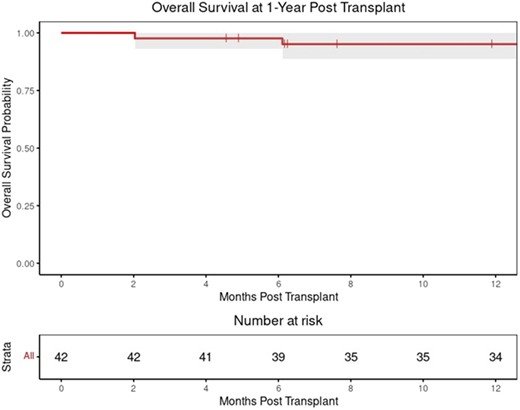
Overall survival after 1 year.
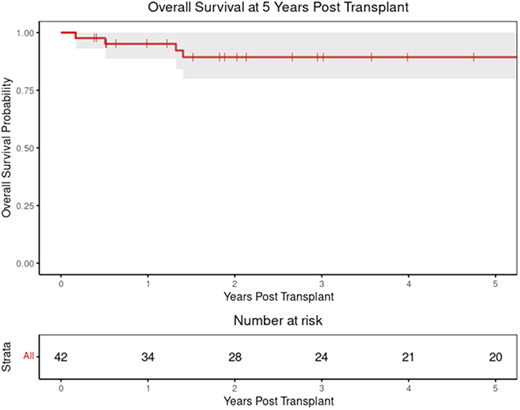
Overall survival after 5 years.