Although the association between disorders of immunity and cancer risk is recognized, the prevalence of different malignancies in this population remains incompletely characterized. Large electronic health record (EHR) databases such as the National Institutes of Health’s All of Us Research Program (AOURP) offer the opportunity to evaluate the prevalence of malignancy in this population.
Diagnostic codes from the EHR of 393,601 participants in AOURP were analyzed. Diagnostic codes were queried for immune disorders (ID). The cohort of participants with ID was compared to a cohort of control participants. Participants were then queried for a diagnosis of malignancy. Control diagnoses with no biological association with ID were selected for comparison. The relative risk of these diagnoses for those with ID was calculated.
Of 256,388 participants with at least one ICD9, ICD10, or SNOMED code in AOURP, 12,886 had at least one diagnostic code for ID (supplemental table 2). The control cohort of 243,502 remaining participants was well matched to the ID cohort for sex, race, and ethnicity (supplemental table 1). The ID cohort skewed slightly older than the controls, likely due to the inclusion of acquired ID and autoimmune conditions, which often develop with age. The median number of diagnoses in the ID cohort was 121 (interquartile range [IQR] 71–190), greater than 35 (IQR 13–76) in the control cohort, reflecting richer EHR data and medical complexity among those participants with ID.
Relative risk (RR) was low (<2) for all control diagnoses, as well as for prostate cancer (1.58) and breast cancer (1.96). However, RR increased for other solid tumors, including melanoma (2.67), lung cancer (3.43), and pancreatic cancer (3.58). Importantly, the highest risk for the ID cohort was for hematologic malignancy, with 8x lymphoma and 9x leukemia risk (Figure 1).
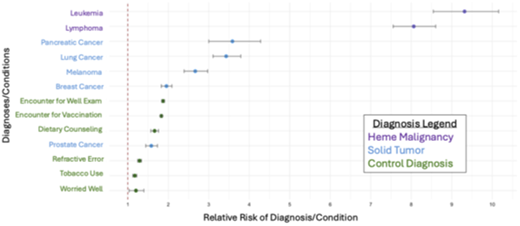
Relative risk of control and malignancy diagnoses for immune disorder participants.
Relative risk of control and malignancy diagnoses for immune disorder participants.
In this cohort, disorders of immunity were strongly associated with lymphomas and leukemias. Notably, participants with an ID diagnosis also had a greater risk of some solid tumor malignancies such as lung cancer, melanoma, and pancreatic cancer. Conversely, risks for other common solid tumors, such as prostate and breast cancer, did not differ from those of control diagnoses.